AlumNUS

Processing the Quantum Question

Quantum computing is an emerging technology with the potential to reshape how we approach complex problems, cybersecurity, research, and innovation. But how close are we to seeing its impact, and what should businesses and individuals be thinking about today? A recent panel unpacked the possibilities, limitations and questions surrounding the technology.

Artificial intelligence (AI) has quickly become part of everyday life. Quantum computing, despite attracting growing interest and investment, is likely to be experienced very differently.

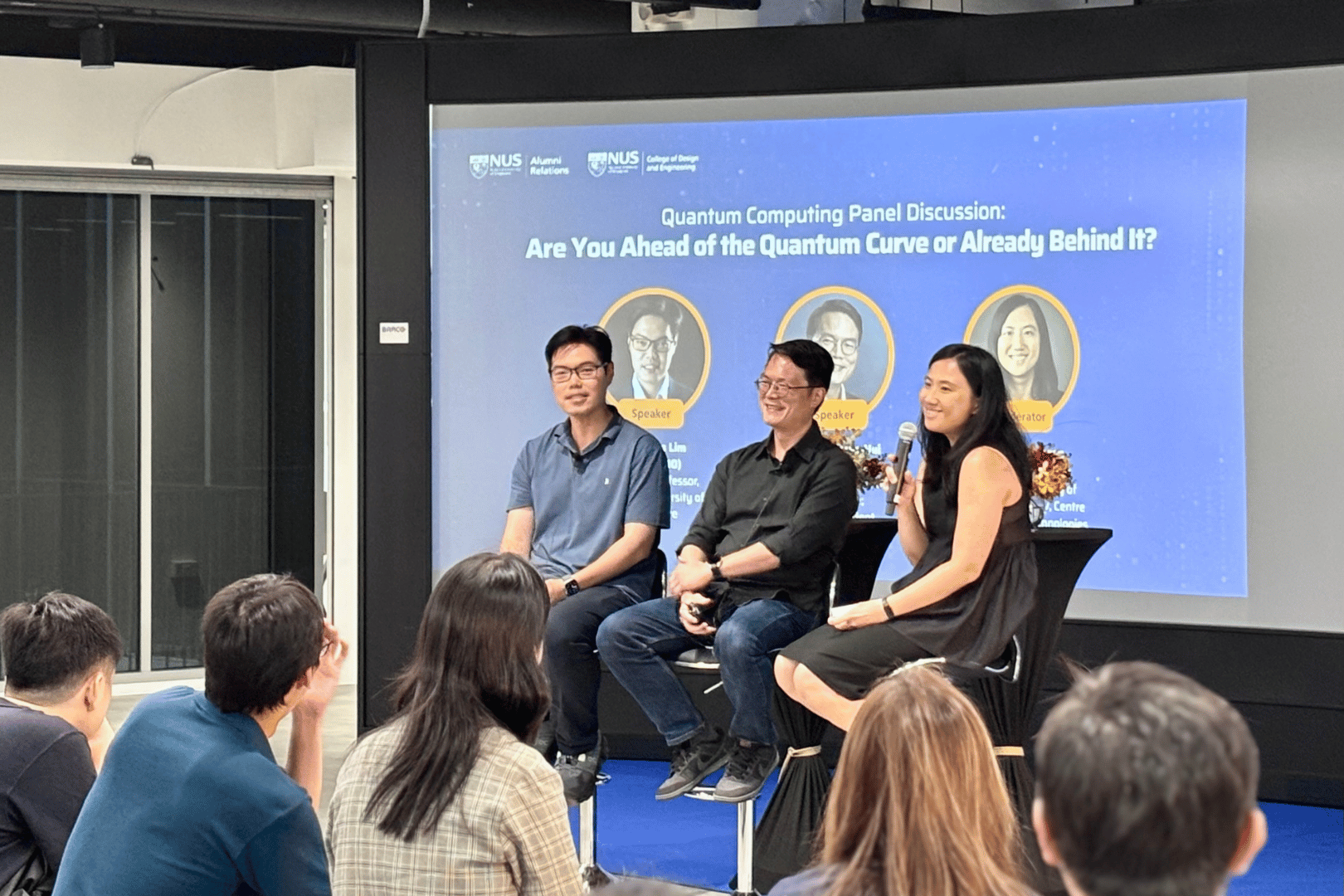
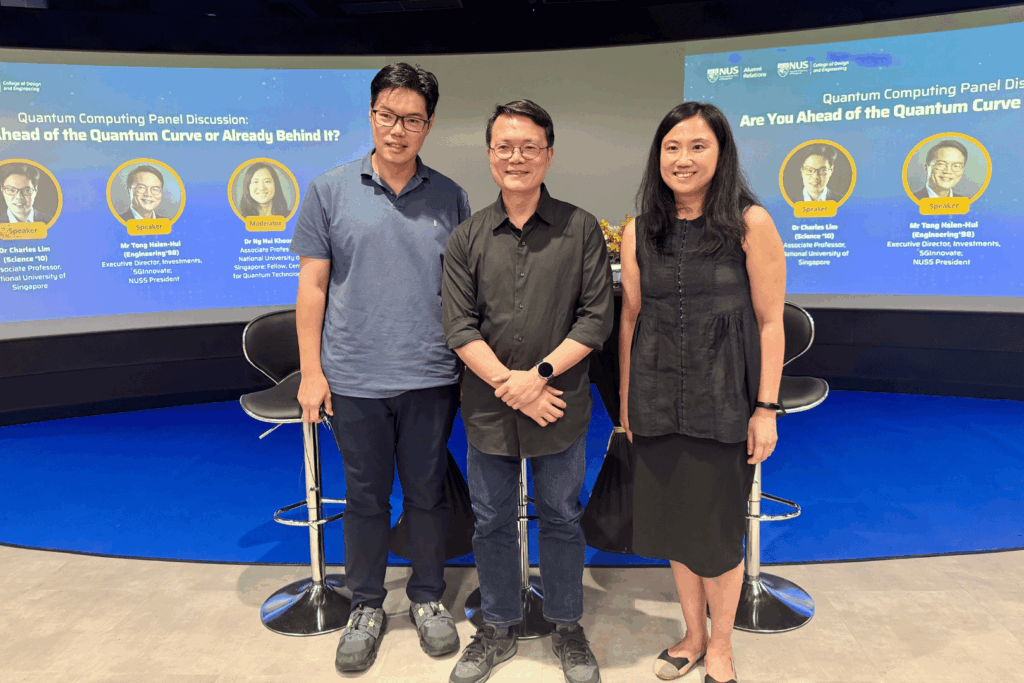
That was one of the themes that emerged from “Are You Ahead of the Quantum Curve or Already Behind It?”, a panel discussion with Dr Charles Lim (Science ’10), Associate Professor at the NUS Department of Electrical and Computer Engineering and NRF Fellow at the Centre for Quantum Technologies, and Mr Tong Hsien-Hui (Engineering ’98), Executive Director of Investments at SGInnovate and President of the National University of Singapore Society. The discussion was moderated by Dr Ng Hui Khoon, Associate Professor at the NUS Department of Physics and Fellow at the Centre for Quantum Technologies.

Together, the panellists explored where quantum technology stands today, how it could interact with AI, its implications for cybersecurity and the opportunities it could create for Singapore.

(L to R) Dr Charles Lim, Mr Tong Hsien-Hui and Dr Ng Hui Khoon

WHAT MAKES QUANTUM COMPUTING DIFFERENT? 

Dr Ng opened the discussion by asking what makes quantum computing fundamentally different — and what people need to know.

Dr Lim noted that, at its simplest, quantum computing uses principles of quantum physics to process information. However, he cautioned against viewing a quantum computer simply as a much faster version of the computers we use today.

Its advantages are likely to apply to particular problems rather than everything we currently use computers for. In many situations, conventional computing will continue to be the more practical option, meaning that most people may never interact directly with a quantum computer.

Unlike AI, where applications such as chatbots and image generators are already highly visible to consumers, quantum computing is more likely to operate in the background. In the future, quantum processors could work alongside conventional CPUs and GPUs, with each handling the parts of a problem for which it is best suited.

HOW CLOSE ARE WE? 

Mr Tong shared that SGInnovate has been investing in quantum technologies for more than a decade. Yet even after years of development, there is no simple answer to when the technology can solve commercially important problems better than existing systems.

One reason is that conventional computing is not standing still.

Dr Lim pointed out that advances in AI are already allowing researchers to tackle problems more effectively using classical computing. As these techniques improve, quantum computing must also improve to demonstrate a meaningful advantage.

At the same time, Dr Ng asked whether AI could help accelerate the development of quantum technology.

Mr Tong highlighted areas such as error correction and scalability as examples of challenges where AI could support the development of quantum machines.

Rather than expecting one clear moment when quantum computing suddenly becomes mainstream, its impact is likely to be more gradual as hardware improves and useful applications emerge.

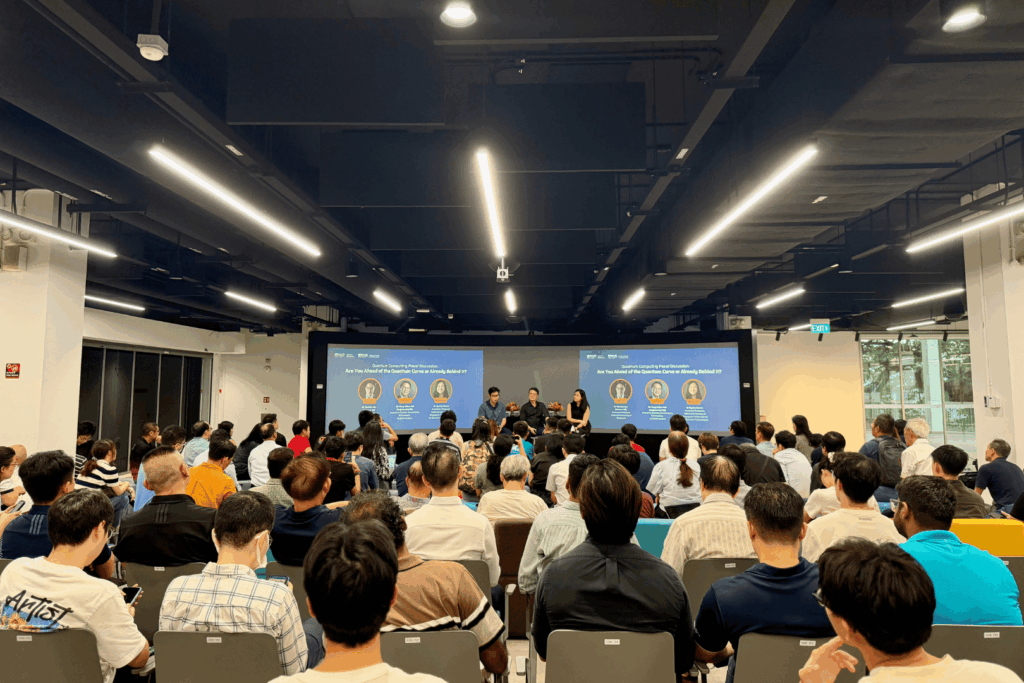
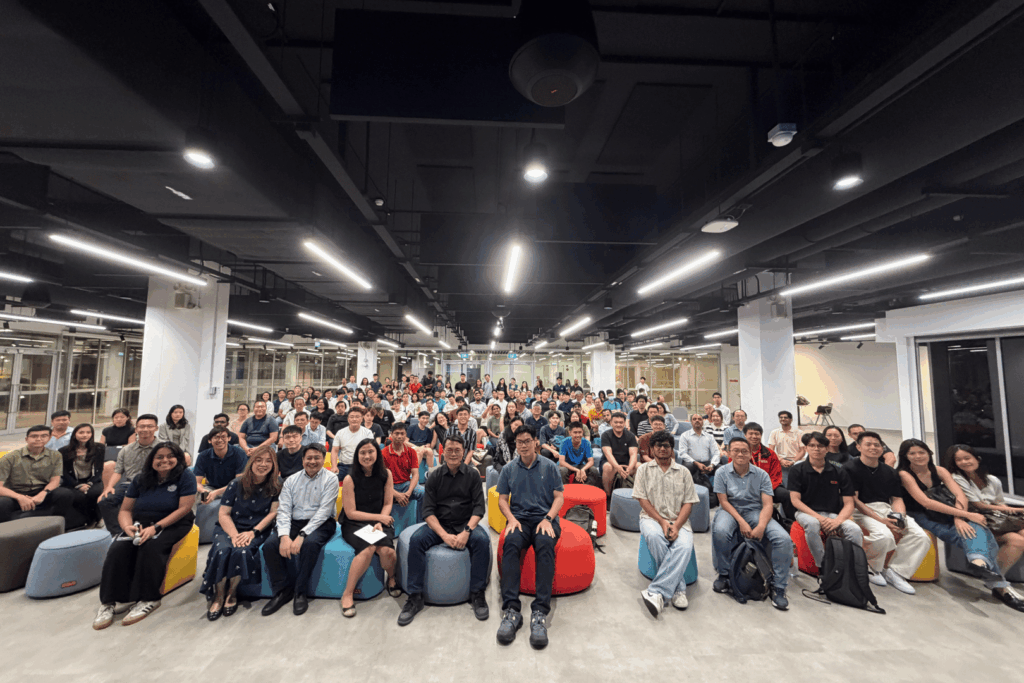
The event attracted a large and enthusiastic crowd.

WHY CYBERSECURITY MATTERS NOW

Dr Ng also asked about the timeline for quantum computing, with Dr Lim noting that cybersecurity is one area where organisations are already preparing for the quantum era.

A sufficiently powerful quantum computer could potentially break several forms of public key encryption widely used today. This has created concern around what is known as “harvest now, decrypt later”.

An attacker could collect encrypted information today and store it. If sufficiently capable quantum computers become available in the future, that information could potentially be decrypted then.

For organisations, the urgency therefore depends partly on the lifespan of their information. If sensitive data needs to remain confidential for many years, preparations may need to begin well before a quantum computer capable of breaking existing encryption becomes available.

QUANTUM IS MORE THAN COMPUTING 

The discussion also highlighted an important distinction: quantum technology is broader than quantum computing.

Quantum sensing, for example, is already finding potential applications outside the laboratory.

Mr Tong shared the example of quantum sensors that can help study structures beneath the Earth’s surface. Such technology could potentially be used to identify underground geological features and resources.

Another area is quantum communications, including quantum key distribution. Singapore companies are among those exploring how quantum technologies could be used for secure communications, including through satellite-based systems.

Financial services are also exploring possible applications. Drawing on his previous experience in the sector, Dr Lim explained that quantum advantages may initially appear in very specific parts of a financial workflow rather than transforming an entire business process.

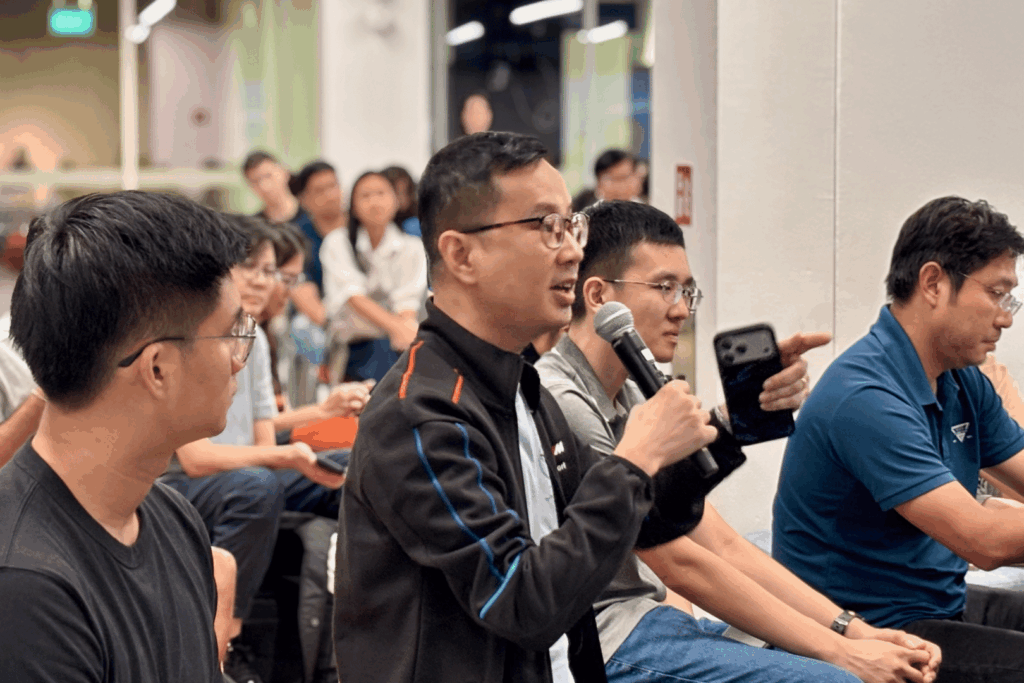
An audience member asks a question.

WHERE DOES SINGAPORE FIT IN? 

Singapore has been investing in quantum research for years, including through the Centre for Quantum Technologies.

But competing in quantum technology does not necessarily mean developing every part of a quantum computer locally.

Mr Tong noted that Singapore does not have the complete supply chains of much larger countries. Its opportunities could instead lie in particular components, technologies and software within the broader quantum ecosystem.

There is also no agreement yet on what the dominant quantum computing architecture will eventually look like. Different approaches, including superconducting systems, trapped ions, neutral atoms and photonics, continue to be developed.

This uncertainty can create opportunities.

Mr Tong cited Singapore-founded Horizon Quantum as an example. Its proposition is centred on developing software that can work across different quantum hardware platforms rather than depending on a single technology.

Investment in quantum technology could benefit related industries. Mr Tong pointed to areas such as semiconductors, photonics, materials and space technologies that could develop alongside advances in quantum research.

IMPLICATIONS FOR TALENT

For students and young researchers in the audience, the conversation turned to careers, with Dr Ng asked how they could remain relevant as technology advances.

As more quantum research moves from universities into companies, Mr Tong sees opportunities for researchers to consider careers beyond academia, including entrepreneurship.

Dr Lim added that the skills researchers need may also change as AI becomes more capable.

He shared his own experience using frontier AI models to support research and described being surprised by how effectively they could work through complex mathematical problems. For researchers, this could shift the emphasis from carrying out every part of the work manually towards knowing how to identify worthwhile problems and assess whether an AI-generated result is correct.

For young researchers, he suggested that understanding the gap between academic research and industry needs is increasingly important.
The audience and speakers pause for a photo.

THE QUANTUM CURVE

So, are we already behind the quantum curve?

Quantum computers still face significant challenges and many potential applications remain at an early stage. Yet organisations are beginning to prepare for post-quantum cybersecurity, while companies and researchers explore applications and investors look for commercially useful technologies.

The discussion offered a measured view of the field: quantum computing has considerable potential, but its impact is likely to be specialised, gradual and closely connected with advances in other technologies.

For now, being ahead of the quantum curve may simply mean understanding what the technology can do, what it cannot yet do, and knowing when it is time to start preparing.

The panel was held on 14 August 2026 and organised by the NUS Office of Alumni Relations in partnership with the NUS College of Design and Engineering.