
AlumNUS

What AI Can’t Do

Mr Xue Wen Tan (Engineering ‘19, PhD ‘25) became an AI scientist after graduating from NUS’ inaugural Digital Financial Technology PhD programme. But as his immersion in AI deepened, he began to think more about what AI should — and should not — replace.
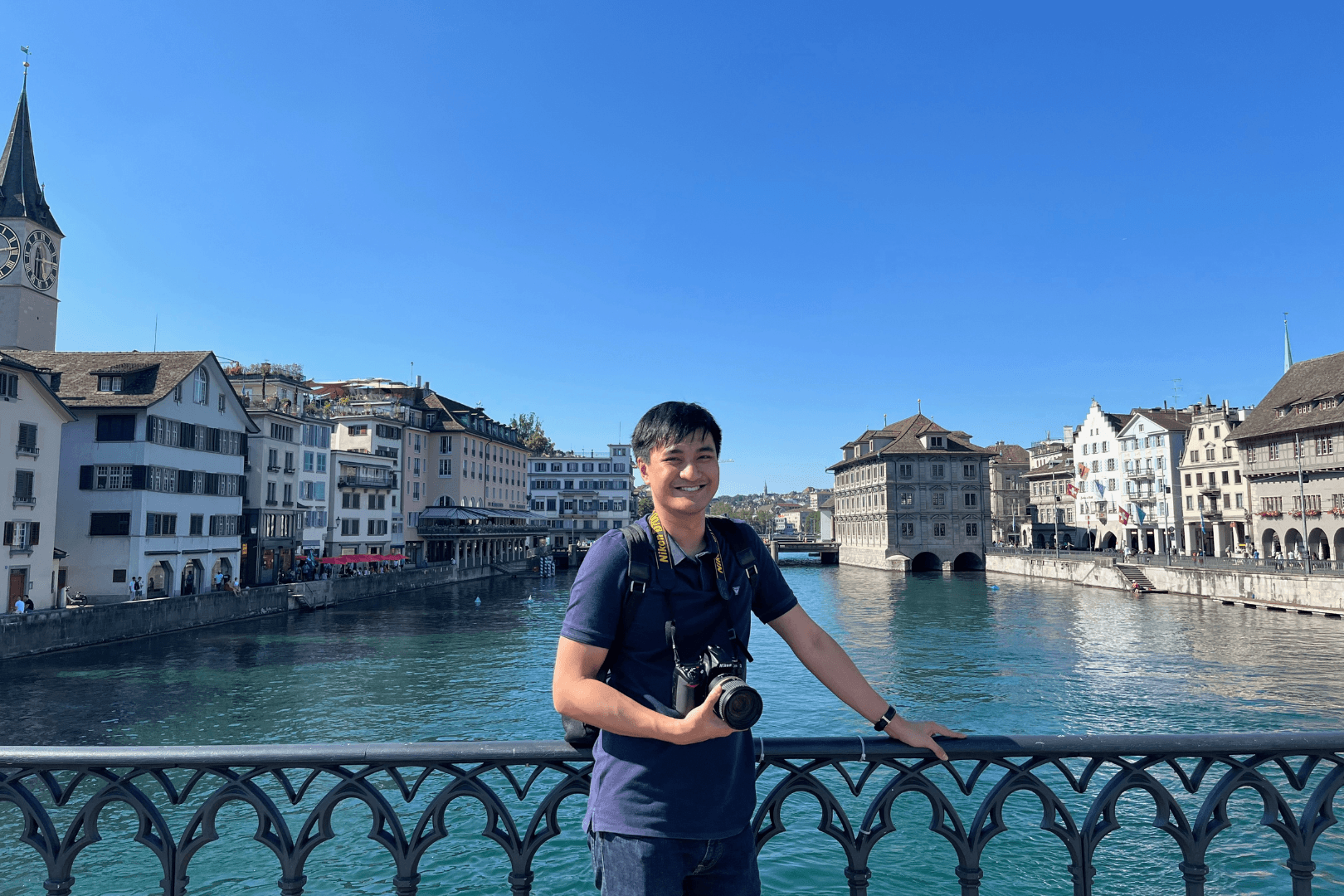
For most doctoral candidates, having two years of research rendered obsolete overnight would be a nightmare. For Mr Xue Wen Tan (Engineering ‘19, PhD ‘25), it became another problem to solve.

Two years into his PhD at the National University of Singapore (NUS), Mr Tan was researching relation extraction, a specialised natural language processing task. Then large language models such as ChatGPT transformed what AI could do. Work that had once required specialised models could suddenly be performed by much more general systems. His research was no longer relevant.

“Of course, anyone would feel disappointed,” he says. But dwelling on what had happened would not change it. “I’d rather use that energy to fix what’s wrong.”

So he pivoted to generative AI, researching how it could be used to combat scams by generating realistic scam-like messages to train people to recognise fraud. It was a practical response to a problem.

“If I had not changed the scope of my research, I would not have got my PhD,” he says, chuckling. It was a hard lesson in “adapt or die”.

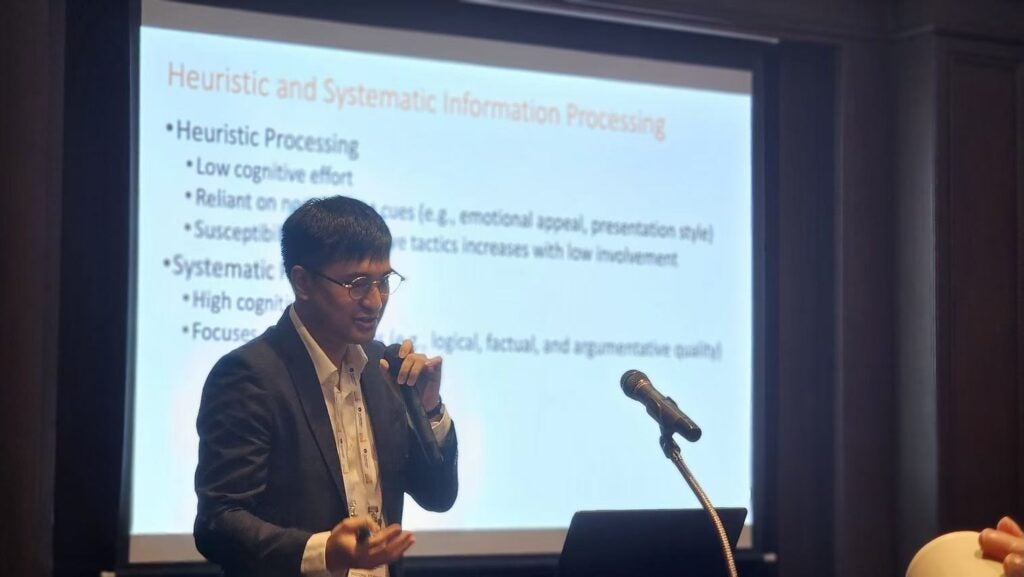
Mr Tan presenting on Heuristic and Sytematic Information Processing.

The human factor
His career has, Mr Tan jokes, been a tour of whatever technology happens to be trendy.

After graduating from NUS with First Class Honours in Electrical Engineering in 2019, Mr Tan joined DBS Bank’s SEED Graduate Associate Programme, working in banking technology at a time when fintech was becoming the fashionable frontier.

“Everyone was talking about Bitcoin, crypto and NFTs,” he recalls.

Two years later, he returned to NUS for its inaugural PhD programme in Digital Financial Technology, combining finance, computer science and AI. Having worked in industry first, he hoped to solve real-world problems, applying what he knew about businesses to spot the gaps and “connect the dots better”.

That said, in the working world, achieving an objective is not always the same as achieving it well.

In an organisation, Mr Tan says, it is possible to meet a target if everyone works overtime or their concerns are downplayed. The objective has been achieved, but the process may leave people unhappy and make the result unsustainable.

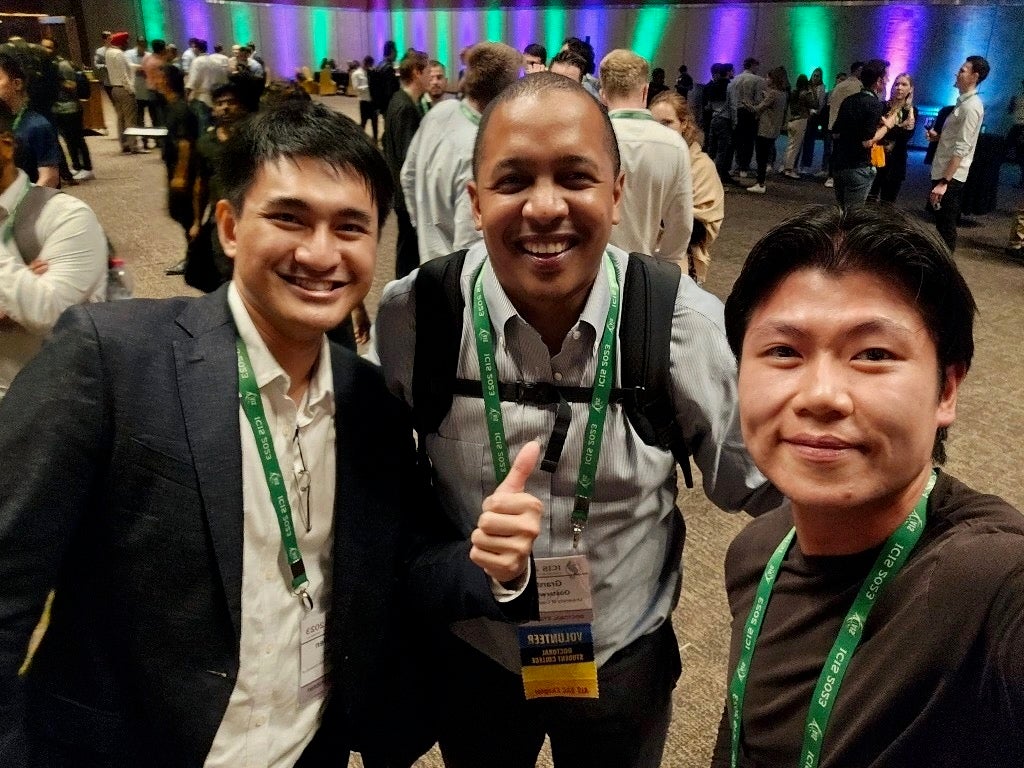
Mr Tan (left) at the International Conference on Information Systems (ICIS).

AI, he observes, is naturally objective-driven. Give it a goal and it will optimise towards it. Humans are messier. They have competing ideas, emotions and needs. They want their suggestions to be heard, be it good or bad.

“Humans are not very optimal creatures,” he says.

Yet that inefficiency has value. People still need someone to listen to them, acknowledge their views and build trust. Those human interactions can take longer and may not be the most efficient route to an outcome, but they are part of how organisations work.

It is a distinction Mr Tan is reluctant to make too confidently. AI is evolving too quickly for anyone to know exactly what it will eventually be capable of.

Still, he believes human judgement will remain important as AI becomes more capable.

For all his academic and professional achievements, Mr Tan does not describe himself as exceptionally gifted.

“I’m not a genius,” he says. “I’m not someone who can learn things very quickly.”

What he has learnt instead is how to learn fast — and how to sift through the enormous amount of information now available to find what matters. In the age of AI, he believes that ability may matter more than knowing any particular tool or technique, since both can become obsolete.

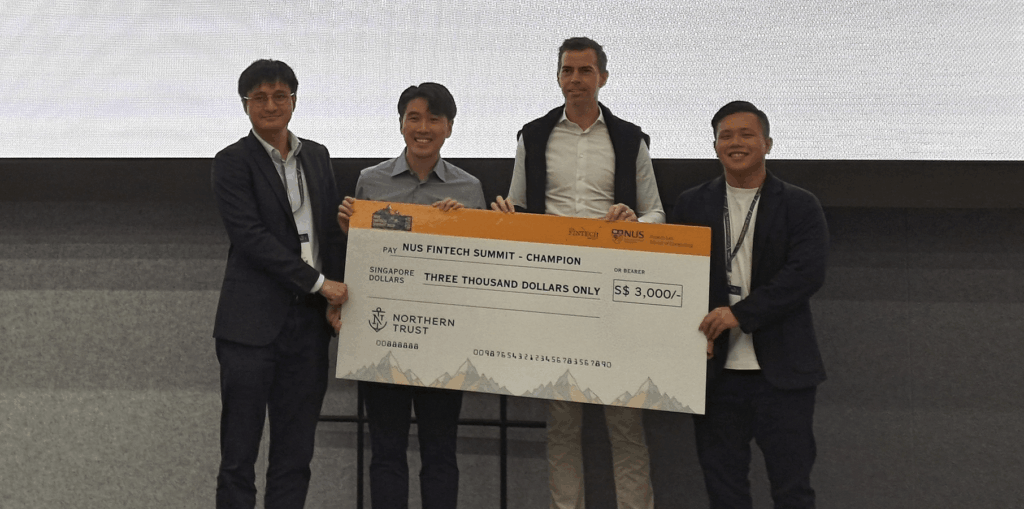
Mr Tan (left) at the NUS Fintech Summit.

Building for a human world


Today, Mr Tan works as an AI scientist at Singapore’s Infocomm Media Development Authority (IMDA), contributing to projects investigating how AI and autonomous technologies can be deployed in the real world.

One project explores how robots and humans might coexist safely in a district, contributing to a future where humans can trust and be supported by robots in their daily lives. The work appeals to him because it shows the real-world impact of technology.

His ambitions for AI are similarly understated. He hopes to play a role in helping Singapore deploy AI safely and scaling AI’s use effectively.

It is a modest ambition from someone who has spent much of his career moving towards the next technological frontier.

“You cannot avoid AI,” he notes. “It’s like electricity in your life every day.”

The challenge is to remain capable ourselves — to question the answers from a machine, make our own judgements and decide what is worth handing over.

Three reflections on living with AI

Role of education
If AI makes knowledge increasingly accessible, Mr Tan believes education will have to offer something deeper: teaching students how to judge whether information is actually useful or correct.

He likens it to learning the violin. Online tutorials can teach technique, but an experienced teacher can hear whether the performance is good. For Mr Tan, that human perspective — developed through years of experience — is what gives education enduring value.

Think for yourself
Mr Tan is less concerned about people using AI as a productivity tool than about what happens when they stop knowing what to think. “Some people cannot write an email without AI anymore,” he observes. “Which I think is very sad.”

What is initially convenience could gradually become dependence — with people parroting AI-generated answers rather than developing their own views.

It’s the algorithm
His most immediate concern may be closer to home. Mr Tan laughs as he recounts confiscating his parents’ phones after they became addicted to streams of AI-generated videos.

“It’s not that they don’t want to control themselves,” he says. “It’s the algorithm. It’s too good.” He hopes to see regulation in the future. “All these videos have no mental vitamins; they cause your brain to rot. It’s something I worry about.”