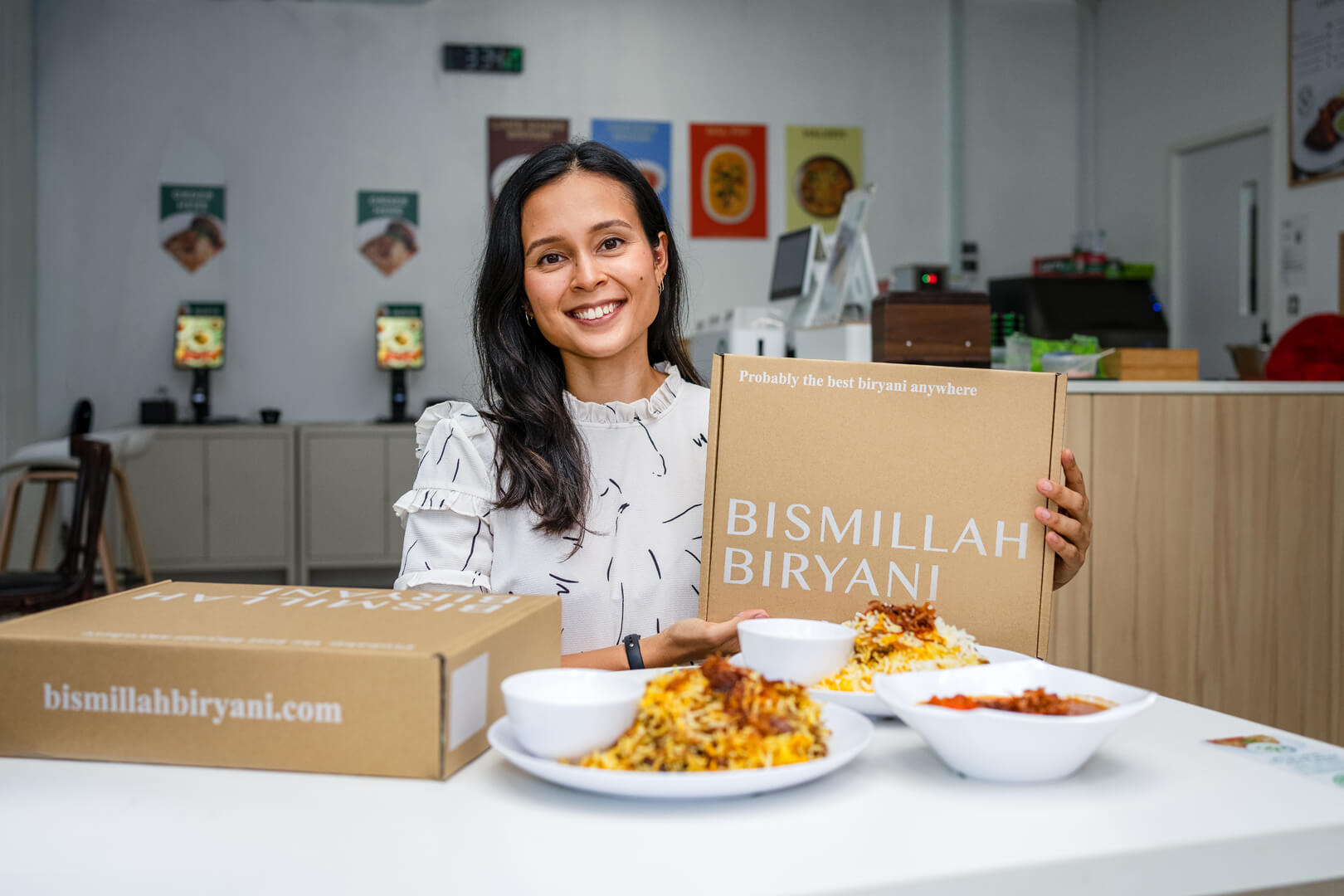

When Ms Zara Salahuddin (Design and Environment ’13) posted a short video on Instagram introducing Bismillah Biryani in Mandarin, she thought little of it.
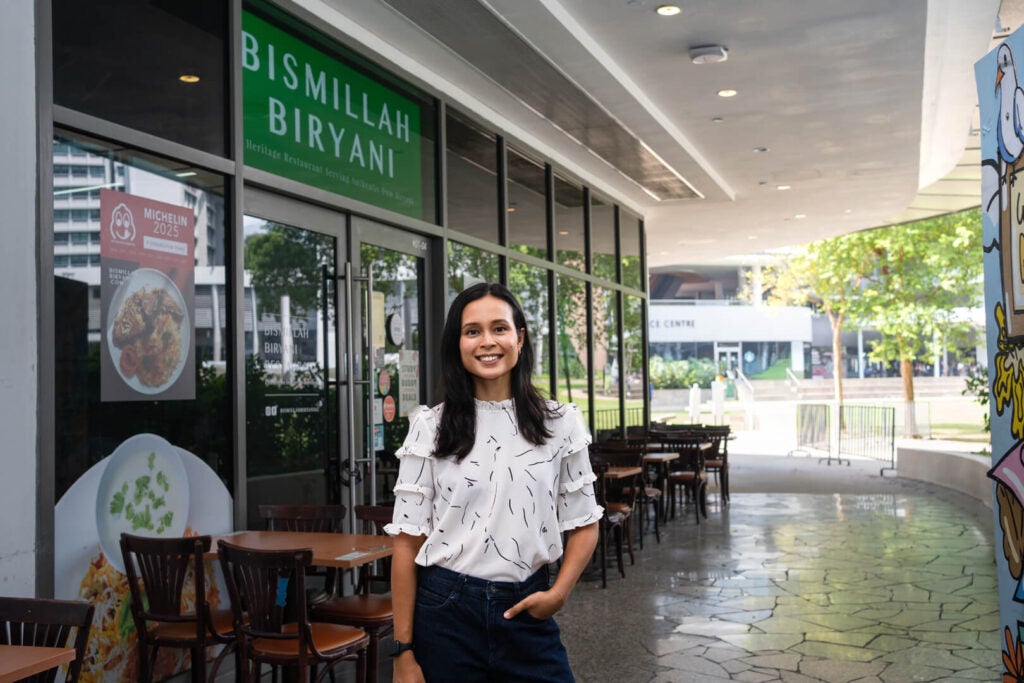
The idea came after she overheard a group of Chinese tourists trying to decipher the menu at the family’s flagship restaurant in Little India. Stepping in to help, Ms Salahuddin wondered if there were more people like them who had yet to discover dum biryani simply because no one had explained it in a language they understood. Having studied Mandarin in school (her mother is Chinese), she decided to produce a short introduction to the restaurant.
The response took her by surprise. The unexpected sight of Ms Salahuddin introducing dum biryani in Mandarin helped the video stand out amid a sea of food content, resulting in hundreds of thousands of views. The reel generated curiosity about the Bismillah brand, drew first-time diners to the restaurant and led to interviews with Chinese-language media. Her father, Arif Salahuddin, a former journalist and IT entrepreneur who founded Bismillah more than 20 years ago, only learnt how far the video had travelled after her story was published.
“I didn’t even tell him,” Ms Salahuddin says with a laugh. “He heard about it through the media.”
For the 35-year-old social media strategist, however, the viral moment was less an overnight success than the culmination of 10 years spent quietly building Bismillah’s presence beyond the kitchen.
DESIGNING A DIFFERENT EXPERIENCE
When Ms Salahuddin graduated from NUS with a degree in Industrial and Product Design in 2013, she had resisted her parents’ call to join the family business. “My dad didn’t pressure me, however,” she says. “They let me do what I wanted first.”
She worked in social media marketing at a small design studio for three years before stepping into the company in 2016, the year that Bismillah won its first Michelin Bib Gourmand.
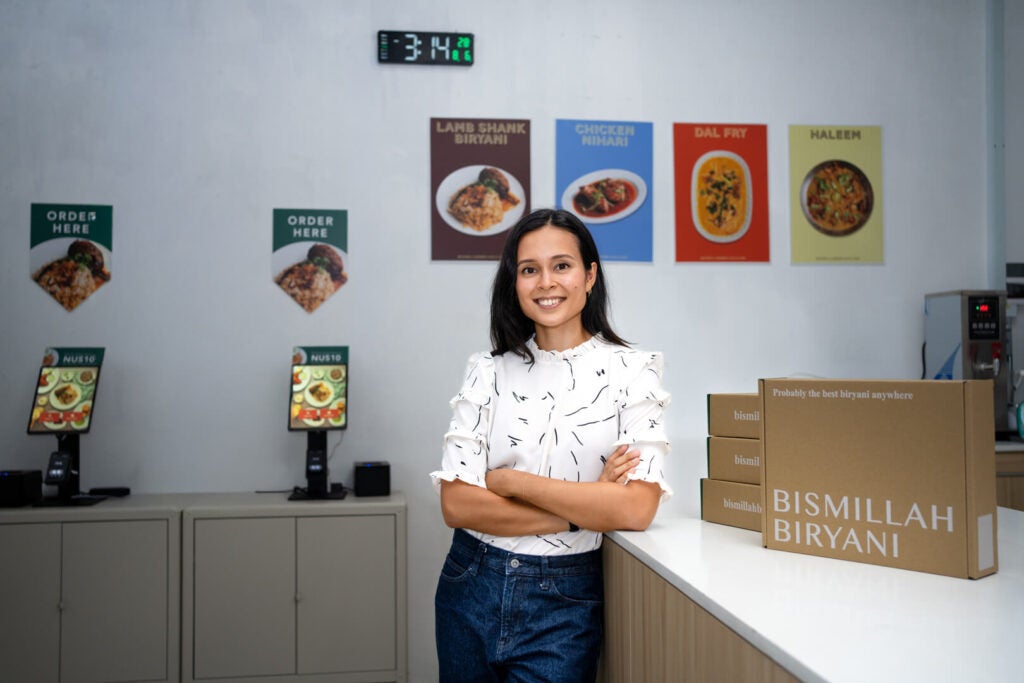
Her role was never about cooking. That domain firmly belongs to her father, whose indefatigable pursuit of the perfect dum biryani — and the process behind making it — has earned Bismillah ten Michelin Bib Gourmand awards over the years. Instead, Ms Salahuddin found ways to apply the design thinking she had developed at NUS to every interaction customers had with the brand.
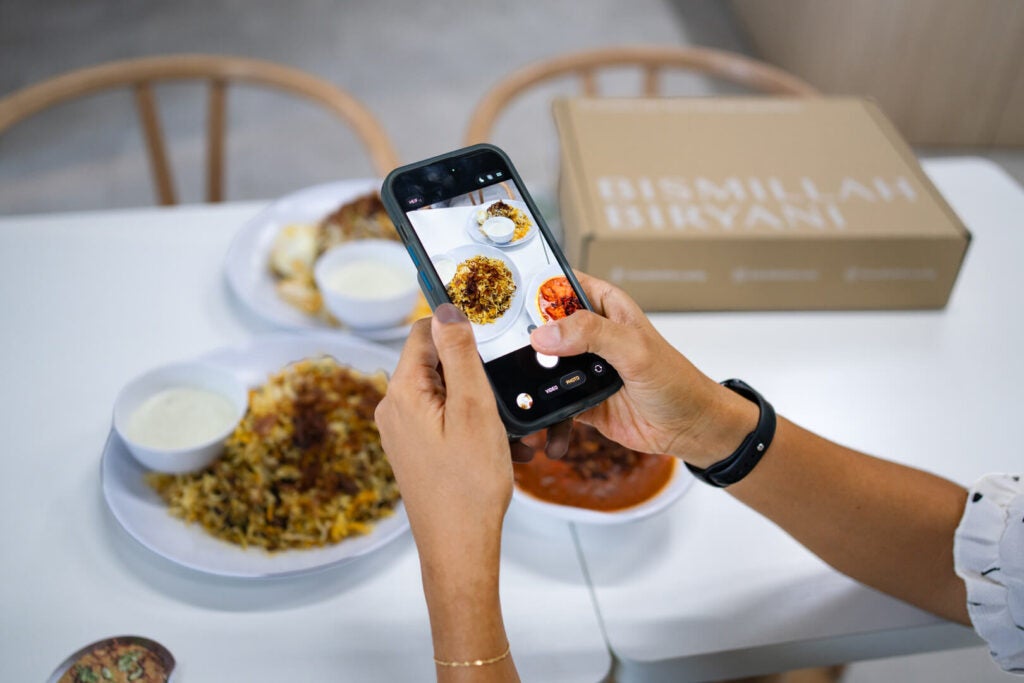
She photographed dishes, designed the company’s website, managed the paperwork required to bring Bismillah onto food delivery platforms and eventually built its presence on Instagram, Facebook and TikTok.
While her father focused on perfecting the food, she focused on how people discovered it.
A STORY WORTH SHARING
Growing up, Ms Salahuddin watched her father devote himself to the business. Curious diners would often ask about the food, and he would happily take them into the kitchen, explaining ingredients, techniques and the painstaking process behind every plate of biryani. The visitors would inevitably emerge impressed.
Their reactions left an indelible impression on his daughter. “Maybe this is the way to run a restaurant,” Ms Salahuddin recalls thinking at the time: “for people to come into your world and really understand the food and know the processes and the mind behind it.” She’s now applying the same concept to Bismillah’s social media content.
“When you visit our pages, you get to know more than the fact that we sell good food,” she says. Instead of polished advertisements, Bismillah’s feeds are filled with family banter, behind-the-scenes moments and light-hearted humour. Videos explain, for example, why moisture matters in rice, introduce the people behind the business, and occasionally feature the inevitable bloopers. She even included the outtakes from her viral video, which showed her repeatedly bungling the Mandarin word for “yoghurt”.
It is a voice that feels distinctly Ms Salahuddin’s — playful without taking the food itself any less seriously. Over time, even her father has come to appreciate a form of storytelling that did not come naturally to him. “When I’m filming videos, he sometimes looks at me like, ‘What are you doing?’” she says, laughing. “But now he trusts the process.”
THE NEXT GENERATION
Running a family business has also changed Ms Salahuddin’s relationship with her father.
As a child, she remembers him constantly working. Joining Bismillah gave them something they had never really shared before: time together. In the early years, she would accompany him on the morning drive to the restaurant, listening to stories about his childhood in Pakistan and learning about the man behind the business. “I’ll always remember that,” she says. “Otherwise, I would never have known my dad at this depth.”
Now a mother herself, Ms Salahuddin often catches glimpses of history repeating itself. Her five-year-old son watches her edit videos late into the night, eagerly offering his own critiques. After seeing an early version of her viral Mandarin video, he proudly pointed out that the revised version sounded much better. More recently, he announced that he wanted to join her and make biryani one day. When she jokingly welcomed him aboard, he heartily shook her hand.
Unlike her own parents, however, Ms Salahuddin has no intention of nudging her children towards the family business. “My dad always talks about, ‘When they join…’” she says with a smile. “I always say no.”
If her children do choose to join Bismillah one day, Ms Salahuddin hopes it will be because they have found their own voice — just as she did.
-
Delayed, More Deliberate, and Less Fertile: What the Latest General Household Survey Tells Us About Marriage in SingaporeSingaporeans aren't marrying less — they're marrying later and more deliberate... -
Chasing the Ephemeral: Keeping Chinese Puppetry in MotionFrom temple festivals to late-night fieldwork across the region, Dr Caroline Chi... -
Friends First, Founders NextFor nearly 15 years, Mr Mustaffa Kamal (Arts & Social Sciences ’08) and Mr...