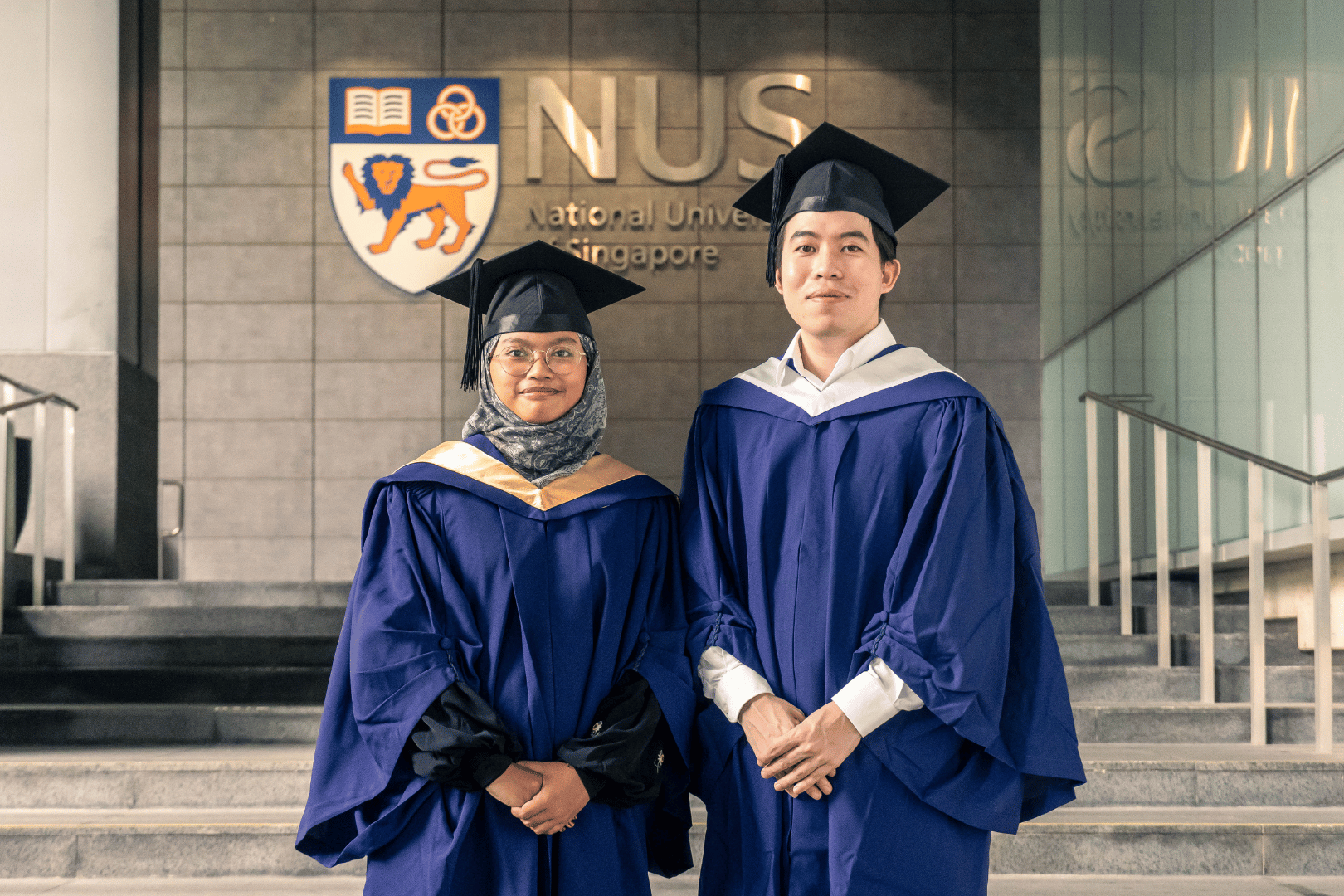
While academic challenges are a given in university life, some students navigate far greater storms. As we celebrate this season of Commencement, we spotlight two NUS graduates from the Class of 2026 who completed their studies while managing significant personal responsibilities at home, emerging stronger and more resilient.
Sean Pang: An Empathetic Leader and Son
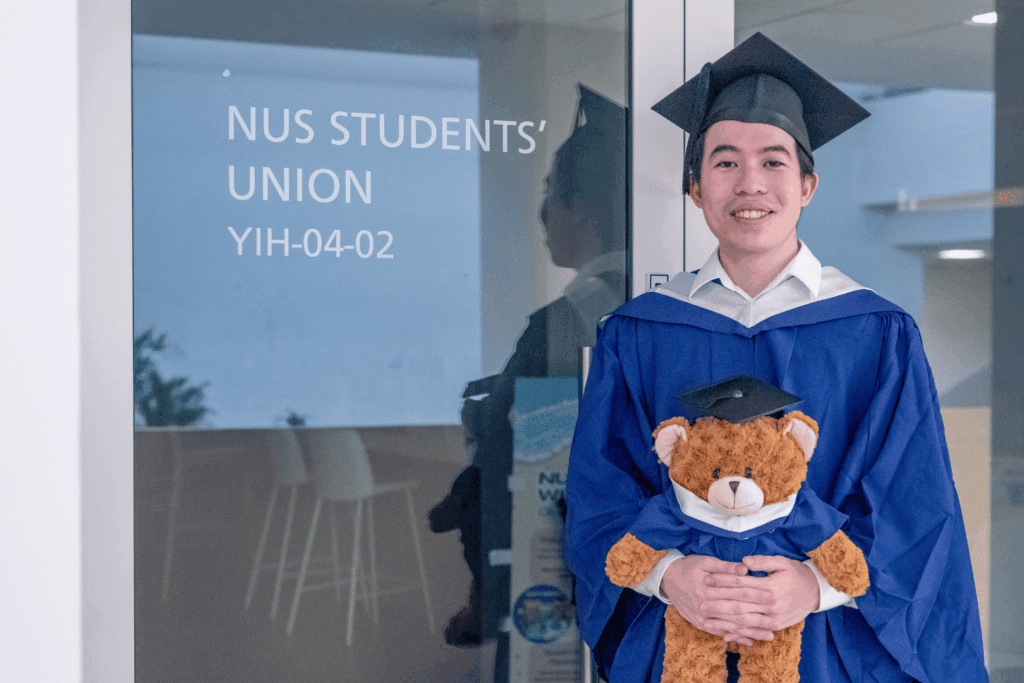
When Sean Pang became President of the NUS Students’ Union (NUSSU) in 2025, he made it his mission to help better support students.
Among his key achievements was a significant policy enhancement that allowed NUS students to carry their first-year Satisfactory/Unsatisfactory credits over to their second year. Previously, these credits – which allow students to take eligible classes without their letter grade impacting their final cumulative average point – would expire after the first year. This change offers students greater flexibility.
While he advocated for the student body, Sean, a Bachelor of Business Administration graduate from NUS Business School, who had specialised in Finance, Marketing, and Leadership & Human Capital Management, faced an unexpected crisis in his final semester.
As he was preparing for a tutorial one morning, he received a call from his father: his mother had suffered a stroke and was admitted to the intensive care unit at Tan Tock Seng Hospital.
“I’d be in the ward with her from 8pm to 8am, and my dad would take over from me each morning. We didn’t know whether she could hear us at times, but we never wanted her to feel she was alone,” recounted Sean.
But things took a turn for the worse. “I was in the ICU when she suddenly became unresponsive,” he added. The doctors informed his family that his mother, in her 70s, had experienced a further brain bleed, and would need to undergo a high-risk surgery.
At that point, Sean was juggling caregiving responsibilities with three final exams, individual assignments and presentations to complete.
“I felt that I should still try my best, because if my mom were conscious, then she’d also tell me not to miss my exams,” he said wryly.
His peers and professors from NUS Business School actively reached out during this tumultuous time, sending him class notes and offering emotional support. Sean’s mother managed to pull through, and he spent the next few months shuttling between the hospital, home and school. He eventually managed to graduate with Honours (Highest Distinction).
“Going through a family crisis in my final semester gave me a perspective I did not have before. I learnt what it actually feels like to be the one who needs support,” he said. “Strength is not about holding everything together by yourself, but knowing when to let others in.”
His personal experience deepened his understanding of mental health advocacy and student well-being initiatives he championed, including the UCare Mental Health Report presented to government stakeholders, and NUSSU Wellbeing Workshops to encourage students to engage in non-academic pursuits.
“I want to be the kind of leader who creates space for the people around him to be human – to struggle, to ask for help, and to find their way through,” he said.
Nur Harisa Binte Hassan: A Family’s Pride and Joy
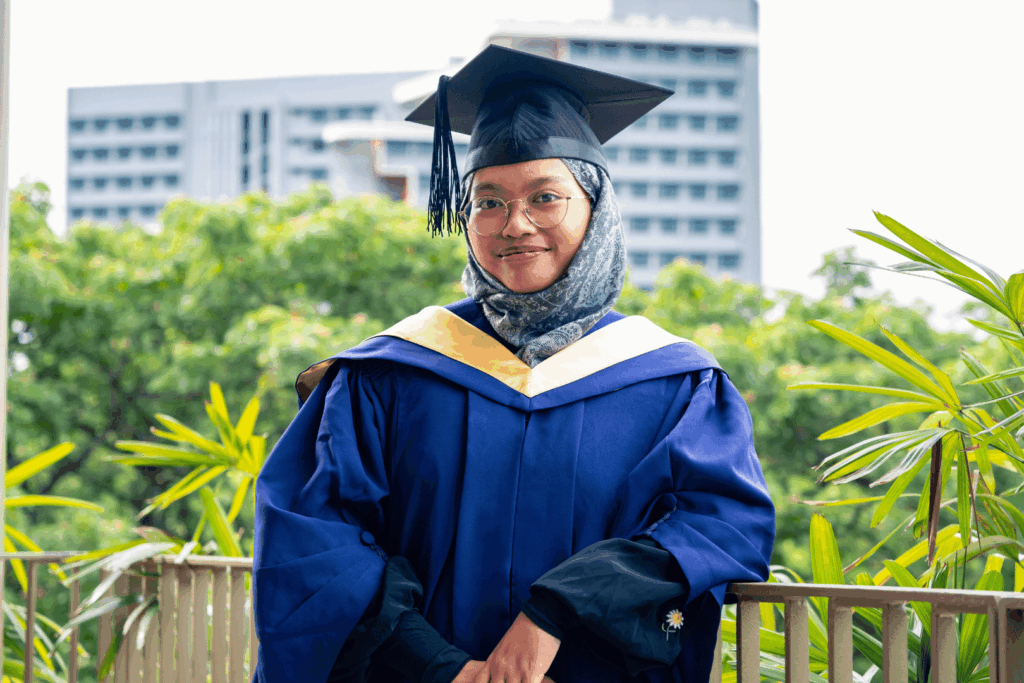
Nur Harisa Binte Hassan’s childhood fascination with crime dramas ignited a dream of pursuing forensic science. This ambition was further fuelled by a deeper, more personal motivation: her mother’s unfulfilled desire for a university education due to financial constraints. “My mother was really determined to go to university when she was younger, but (didn’t) manage to because of financial reasons,” Harisa said. “That motivated me to try my best and go to university for her, as well.”
However, she did not do well enough to get into any of her chosen courses after A-levels.
She decided to defer attending university, opting instead for Temasek Polytechnic’s Diploma in Medical Biotechnology. Her initial aim was to graduate quickly and secure a good job to supplement the family income, as her father was grappling with the effects of diabetes on his health.
Three years later, she did well enough to pursue a degree in life sciences, offered by the Faculty of Science at NUS. Through fitDeen, an outdoor-based group under the NUS Muslim Society, she discovered a love for hiking and went on multiple expeditions, scaling mountains across Southeast Asia.
Just before her third year of study, her father’s diabetes unfortunately worsened and he began showing early signs of dementia. This meant her mother had to take on additional work to support the family, while Harisa and her sister stepped up as caregivers to her father, sharing responsibilities like taking turns to bring him to daycare and administering medication.
“You’d think that your parents’ health would only get bad when they become grandparents,” she said. “It’s a different feeling altogether, to have to take care of them earlier on in your life.”
Despite these immense challenges, Harisa found solace and strength in her strong support network at NUS, particularly her friends in the Muslim Society, whose shared faith and frequent encouragement uplifted her.
Reflecting on her journey, Harisa said, “We spend so much time wondering why bad things happen to us that we often forget to find the light in the darkness.”
This story was first published by NUS News in their coverage of Commencement 2026, celebrating the achievements of our graduates from the Class of 2026. For more, read NUS News’ stories and graduate profiles, check out the official Commencement website, or look up and tag #NUS2026 on social media!
-
Degrees of FreedomFor a growing number of NUS graduates, the ideal career no longer fits neatly in... -
Vox Alumni: From Paycheck to PurposeIs career success about your title, salary or the personal fulfilment you find i... -
A Life Shaped by LearningA bequest from the late Mr Tan Peng Hock (Arts & Social Sciences ’69) to N...