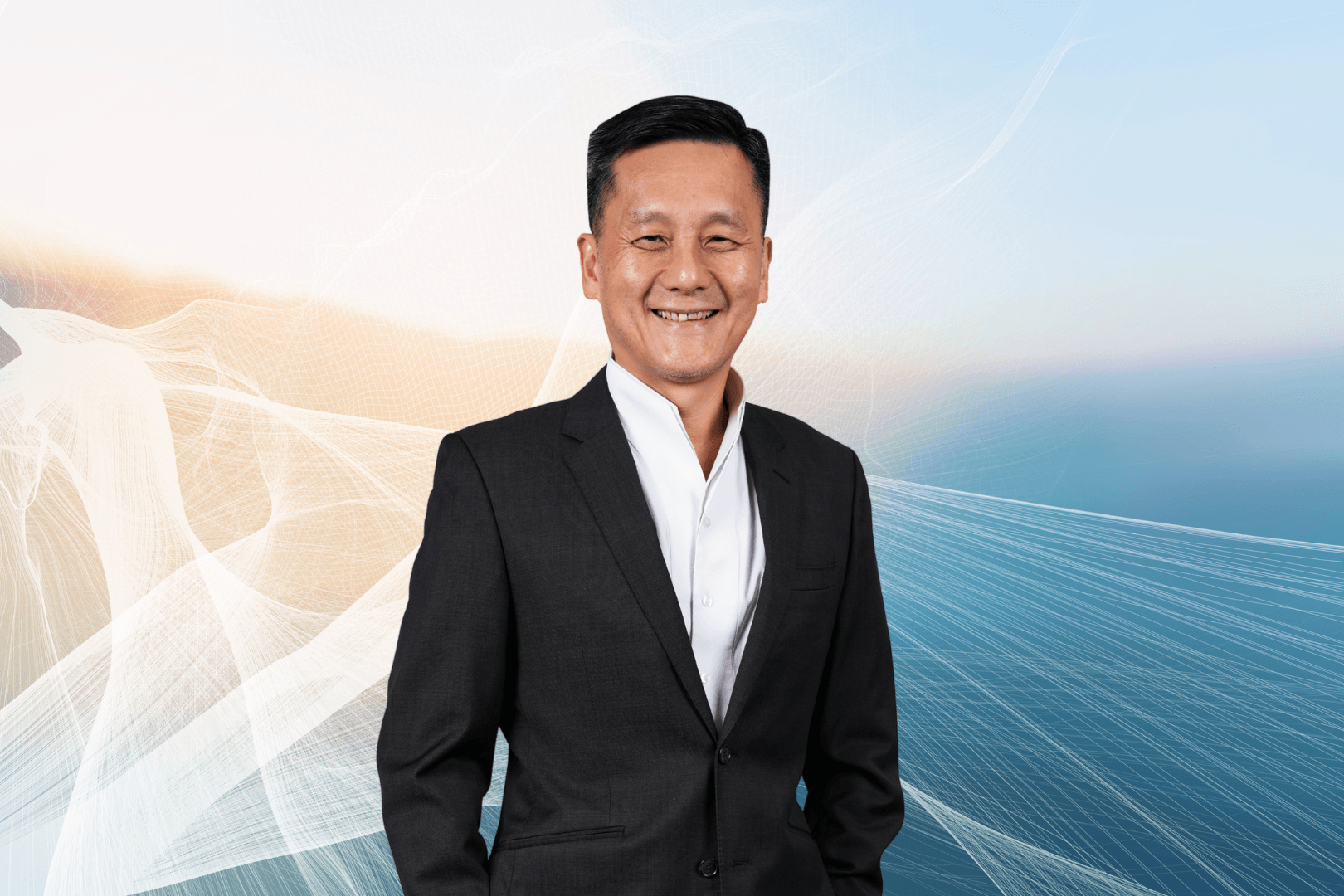
Perhaps the most surprising part of an interview with Singapore General Hospital (SGH) Chief Executive Officer Dr Tan Hiang Khoon was when the surgical oncologist revealed that his 84-year-old mother is still serving hot drinks at a primary school canteen stall in Singapore — because she loves her job and wants to stay active.
“I’ve told her to stop for many years, but she refuses,” he said, when The AlumNUS met him to discuss SGH’s latest accolade as one of the world’s Top 10 hospitals. “I have stopped asking her because it clearly makes her happy.”
The senior consultant, who specialises in treating head and neck cancer at the National Cancer Centre Singapore (NCCS), SGH and the SingHealth Duke-NUS Head & Neck Centre, shared the anecdote to illustrate that his path to medical school — and now to leading Singapore’s oldest and one of its best hospitals — was not straightforward.
FAMILY TRAGEDY
His mother, who had been a housewife, had taken on the job at the school when Dr Tan was 14, following the sudden death of her husband.
With two young children to support, she sought help at Meet-the-People sessions, where the family met their Member of Parliament, Mr Goh Chok Tong (Arts ’64, HonLLD ’15). Mr Goh, who later became Singapore’s Prime Minister, told them a primary school was opening in their neighbourhood and helped Dr Tan’s mother to secure a post. She has been there ever since, running the stall with her sister.
As a result, she was able to provide for Dr Tan and his elder sister. He went on to study medicine at NUS with financial support from family and charitable organisations. “I am very thankful that someone like me had the opportunity and the support to even go to medical school,” he said.
Following a memorable stint at university, where he spent two years as President of Sheares Hall honing his leadership and organisational skills — “I was a full-time hostelite, part-time student” — he stepped into what has been an impactful career marked by a string of leadership appointments.
MAKING OF A LEADER
One of the pioneers in the development of endoscopic and robotic head and neck surgery in Singapore, he was the inaugural Head of the SingHealth Duke-NUS Head and Neck Centre, led the integration of SGH’s Division of Surgery and NCCS’ Division of Surgical Oncology, and, during the COVID-19 pandemic, spearheaded efforts across SingHealth to set up and manage 3,700 beds in two community care facilities.
In January 2025, he took over the top job at SGH. This year, brand valuation consultancy Brand Finance ranked SGH #10 among the World’s Strongest Hospital Brands, and #2 globally on its Care score. This was based on a global study of over 2,500 healthcare professionals across 30 countries. As for global media brand Newsweek, SGH placed #9 among the world’s best hospitals in its latest ranking.
On the accolades, which were unsolicited, Dr Tan said, “The first thought that came to mind was really a deep appreciation of the trust we have built over the years — from patients choosing us as their care provider, to partners who are willing to work with us, and staff who show up to provide care to people who come to us at the worst time of their lives. There is a lot of hard work behind the recognition.”
The hospital’s 200-year history, during which its doctors have constantly sought to raise the bar on clinical care and service standards, may have something to do with it. SGH has been at the forefront of several medical milestones in Singapore, performing the country’s first kidney and heart transplant, and becoming the first hospital to bring in an MRI and proton machine.
But Dr Tan states that history alone will not guarantee SGH’s future success. “I’m a firm believer in that what gets you here won’t get you where you want to be,” he said. “We constantly push ourselves to learn and be innovative.”
BUILDING THE WORLD’S BEST PHYGITAL HOSPITAL
For him, the next big thing is technology – especially because of the leap in artificial intelligence and large language models in the last few years. He explained, “We have always talked about digital transformation, but technology has never been so easy to use and so accessible. The bar to transformation is much lower now. The question is: how can SGH be the best phygital hospital in the world?”
He sees that technology can be applied in the hospital in three main areas: smart operations to automate back-end work like billing that can save “tens of thousands of man hours every year”; smart treatments, currently focused on using technology to read scans and images; and smart services.
One of the biggest strides is Note Buddy, developed by SingHealth and Synapxe, which records and transcribes doctor-patient interactions, allowing doctors to focus on their patients instead of typing notes during consultations.
The technology can also filter out the parts of the conversation unrelated to the patient’s condition — like chit-chat about travel plans or family updates — which Dr Tan says are critical for building trust and rapport. “Note Buddy can extract the clinically-relevant information, distil and present it in a structured way. That allows the doctor to just talk to the patient. It certainly reduces stress on the doctors.”
As he rose up the leadership ranks, Dr Tan later chose to do his EMBA at NUS, which he completed in 2022. “At the time that was the only EMBA with an Asian focus,” he explained. “There are many things that are good about Asian healthcare and Asian businesses, but we don’t talk enough about it, and I wanted to learn more.”
MATTERS OF THE HEART
Yet, for all the talk of technology and strategy, it is the people who are the heart of what he does.
In previous interviews, Dr Tan — who co-founded the Children’s Cancer Foundation after being motivated by the plight of a patient’s need for wider community support — has spoken at length about the patients he gets to meet and treat.
That same human focus emerges in this conversation. In a rare moment for a C-suite interview — where discussion is usually confined to “hard” topics like leadership philosophy or corporate priorities — Dr Tan brings up his family of his own accord.
Said the father of three daughters aged 13, 15 and 18, “I just want to register that family support has been important. When you have so much time-consuming work, I am constantly grateful for my wife and my children. It really gives me a different dimension because it takes my mind off work and I truly treasure what I have.”