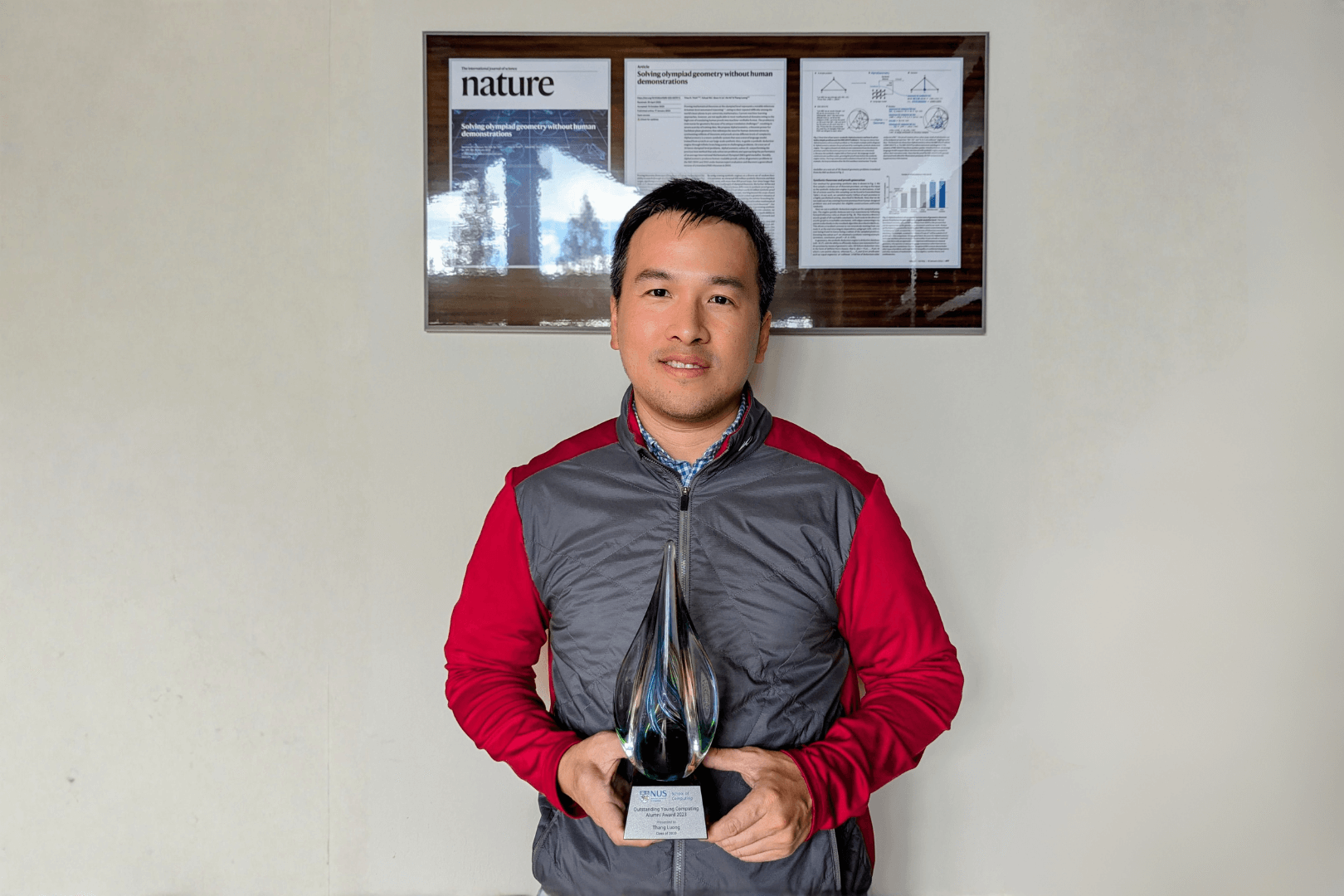
In July 2025, Gemini Deep Think, developed by Google DeepMind, made history when it achieved a gold medal performance at the International Mathematical Olympiad (IMO)—making it the first artificial intelligence (AI) system to officially do so. For Dr Thang Luong (Computing ’09), who led Google’s IMO team, the moment carried special meaning. As a high school student in Vietnam, Dr Luong had once ranked among the country’s top mathematics students—but narrowly missed the chance to compete at the IMO.
“They only picked the top six students in the country,” he recalled. Ranked eighth nationally, he was left out. “I was so sad. So, I quit math.” Two decades later, mathematics would find its way back to him—this time through AI.
Today, Dr Luong is a Principal Scientist and Director of Research at Google DeepMind, where his work focuses on pushing AI beyond pattern recognition towards deep reasoning and discovery. His journey there began not in a lab in Silicon Valley, but in a lecture hall at the National University of Singapore (NUS).
NUS: WHERE RESEARCH FIRST TOOK ROOT
That path took shape at NUS, where Dr Luong studied Computer Science from 2005 to 2009. During his undergraduate years, he was selected for the School of Computing’s Special Programme, later renamed the Turing Programme—a formative experience that introduced him to academic research.
“That was the first time I ever learned how to do research,” he said. “I’m very grateful that the School of Computing created that programme.”
A key influence during this period was his research mentor, Associate Professor Min-Yen Kan, under whom Dr Luong worked as a research assistant. While Dr Luong initially focused on information retrieval—search engines and ranking systems, his curiosity soon shifted to machine translation.
“I was so curious about how we can translate without even knowing the target language,” he said. He recalled working on language pairs he did not speak himself, including Finnish. “I think it’s actually a good thing. Then you’re forced to develop general approaches that work for any language.”
More than technical skills, NUS instilled in him a way of thinking. “It actually opened the door for me into research, which I actually had no idea about,” he said.
That foundation would take him far beyond the NUS Kent Ridge campus.
FROM STANFORD TO GOOGLE: RESEARCH WITH REAL-WORLD IMPACT
With strong research training from NUS, Dr Luong went on to pursue a PhD at Stanford University, specialising in natural language processing. During this period, he interned at Google—an experience that would later lead to a full-time role.
He joined Google in 2016 and soon played a pivotal role in the shift to neural machine translation, an advanced AI method that uses deep learning and neural networks to translate text into more natural, human-like translations. In 2017, his work helped to fundamentally transform Google Translate, dramatically improving translation quality across languages used by millions daily.
For Dr Luong, making an impact at scale has always been a priority. “I always try to think really hard about a problem where you can have research impact, and at the same time land it into Google products and make an impact on billions of people,” he said. “We don’t just do research for the sake of doing research.”
This philosophy also guided his involvement in early chatbot research—work that began as a small internal project and later became part of the foundation for Bard and the Gemini ecosystem.
TEACHING AI TO THINK THROUGH GEMINI DEEP THINK
In recent years, Dr Luong’s focus has shifted to one of AI’s hardest frontiers: reasoning.
This led to the development of Gemini Deep Think, a model designed to explore multiple lines of reasoning in parallel—allowing ideas to interact, refine one another, and converge on stronger solutions. This approach was instrumental in the team’s IMO gold medal achievement in 2025.
Unlike earlier AI systems, Gemini Deep Think is designed to “think” for extended periods. During the Olympiad, the model ran for about four and a half hours each day to solve three problems—mirroring the conditions faced by human contestants.
“These are very new problems,” Dr Luong explained. “This is the best test for AI where we know the AI hasn’t seen these problems.”
The challenges require long, structured proofs. “To solve math, you really have to reason everything robustly,” he said. “It’s long-horizon, multi-step reasoning.”
Dr Luong also highlighted a major shift in how the system operates. In 2024, solving such problems still required human-in-the-loop methods, meaning systems that operated in formal proof languages such as Lean and required expert interpretation. By 2025, the process had become fully automated, with natural language processing driving the reasoning end-to-end.
To strengthen the model, Dr Luong and his team worked closely with International Mathematical Olympiad medallists from around the world, learning how elite human problem-solvers approach unfamiliar challenges. These collaborations helped expose gaps in AI reasoning—such as the tendency to rush—guiding further improvements.
Gemini Deep Think is currently available through Google’s Ultra subscription, though Dr Luong hopes to make it accessible to more people, including mathematicians and students.
“If we can solve these kinds of hard problems without hallucinating facts, then maybe we can also figure out a way to fight the hallucination problem,” he said.
GIVING BACK: NURTURING THE NEXT GENERATION OF AI TALENT
Beyond his work at Google, Dr Luong is also the co-founder of the New Turing Institute, a non-profit organisation focused on developing AI talent across Southeast Asia and beyond.
The GStar Bootcamp by the New Turing Institute (NTI) is a 12-week, intensive global AI talent programme that equips emerging technologists with cutting-edge large language model (LLM) skills as well as research and leadership capabilities, blending theory with hands-on practice to prepare participants for careers in AI research and industry.
GStar has attracted a diverse cohort of students from around the world, including some from NUS. Former members of NTI, such as Dr Trieu Trinh and Mr Long Phan, have been highlighted in major media outlets such as The New York Times.
“My dream at that time was how to put Vietnam into the AI roadmap,” he said. What began in 2018 as a Vietnam-focused initiative has since grown into a global programme, attracting hundreds of applicants from over 15 countries—including Singapore and the US.
At its heart, the institute reflects the mentorship Dr Luong himself received. “I want to nurture the talents, just like how my advisor mentored me,” he said. “I want to see people succeed.”
A JOURNEY COMPLETE AND REIMAGINED
Recalling his own journey from math to AI, Dr Luong said: “I quit math and went into AI, and after almost 20 years, AI brought me back to math.”
The student who once narrowly missed the Olympiad stage now helps AI reach it—advancing not just technology, but the possibility of discovery itself.
In recognition of his contributions and pioneering work in AI, Dr Luong received the NUS Outstanding Young Computing Alumni Award in 2023, underscoring his impact both globally and as part of the NUS community.
Looking ahead, he sees AI as a powerful engine for scientific discovery. “I’m actually quite positive about AI in terms of discovery,” he said, pointing to areas such as new drugs and cancer treatment. “I hope AI can help us cure cancer in the next five to ten years.”