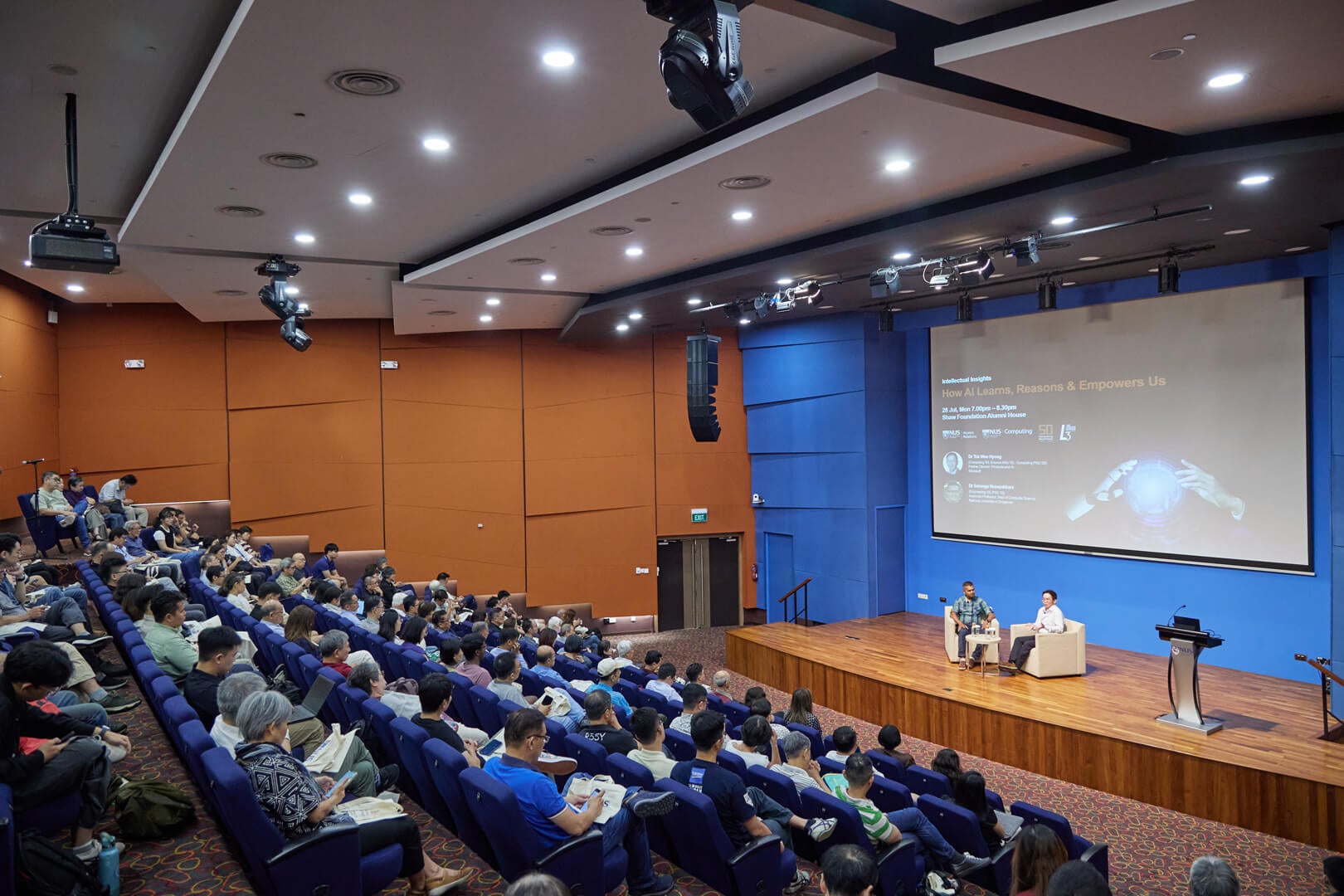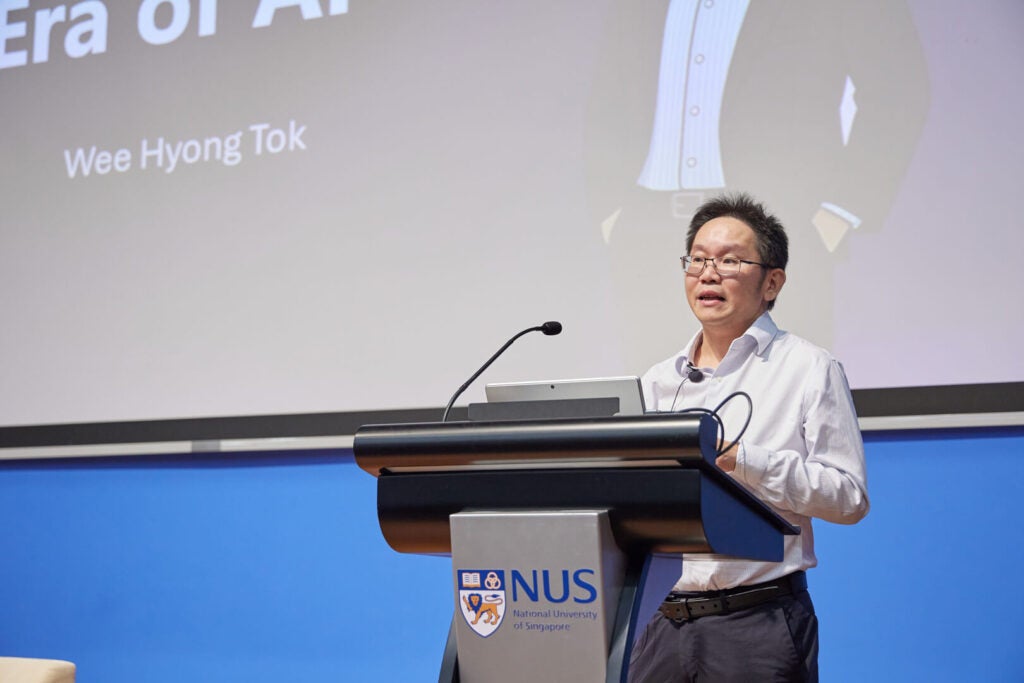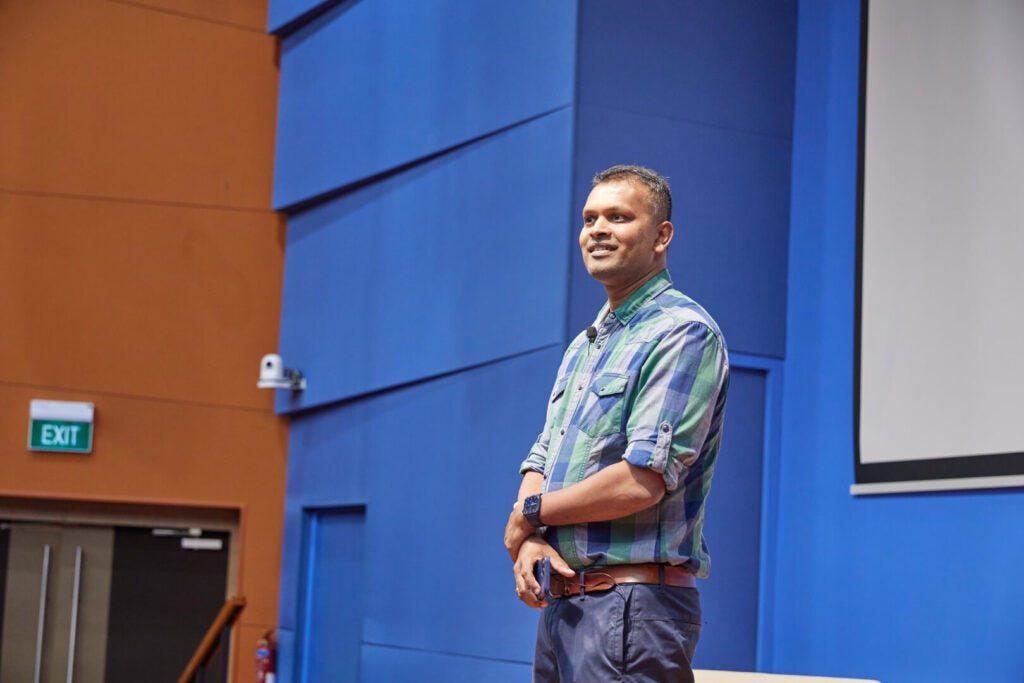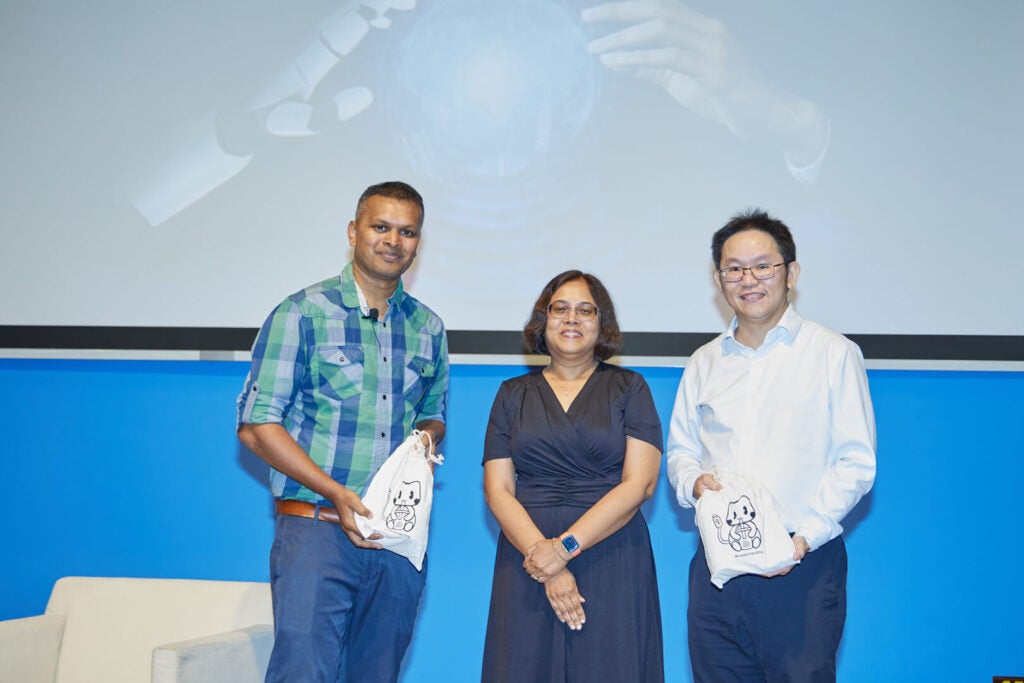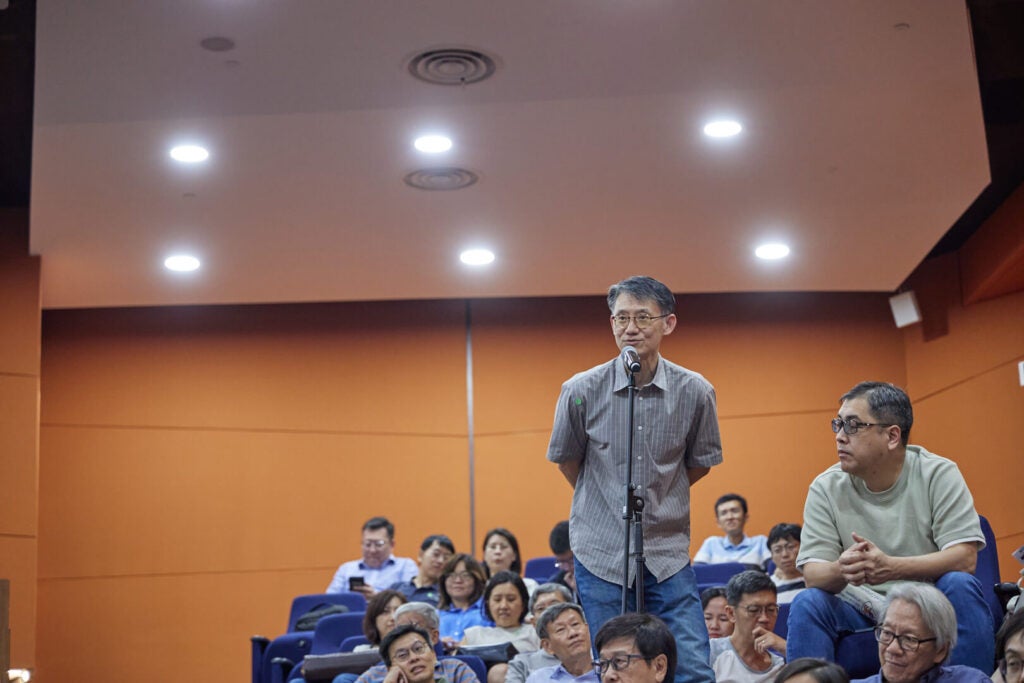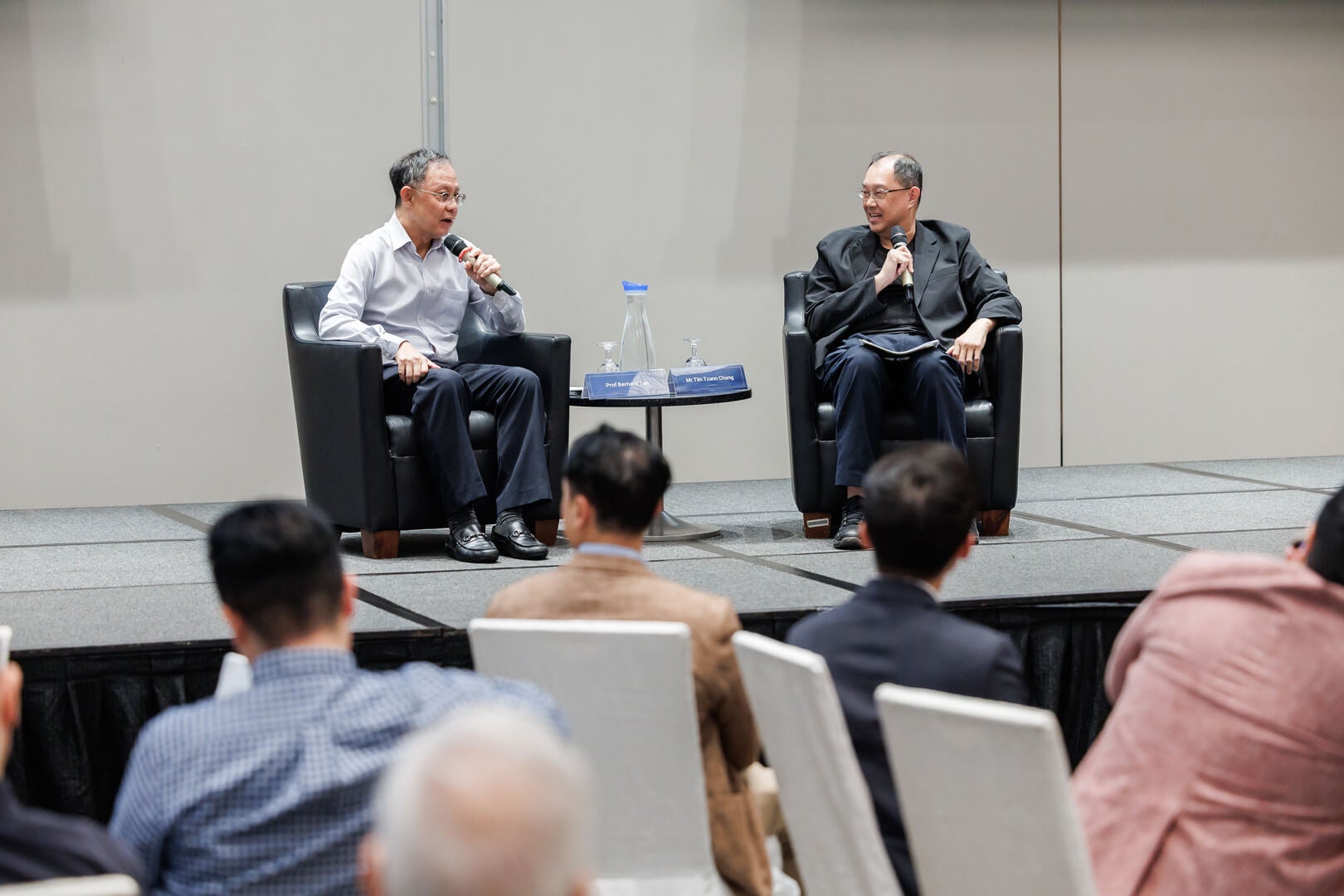

Artificial intelligence (AI) is no longer just a futuristic concept — it’s already transforming how we work, learn and live. At the recent Intellectual Insights event, titled “How AI Learns, Reasons and Empowers Us”, alumni and students heard from two speakers deeply involved in AI development and application: Dr Tok Wee Hyong (Computing ’00, Science MSc ’02, Computing PhD ’09), Partner Director of Products and AI at Microsoft, and Dr Suranga Nanayakkara (Engineering ’05, PhD ’10), Associate Professor at the NUS School of Computing. The event was held on 28 July at the Shaw Alumni Foundation House and organised by the NUS School of Computing, the NUS Office of Alumni Relations and NUS Lifelong Learning for Alumni.
Together, the speakers shared compelling stories of how AI is being applied across various fields, including healthcare, education, accessibility and software development, while reminding us that AI alone isn’t enough. To thrive in this new era, human creativity, critical thinking and solid foundational knowledge are more important than ever.
AI IN ACTION: FROM HOSPITALS TO CLASSROOMS TO CODING
Dr Tok offered a sweeping view of how AI is already embedded in daily operations across industries. To highlight the importance of good data, one example he shared was inspired by 19th-century nursing pioneer Florence Nightingale, who was also a data visualisation innovator. She used statistical charts to persuade stakeholders to improve healthcare conditions. “Back then, the message she showed was clear: good data, when interpreted properly, can save lives,” said Dr Tok.
Fast forward to today, and AI is accelerating discoveries in fields such as chemistry and physics, where recent Nobel-winning work involved collaborations between computer scientists and domain experts. “Every field is being disrupted, and the time for AI is now,” Dr Tok noted.
He also highlighted real examples of AI in Singapore:
- Preschoolers learning with AI tutors: Local companies have developed AI-powered language tools that help children learn vocabulary more effectively. These tools offer customised feedback, enabling students to pick up words up to ten times faster, while teachers remain essential as guides and facilitators.
- Developers boosted by AI copilots: Tools like GitHub Copilot are changing how code is written, reviewed and deployed. Dr Tok shared how developers are assigning repetitive coding tasks to AI, improving productivity while still reviewing and refining the final output themselves.
- Visually summarising conferences: Local content creators and web developers have started using AI to convert speech into impactful visual notes, allowing faster content creation for events and meetings.
Behind these examples is Singapore’s growing AI ecosystem, supported by national strategies, industry-academia partnerships and talent development. “We’ve reached a point where Singapore not only uses AI but contributes meaningfully to its development for the region,” said Dr Tok.
WORKING WITH TECH, NOT AGAINST IT
Dr Nanayakkara offered a different but complementary lens. Instead of focusing on AI’s technical side, he zeroed in on how people interact with it — and how good design can make AI more human-friendly.
His research in assistive technologies includes innovations such as:
- Wearable companions for the visually impaired that use gestures and speech to help users identify objects or navigate public spaces.
- Smart doorbells that convert vibrations into visual signals to alert deaf users.
- Musical interfaces that allow people with hearing loss to experience music through touch.
These inventions don’t just showcase smart tech — they stem from a deep understanding of human needs. “There’s a mismatch between what technology wants us to do and what we’re naturally good at,” said Dr Nanayakkara.
To bridge this gap, he shared five design principles that guide his work:
- Reframe the problem – Shift your perspective. Instead of asking, “How do we build an alarm clock?” ask, “How do we help people wake up better?”
- Connect and combine – Blend ideas from unlikely sources. He once merged chewing gum and an electronic component to create a hands-free control device for cyclists and wheelchair-users.
- Challenge assumptions – Good tech isn’t always complex. His team used low-power infrared sensors to detect hand gestures on smartwatches.
- Pay attention – Real insights come from observing behaviour, not just surveys. A friend who is blind had no issue with a multi-step scanning app, but Dr Nanayakkara noticed the process could be made far more intuitive.
- Make it happen – Prototype fast and refine as you go. Many of his projects, such as the wearable reader, evolved over more than a decade because of constant iteration and passion.
And most importantly? “Have serious fun,” he said with a smile. “Fun leads to impact.”
BUILDING THE RIGHT FOUNDATIONS
While the potential of AI is immense, both speakers agreed that the right mindset and foundational knowledge are key to using it well.
AI can boost productivity, summarise meetings and suggest code, but it still needs human oversight. Whether it’s coding, data literacy or critical thinking, these core skills are what empower people to use AI well and question it when it’s wrong. Dr Tok also highlighted how students who rely too much on AI often falter in exams where they can’t use digital tools. “Tools are only useful when you know how to use them wisely,” he said.
AI is changing how we live, learn, and work, but the future isn’t just about smarter machines. It’s about how we, as humans, choose to design, use and grow with them.
Whether you’re a teacher, developer, designer or business owner, the message is clear: don’t fear AI and choose to understand it instead. We humans need to build the right skills, ask better questions and reframe problems. And above all, don’t forget the human touch.
Q&A HIGHLIGHTS: WHAT THE AUDIENCE ASKED
Q: How do we handle AI getting things wrong, especially in high-stakes situations?
Dr Tok: AI makes mistakes, just as humans do. We need to approach it with a growth mindset. You can view it as a helpful subject matter expert. For example, my son built a website using ChatGPT. While the AI gave the working code, he couldn’t debug it due to a lack of foundational knowledge. This mirrors what NUS President Prof Tan Eng Chye once said during an alumni networking event in the Bay Area [in San Francisco]— that laying strong foundations is crucial to using AI meaningfully.
Q: Will demand for large data centres decrease as AI models become smaller and more efficient?
Dr Tok: We’re seeing both trends. While some models are shrinking for specific use cases, the demand for computing, especially for training and deploying large-scale models, continues to grow. It’s not either-or. There’s space for both.
Q: What about AI’s environmental impact? Can we improve sustainability in data centres?
Dr Suranga: AI does consume a lot of energy. That’s why sustainability must be part of the conversation. This isn’t just about technology — it’s about responsibility, values and policies. We need to guide AI development in a direction we believe in.”
Photos by Mark Lee
-
In Service to ManyA surgeon, educator and president of the Medical Alumni Association, Dato’ Pro... -
How NUS is Redesigning Undergraduate Education in the Age of AIAs generative AI transforms how we learn, work and think, NUS is taking a bold a... -
NUS: Reprogrammed for TomorrowIn just three years since the launch of ChatGPT, NUS has launched ambitious prog...