From lion mascots and dinosaur bones to residential halls and lab innovations, the University’s 120-year legacy comes alive through a series of iconic items, reflecting its evolution into the global institution it is today.
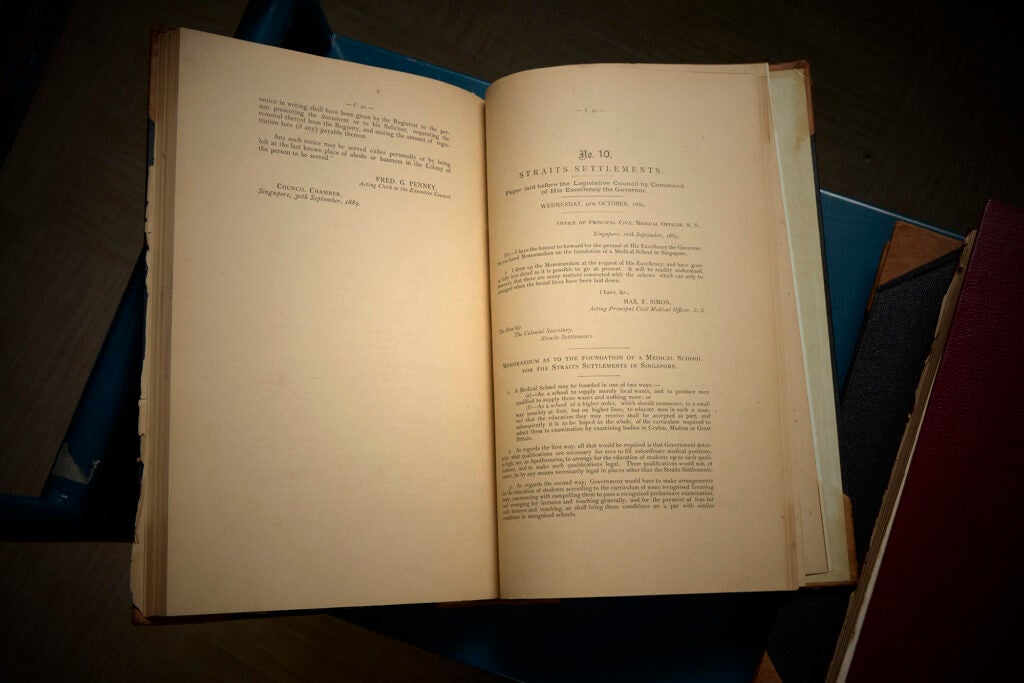
The 1889 Memorandum, published in the Proceedings of the Legislative Council of the Straits Settlements for 1889 and available in NUS Libraries’ Rare Book collection.
ORIGINS OF A MEDICAL SCHOOL
The National University of Singapore (NUS) traces its origins to 1905, when the Straits Settlements and Federated Malay States Government Medical School was launched on 3 July of that year. But calls for a medical school in Singapore had begun decades earlier. Within NUS Libraries, the earliest-dated document on the subject is the Memorandum as to the foundation of a Medical School for the Straits Settlements in Singapore, submitted on 16 September 1889 and written by Dr Max F Simon, Acting Principal Medical Officer of the Straits Settlements. Though the proposal faced opposition due to its prohibitive cost and the low demand from students, the turning point came in 1904, when Mr Tan Jiak Kim, a leader within the Chinese community, submitted a petition to the Governor, urging him to consider establishing a medical school. In response, the Governor challenged the community to raise the funding. They did — exceeding the target — and the School opened the following year. Mr Tan’s efforts helped shape the “by the community, for the community” ethos that is integral to NUS today.
2
FROM CREST TO MODERN LOGO
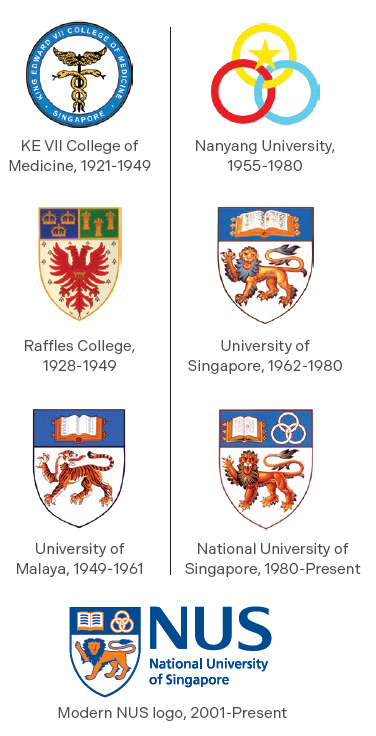
The evolution of the NUS logo mirrors the University’s journey from colonial college to world-class institution. Through name changes, mergers and separations, each crest reflected a new chapter. The current identity — adopted in 2001 and made up of a modernised coat of arms and the NUS namestyle — is rich in meaning: the lion aligns with our national identity, and symbolises courage, integrity and idealism; the open book establishes the University as a portal to a world of knowledge; and the three inter-connected rings reflect NUS’ role in creating, imparting and applying knowledge. They also represent the ideals of a global university — creativity, innovation and entrepreneurship — and how these values reinforce one another.
3
NATURE’S WITNESS TO HISTORY
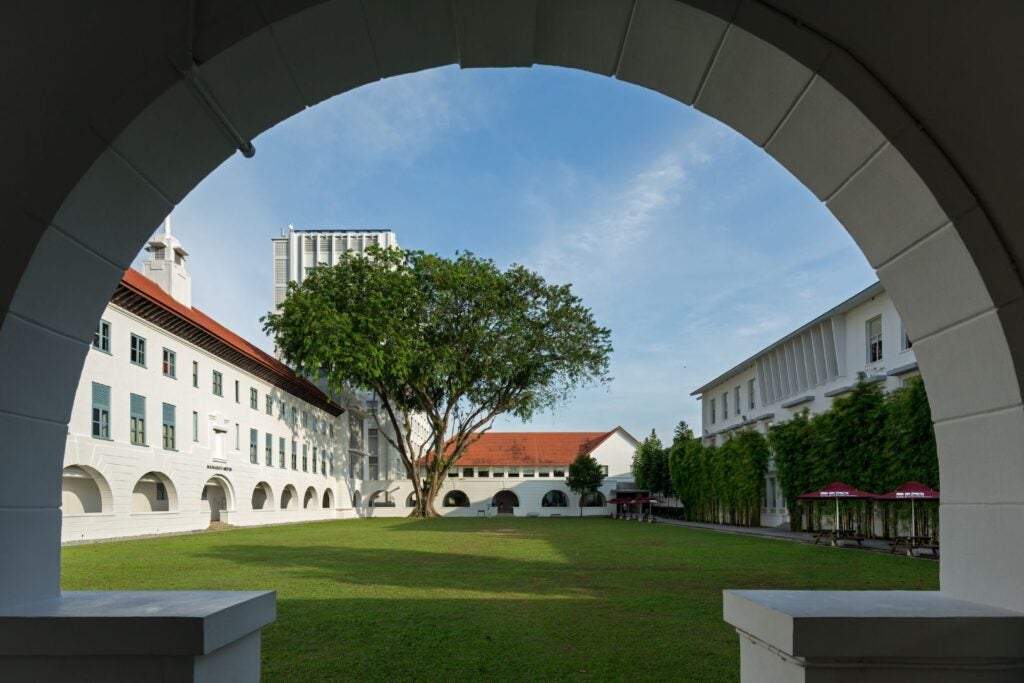
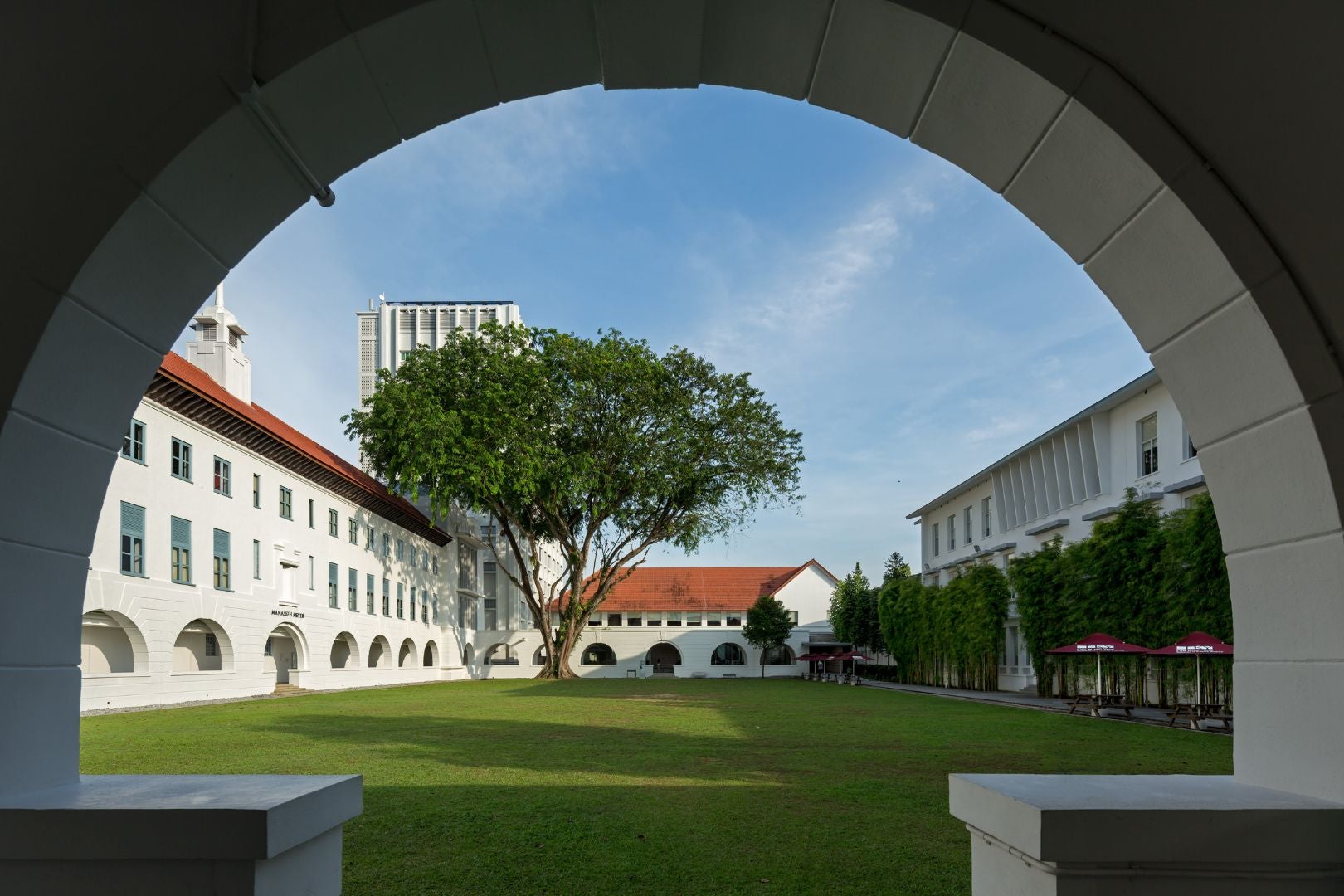
At the Lower Quadrangle of the NUS Bukit Timah campus, a towering angsana tree, planted shortly after the campus was established in the 1920s, stands as a silent witness to history. This former home of Raffles College and the University of Malaya saw debates on self-rule, nationhood and the shaping of Singapore’s earliest thinkers — some under the shade of this grand tree. For instance, speaking about his time as a young philosophy student, Mr Kishore Mahbubani (Arts & Social Sciences ’71), Distinguished Fellow at the NUS Asia Research Institute, told The AlumNUS in 2022 that there was a “magical aura” about the place. “It was a wonderful campus, very green and welcoming,” he recounted. More than a landmark, the angsana tree reflects NUS’ longstanding tradition of building with nature. Today, that ethos continues with the University’s goal to plant 100,000 trees on campus by 2030 — a target reached halfway by 2024.
4
HONOURING 11 BRAVE SOULS
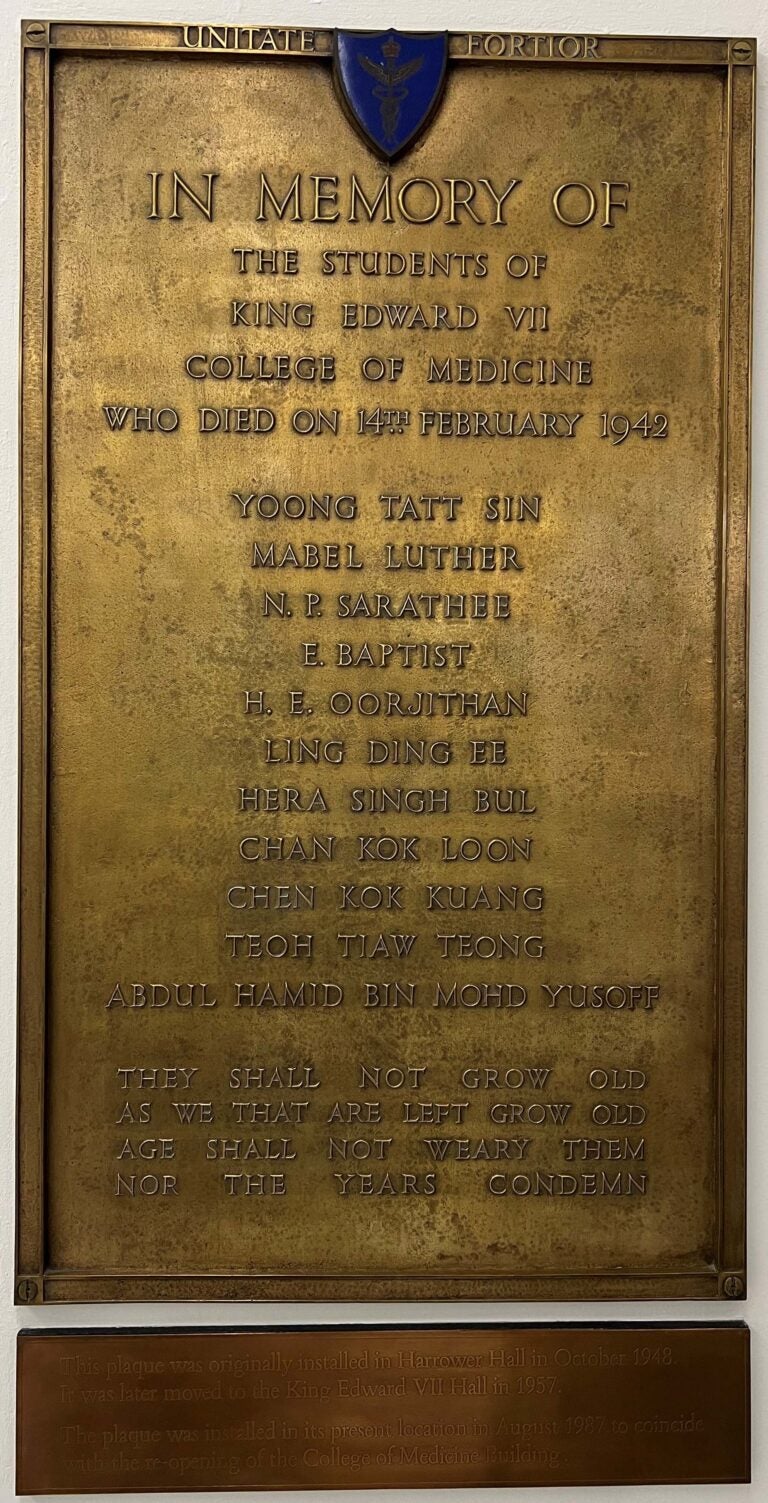
Tucked in the old College of Medicine Building (the present-day Ministry of Health), a bronze plaque pays tribute to 11 brave King Edward VII College of Medicine students who perished during the Japanese bombardment in World War II — just one day before the British forces formally surrendered Singapore. As recounted in Beyond Degrees, a book that chronicles the history of NUS, the College insisted on holding classes and examinations as the Japanese closed in, with many medical students helping to treat the wounded in hospitals and the Medical Auxiliary Service. Raffles College served as the headquarters for the Service, for which many students and staff volunteered while all academic activity of the College was suspended.
Their sacrifices embodied the wartime resilience of the two institutions, which emerged from the war to unite as the University of Malaya in 1949. From the ashes of World War II to the twilight of British rule, the Colleges laid the intellectual foundations of an independent Singapore and a university that would serve a self-governing people. The plaque stands today not just as a memorial, but as a reminder of education’s role in courage, service and nationhood.
5
UNIVERSITY MACE
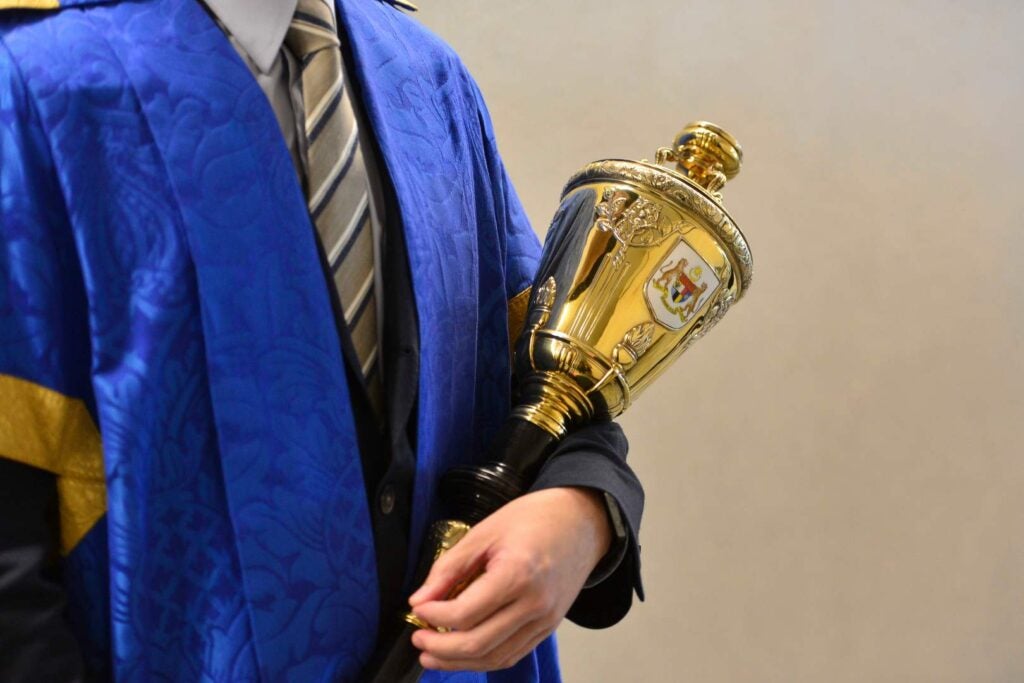
If you have attended a graduation ceremony at NUS, chances are you would have seen the university mace leading the procession — a ceremonial torch signifying the light of knowledge and authority. Gifted to the University of Malaya in 1955 by Mr Tan Chin Tuan, a member of the University Court, the ebony and silver-gilt mace was fashioned by London jewellers Messrs Mappin and Webb, incorporating the coats of arms of Singapore, the Federation of Malaya, and the University of Malaya. Following the split of the University of Malaya in 1962 into two separate entities, the mace became part of the University of Singapore, remaining in ceremonial use by NUS today.
6
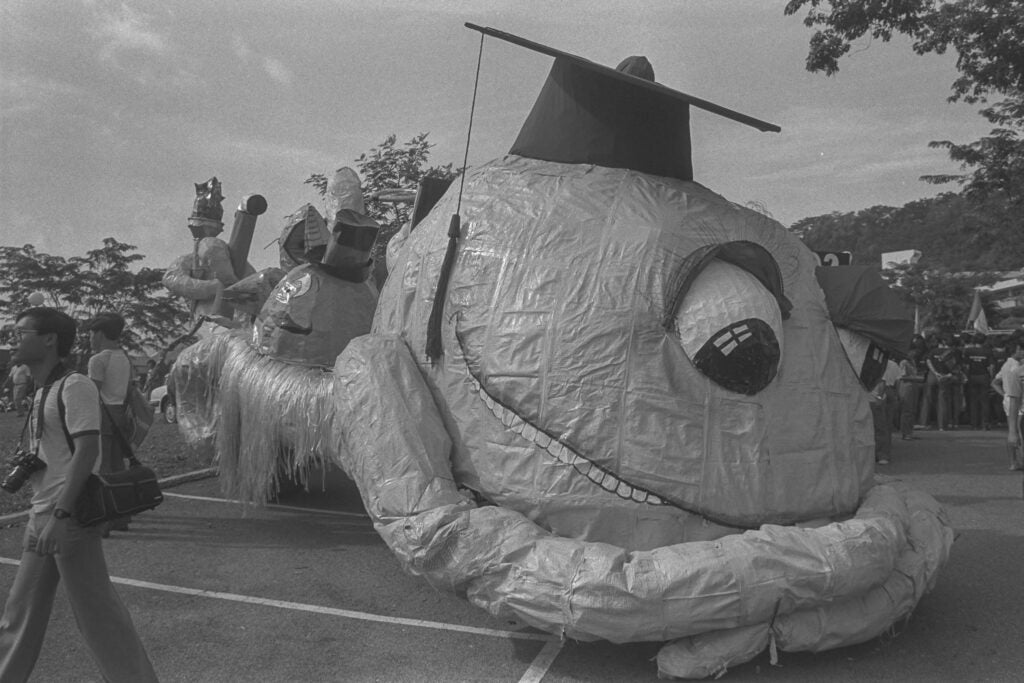
A float from the 1985 Rag and Flag Day. Photo credit: Ministry of Information and the Arts Collection, courtesy of National Archives of Singapore.
REMEMBERING RAG DAY
A riot of colour and camaraderie, Rag (Receiving and Giving) Day is etched in the collective memory of generations of NUS students. What began in 1958 as an event where students and staff rallied together to give back to society soon became an annual campus institution: NUS Students’ Union (NUSSU) Rag and Flag Day. After a period of fundraising for charity, students would stage spectacular performances in a show of appreciation to donors for their invaluable support. (In the last 15 years, NUS students have raised close to S$4.6 million in donations in aid of local beneficiaries.) As awards were given for the best efforts, students poured their hearts into elaborate floats, themed costumes and synchronised performances, often working through the night on campus. Rag was not just a show; it was a rite of passage and a way to bond across faculties and hall rivalries. In those pre-digital days, poster paint, crepe paper and sheer grit brought ideas to life. While its format has evolved, the tradition continues to spark nostalgia and inspire new generations of undergraduates.
7
THE KENT RIDGE CAMPUS
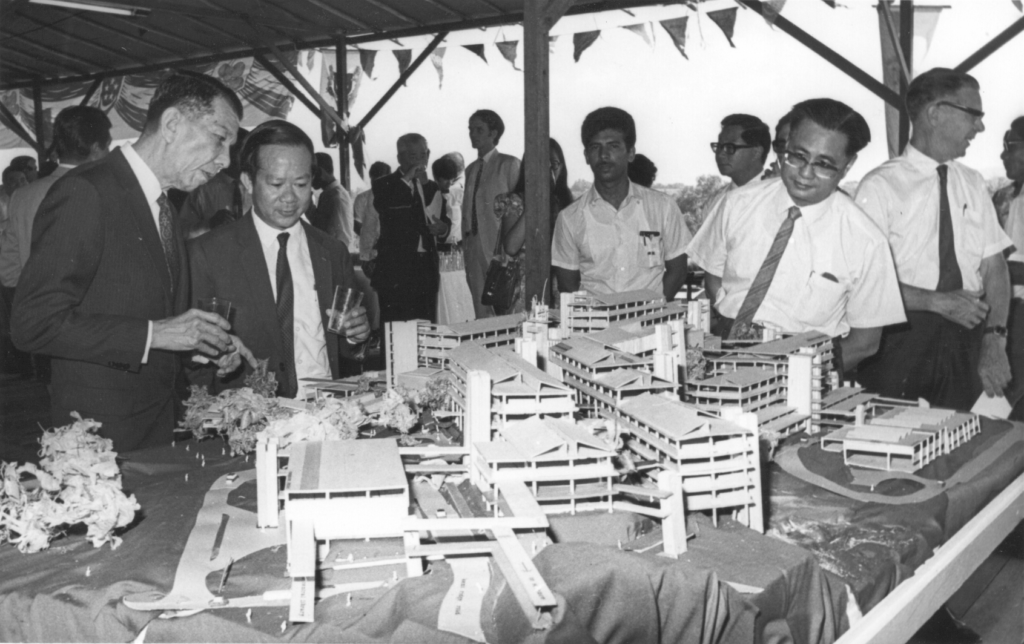
The original model of the Kent Ridge campus is a quiet relic of ambition. The model reflects a pivotal moment in NUS history when rapid student growth and limited space at Bukit Timah spurred the bold move to Kent Ridge, a forested hill earmarked in the early 1970s for a modern, integrated campus. Over more than a decade — from the campus’ groundbreaking in 1972 to its completion in 1986 — the University expanded faculty by faculty, bringing science, engineering, medicine, law and the arts together in one space. The detailed model — once used to visualise lecture theatres, hostels, and shared spaces — now stands as a nostalgic tribute to that transformation. It marks not just a physical relocation and expansion, but NUS’ evolution into a global institution rooted in Singapore’s post-independence aspirations.
8
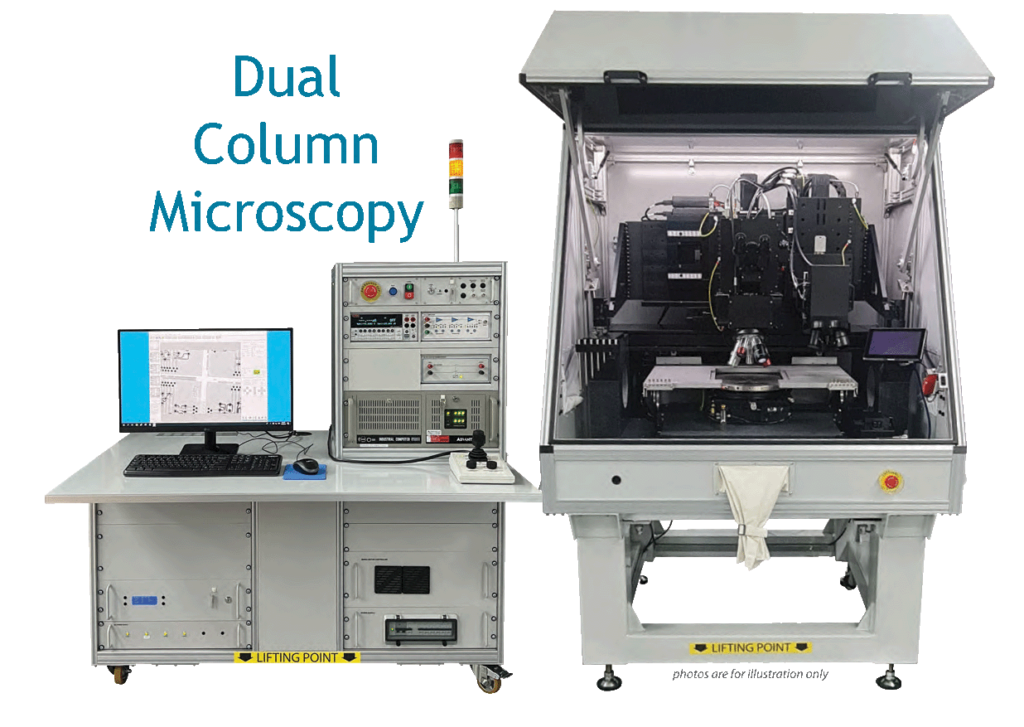
The SEMICAPS 1300 Upright Analytical System.
BRIDGING ACADEMIA AND INDUSTRY
With the advent of the knowledge economy, NUS made a pioneering leap into research commercialisation when its first spinoff, SEMICAPS, was founded in 1989. The venture specialised in advanced diagnostic tools for semiconductor failure analysis and was helmed by Professor Jacob Phang from the Faculty of Engineering, a physicist-entrepreneur who would later become the first CEO of NUS Enterprise. His dual role symbolised a turning point: the University’s transformation from a traditional academic institution into a hub for innovation and entrepreneurship. SEMICAPS’ success laid the groundwork for the hundreds of NUS spinoffs and startups that would follow. Today, NUS Enterprise is known for key initiatives like NUS Overseas Colleges (NOC), BLOCK71 and the Graduate Research Innovation Programme (GRIP), which have become central pillars in Singapore’s startup scene.
9
LiNUS, as he appeared in the 2000s.
LINUS THE LION
Meet LiNUS, the wide-eyed lion mascot with a knowing grin, proudly donning a mortarboard and pawing his way into NUS lore. LiNUS — a clever nod to both the lion and the University — reflects NUS’ spirit of boldness and learning, a modern-day evolution of the University’s longstanding lion symbolism. Since his debut in the mid-2000s, LiNUS has appeared everywhere from Rag floats to convocation halls, with his cheerful presence adding warmth to official events and student campaigns. LiNUS even has his own Instagram page!
10
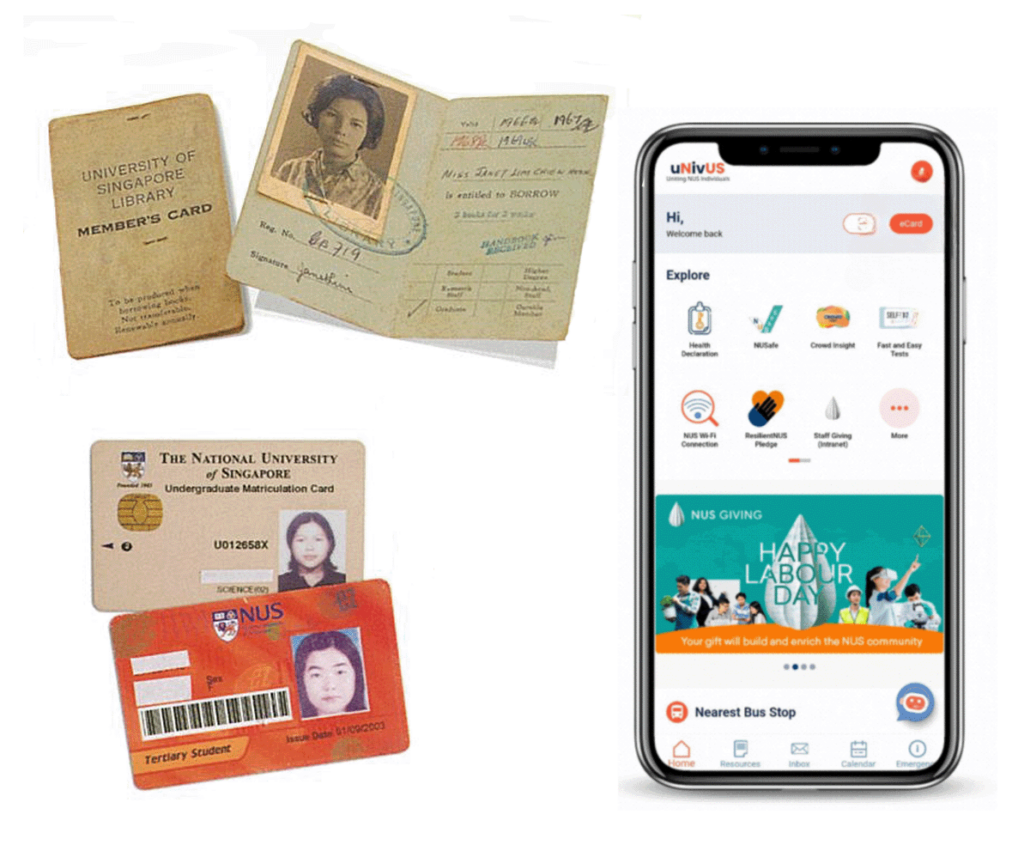
Left: NUS student cards over time. Image first appeared in The NUS Story: 100 Years of Heritage. (2006). NUS Museum. Right: The uNivUS app.
FROM PHYSICAL TO DIGITAL
In 1992, NUS became the first academic institution in the Asia-Pacific to introduce smart card technology. With time, students’ ID cards could be used to borrow books, unlock doors, book sports facilities and even pay for kopi. Nowadays, to complement plastic cards, the uNivUS app serves as a one-stop-shop for NUS-related information and services. Students can access their digital ID cards, monitor bus timings, reserve library seats, and check exam scores and mark their attendance via the app.
11
BEST CAMPUS LIFE
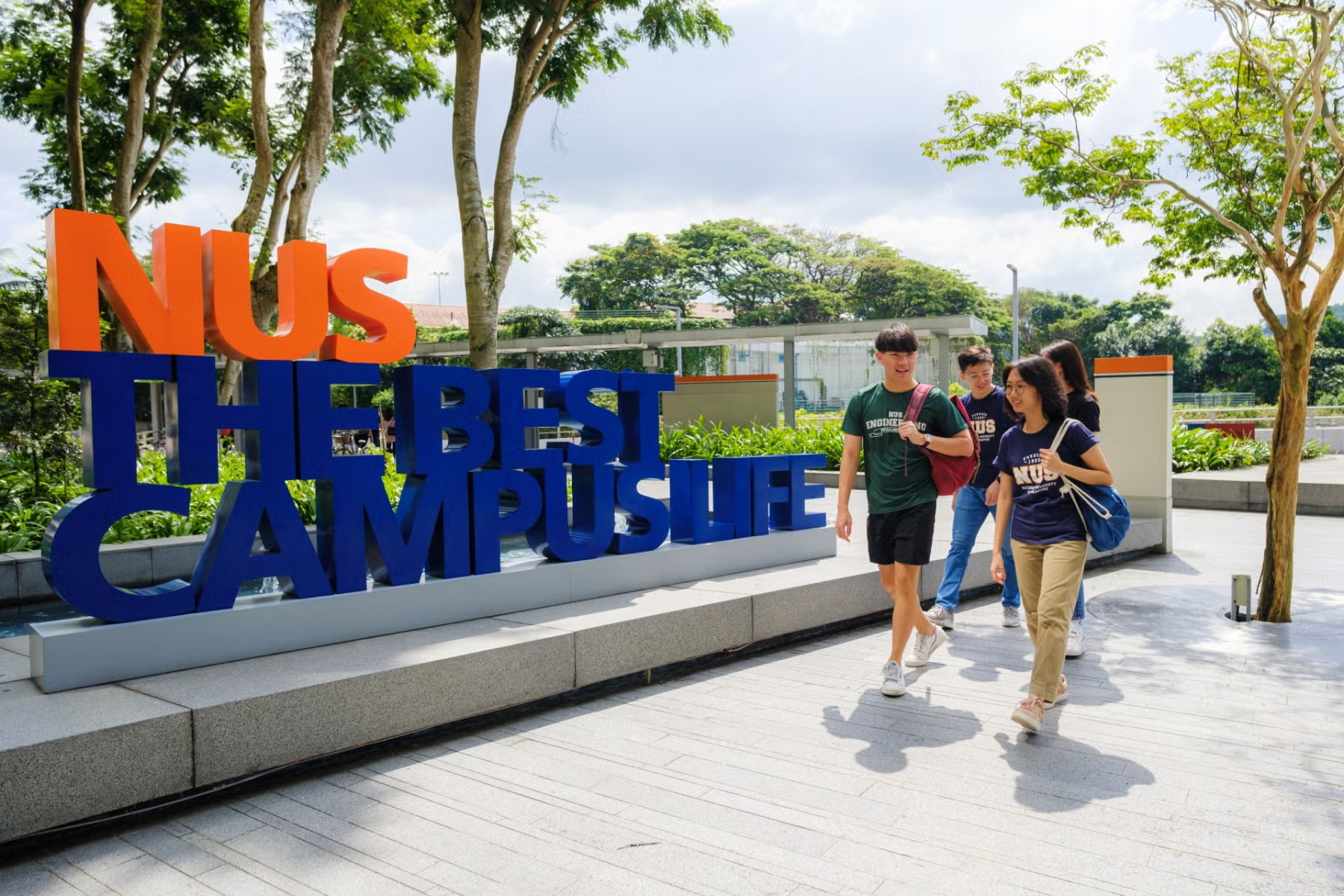
From its opening in the 1920s, Raffles College required students to stay at least one year in a hostel. Today, the integration of living and learning is being reimagined at NUS. In University Town (UTown), the “NUS: The Best Campus Life” sign alludes to the University’s push to redefine student residential life. From UTown colleges to themed halls, NUS is expanding its residential landscape. The upcoming Acacia College, for instance, integrates Artificial Intelligence (AI) into its curriculum and community life, while Valour House will centre on sports, leadership and resilience. Both are part of NUS’ broader strategy for holistic education, supported by initiatives like NUSOne, which emphasise life beyond the classroom. Residential colleges today are incubators for values, ideas and inter-disciplinary collaboration.
12
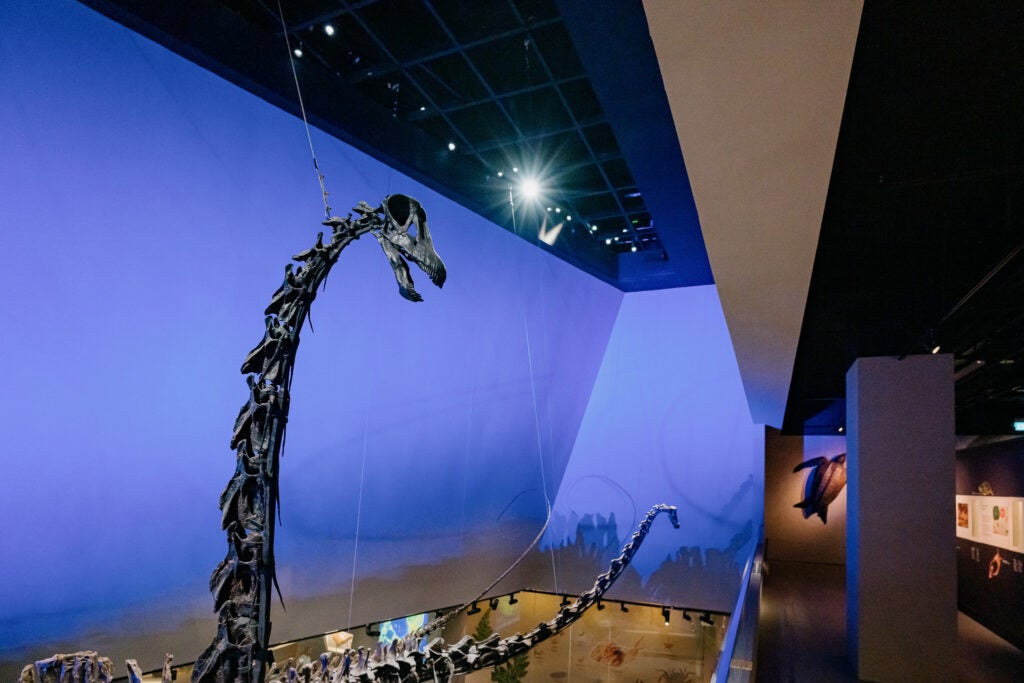
LKCNHM celebrates its 10th anniversary this year. Photo credit: Lee Kong Chian Natural History Museum, National University of Singapore.
THE PAST LIVES ON
At the Lee Kong Chian Natural History Museum (LKCNHM), dinosaur skeletons stop visitors in their tracks. Their presence on campus nods to a proud legacy of university museums at NUS. For instance, the Medical School’s Pathology Museum was founded in 1907. And in 1955, the University Art Museum was established, laying the foundation for what is now the NUS Museum. Today, students can admire art at the NUS Museum, walk through the rich biodiversity of Southeast Asia at LKCNHM, study medical specimens at the Pathology Museum, and step into Peranakan heritage at the NUS Baba House. More than repositories, these museums are living classrooms, preserving stories of science and society