

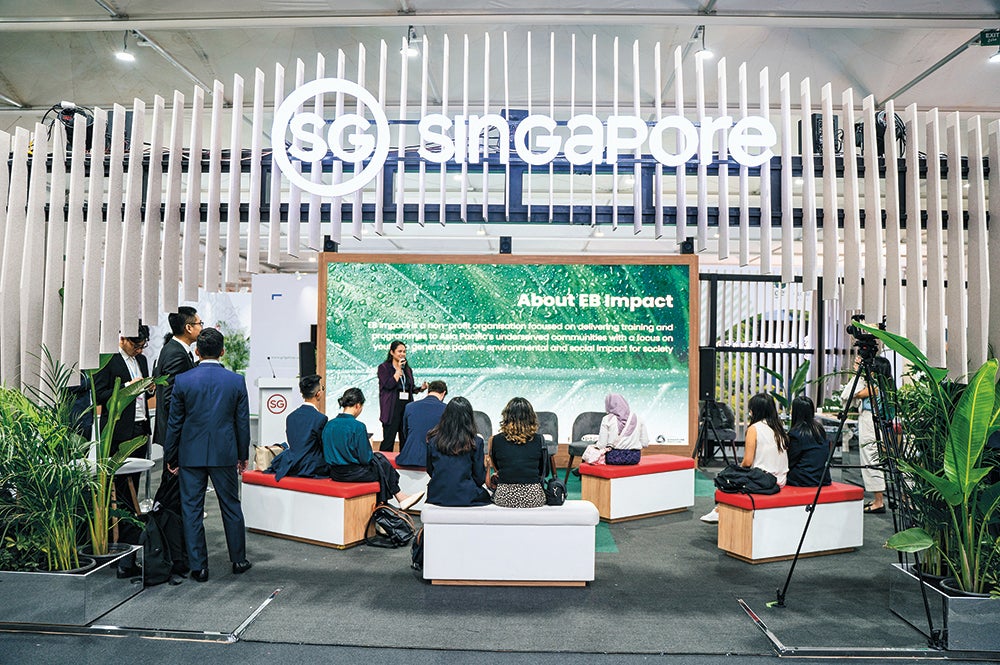


The United Nations (UN) Climate Change Conference may not, to some minds, be the likeliest place to bump into an NUS academic. Yet several of them were part of the Singapore contingent at the 27th Conference of the Parties to the UN Framework Convention on Climate Change (UNFCCC) — commonly referred to as COP27 — in Egypt in November 2022.
Together with government officials, business leaders and youth activists, NUS faculty and researchers flew
to the Egyptian city of Sharm el-Sheikh, where they sat in on multilateral negotiations, hosted panel discussions at the inaugural Singapore Pavilion, and took part in other side events.
In fact, NUS staff and students have been a regular presence at the annual climate summit since 2014 (COP20), following the University’s accreditation by the UNFCCC as an observer organisation. This in itself reveals a lot about the global reach NUS has achieved, as well as its commitment to environmental sustainability. Such dedication to the cause is apparent in the wide-ranging actions NUS has taken, from launching new educational offerings and exploring ground-breaking ways of reducing carbon emissions to supporting eco-minded alumni in their entrepreneurial journeys. Increasingly, technology is the lever driving these efforts forward.
A STATEMENT OF INTENT
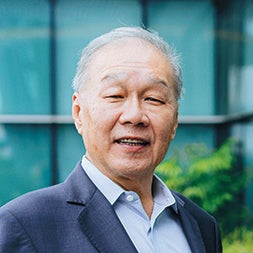
Recent changes at the senior leadership level have laid down a marker of NUS’ ambition to advance sustainable development and contribute to the global fight against climate change. In August 2022, former Faculty of Engineering Dean Professor Low Teck Seng stepped down from his post as Chief Executive Officer of the National Research Foundation to assume the brand-new position of Senior Vice President (Sustainability & Resilience) at NUS. His role is to serve as a catalyst in facilitating collaborations between different NUS research institutes, as well as with industry partners, to augment Singapore’s climate resilience and sustainability through the development of novel mitigation and adaptation solutions.
“We will look towards achieving thought leadership in sustainability by NUS with these key work streams — research, education, carbon net-zero campus, and building a culture of consciousness of sustainability and resilience. Looking into the future with the outcomes from our efforts, and with the right technological solutions in place, we will be able to build up resilience against the impact of climate change,” said Prof Low prior to returning to NUS. “I hope to bring together colleagues from many different faculties to address the concept of resilience. This could be via research which straddles different disciplines — for example, the nexus of energy, water, waste, environment and food security. There are many areas we need to examine as these are existential issues for Singapore.”
Prof Low is also a member of the University Sustainability and Climate Action Council, which was formed in 2021 in response to the increasing urgency of climate change. Made up of faculty and staff from a wide spectrum of disciplines, the Council coordinates the University’s activities across the fields of education, research, innovation and enterprise, campus operations and administration, and community engagement, to catalyse solutions for greater sustainability impact.
The Council is chaired by NUS President Professor Tan Eng Chye (Science ’85), who touched on NUS’ growing momentum in this area in an interview with The Straits Times. “As a university at the forefront of scientific research, we are at a great vantage point to drive change and test cutting-edge practices and solutions by serving as living laboratories for experimentation. Green research is an exciting new frontier offering opportunities for interdisciplinary collaboration,” he said. “By harnessing the knowledge and expertise of our faculty and researchers from different disciplines, we can make significant contributions to enhance the climate resilience and sustainability of Singapore.”
Looking into the future with the outcomes from our efforts, and with the right technological solutions in place, we will be able to build up resilience against the impact of climate change.
Professor Low Teck Seng, Senior Vice President (Sustainability & Resilience), NUS
INFUSING SUSTAINABILITY — AND TECHNOLOGY — INTO THE CURRICULA
In the educational arena, NUS has rolled out a raft of undergraduate and postgraduate courses to empower students to contribute to the sustainability movement. For example, a new degree programme by the College of Design and Engineering (CDE), the Bachelor of Engineering (Infrastructure and Project Management), seeks to nurture built environment professionals with the interdisciplinary knowledge and skills to create sustainable urban environments in the face of the changing climate. It covers modules in engineering, design, management, technology, building science and law, with electives focusing on digital technologies like building information modelling and smart facilities management. Alternatively, interested students can pursue a Second Major in Sustainable Urban Development or a Minor in Meteorology and Climate Science, among other options.
A variety of sustainability-themed master’s programmes is also available to postgraduate students. New offerings include the Master of Science (Energy Systems), which combines understanding of energy technology and innovation management to facilitate decision-making in energy solutions and investment; and the Master of Science (Sustainable and Green Finance), launched by NUS Business School in collaboration with NUS’ Sustainable and Green Finance Institute. The latter programme extends conventional, profit-maximising finance models to incorporate environmental, social and governance (ESG) considerations into business and investment decisions. Using various measurement tools which harness big data and analytics, students are trained to assess business impacts on society and the environment, identify opportunities for sustainable investing and propose novel green financial instruments.
Not forgetting the importance of lifelong learning and workforce upskilling, NUS is ramping up its continuing education programmes in this area as well. For instance, C-suite executives can enrol in the five-day programme, Leading in Sustainability and Climate Change: Lessons from the Little Green Dot. Administered by the School of Continuing and Lifelong Education (SCALE), it gives participants a better understanding of the science behind climate change, relevant regulatory and technical aspects, and how to champion sustainable business practices in their organisations. Other bite-sized courses allow working adults to obtain certification in specialised topics such as green fintech, urban farming biotechnology, and key analytical tools for biodiversity conservation and nature-based climate solutions.
SINGAPORE’S PATH TO NET-ZERO
- To cut greenhouse gas emissions to 60 million tonnes in 2030
(updated in October 2022 from the previous target of 65 million tonnes)
- To achieve net-zero emissions by 2050
The Government submitted its enhanced climate targets to the UNFCCC at the COP27 summit.
- Serious difficulties in pursuing renewable energy sources (e.g., solar, hydroelectric, wind, nuclear, geothermal) due to geographical limitations
- These include small land area, relatively flat and low-lying terrain, low wind speeds, high urban population density and a lack of natural resources
THE SOLUTION > Adopt low-carbon energy technologies such as:
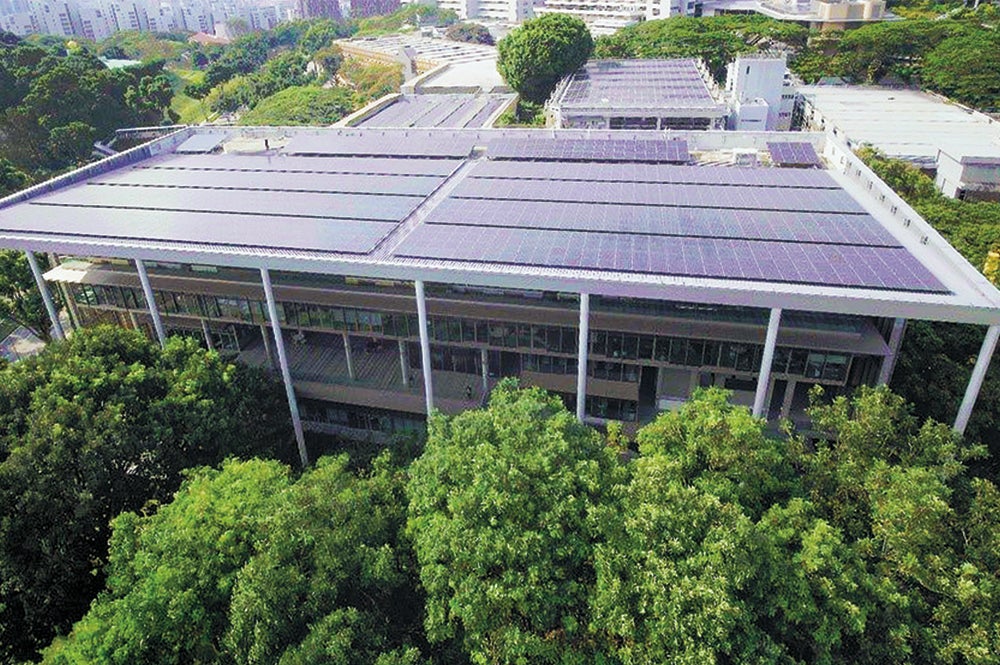
- Creative ways to maximise solar deployment — e.g., installing solar panels on rooftops, reservoirs and open sea
- National Hydrogen Strategy — hydrogen (a clean fuel that produces only water vapour, not carbon dioxide, when burned) to supply up to half of Singapore’s power needs by 2050
- Carbon capture, utilisation and storage — trapping carbon dioxide emissions and either reusing them or permanently storing them deep underground
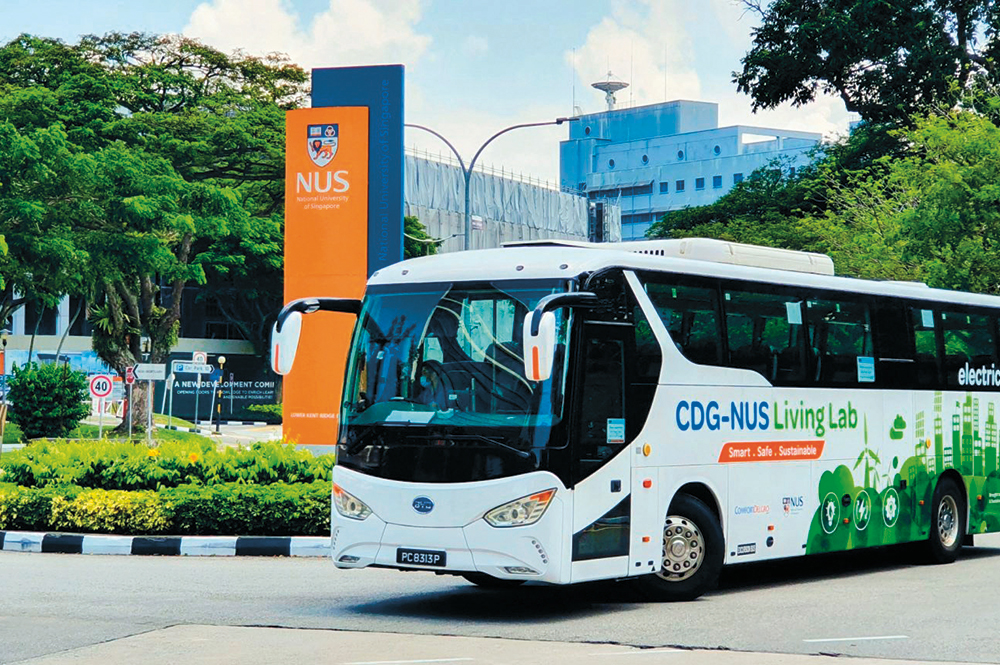
- Green mobility — electrifying vehicles
- Transformation of the built environment — developing Super Low Energy and Zero Energy buildings
“Even though Singapore only accounts for just 0.1 per cent of global emissions, we want to do our part in the global effort to address the climate crisis and steward our resources for future generations.” Mr Lawrence Wong, Deputy Prime Minister and Minister for Finance, at the Singapore International Energy Week in October 2022
LEVERAGING NATURE THROUGH TECH
One might ask, what are nature-based solutions to climate change? They refer to the conservation, restoration and responsible management of landscapes and ecosystems to remove carbon dioxide from the atmosphere. Examples include protecting or restoring forests and mangroves, as well as practising regenerative agriculture such as no-till farming and cover crop rotation. Based on research by global non-profit The Nature Conservancy, natural climate solutions can provide over one-third of the greenhouse gas emissions reductions needed by 2030 to stabilise warming to below two degrees Celsius.
At NUS, research in this field is led by its Centre for Nature-based Climate Solutions (CNCS), housed within the Faculty of Science. Ms Audrey Tan (Arts and Social Sciences ’13), Science Communication and Outreach Lead at CNCS as well as the Tropical Marine Science Institute (TMSI), discussed the importance of nature-based solutions — especially reforestation — in a TODAY commentary which was published on 17 November 2022. “[I]n the near-term, even as Singapore contributes to the research and development of emerging low-carbon technologies, it would need to buy carbon credits to meet its eventual goal of having its emissions reach 60 million tonnes in 2030, before coming down to net-zero by 2050,” she noted. “Nature … has a ready-made ‘technology’ that does exactly that: trees. Reforestation projects can help to draw down the amount of planet-warming carbon dioxide (CO2) in the atmosphere. Each tonne of CO2 removed by the reforestation project could be sold as a carbon credit, which can be bought by another country who can claim the emissions reduction as its own.”
Two new initiatives demonstrate CNCS’ resolve to grow the carbon market. In September 2022, together with ST Engineering Geo-Insights (known for its satellite data and geospatial analytics capabilities), CNCS launched the Carbon Prospecting Dashboard (CarbonProspecting.org). This is an open-access platform that maps out high-quality nature-based carbon credit projects worldwide.
Policymakers and investors can use this first-of-its-kind dashboard to identify the location of carbon-rich natural ecosystems like forests and mangroves; calculate the estimated yield of carbon projects and their financial return on investment; as well as quantify other positive benefits of the projects, such as improving food security, ensuring clean water supply and conserving key biodiversity areas.
In the near-term, even as Singapore contributes to the research and development of emerging low-carbon technologies, it would need to buy carbon credits to meet its eventual goal of having its emissions reach 60 million tonnes in 2030, before coming down to net-zero by 2050. Nature … has a ready-made ‘technology’ that does exactly that: trees.Ms Audrey Tan, an NUS climate science communicator, in a TODAY commentary

E-LEARNING: UNLOCKING ENVIRONMENTAL BENEFITS
When it comes to the intersection of technology and sustainability in education, there is more to it than learning about the latest green tech inventions. The way such learning is delivered — specifically, the switch to remote learning during the COVID-19 pandemic — also matters.In a study by the United Kingdom-based Open University, researchers found that the provision of online learning courses produced carbon profiles that were almost 90 per cent lower than for face-to-face classes. Environmental gains were derived from a mix of factors, including reduced air pollution as students and staff no longer had to travel to and from campus; reduced deforestation by eliminating the need for paper; reduced energy consumption in university buildings; and reduced raw material requirements (e.g., plastic, metal, wood, concrete) to construct and upgrade those facilities.
The widespread adoption of virtual learning may have been forced during the pandemic, but it had the benefit of lowering the carbon footprint of individuals as well as educational institutions. Now that face-to-face (or hybrid) learning is back in full force, discussions are ongoing about how best to balance the need for physical interaction with the use of digital learning to make education more accessible and to help achieve urgent environmental goals. It is a complicated issue, but one that deserves scrutiny.

A team from CNCS, including its Director Professor Koh Lian Pin (Science ’01) and Ms Tan, also represented NUS at the COP27 summit in November. There, they launched the Carbon Market Integrity Research and Development Programme Singapore (Carbon Integrity SG), a five-year research project to support the establishment and monitoring of high-quality nature-based carbon projects across Southeast Asia. Under this $15 million programme, which is funded primarily by the National Research Foundation, CNCS researchers will work with partners — including other universities, government agencies and corporations — to set up a network of forest carbon monitoring plots around the region. They will use high-tech tools like Light Detection and Ranging (LiDAR) to accurately measure biomass carbon stocks in those habitats, thus improving carbon yield estimates on the Carbon Prospecting Dashboard.
By tapping into Southeast Asian expertise in forestry, geospatial technology and other sectors, we can tailor global models to our unique context.
Professor Koh Lian Pin, Director, NUS’ Centre for Nature-based Climate Solutions, on the Carbon Integrity SG initiative
HIGH HOPES FOR HYDROGEN
While nature-based climate solutions may provide the quickest route to cutting carbon emissions, a longer-term outlook is also evident among NUS faculty and researchers who are intent on developing and implementing cutting-edge sustainable technologies. This is the express goal of the Keppel Infrastructure–NUS Low Carbon Living Laboratory, which was established to create, testbed and scale up the deployment of commercially-viable innovations in energy management and decarbonisation.- A hybrid microgrid that integrates renewable and distributed energy resources (e.g., solar photovoltaic systems) into the main power grid without disruption to the electricity supply
- Smart electric vehicle (EV) charging algorithms that balance the needs and constraints of the existing electrical network
- Next-generation district cooling systems to help buildings save energy and space, as well as reduce the urban heat island effect
- Enhanced pre-treatment of seawater before the desalination process, for better carbon dioxide sequestration and scalant removal

As part of the Singapore Green Plan 2030, the city-state aims to position itself as a LEADING CARBON SERVICES HUB — home to firms offering an array of carbon-related services including but not limited to the generation and trade of carbon credits.
HERE COMES THE SUN
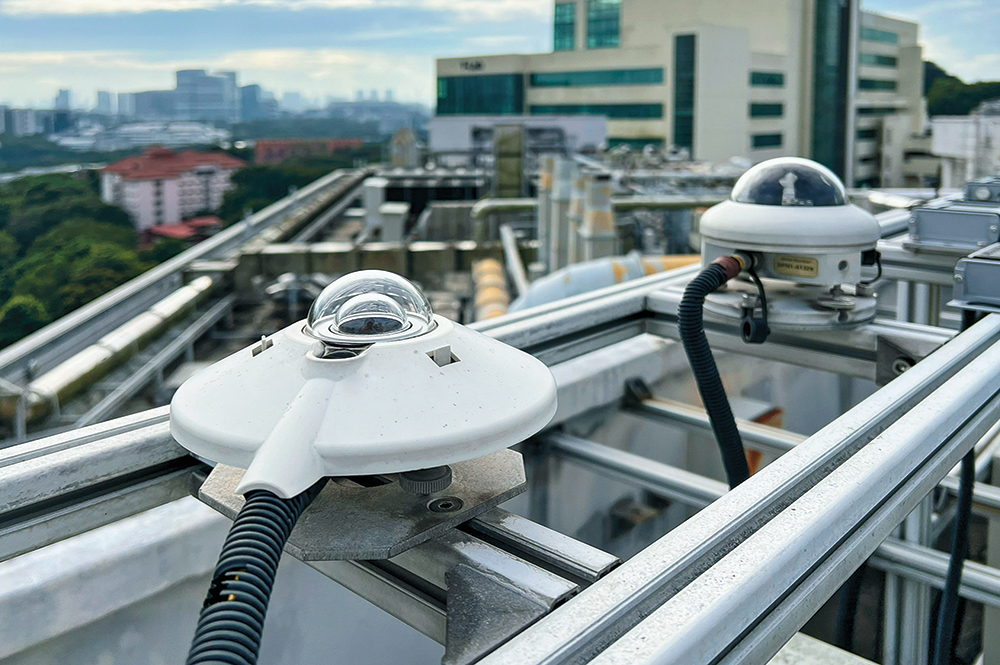
NUS’ Solar Energy Research Institute of Singapore (SERIS) has developed a model capable of accurately predicting the country’s solar irradiance — the amount of light energy received from the sun — up to 24 hours in advance. By collecting and aggregating data from various sources, including irradiance sensors installed island-wide, satellite imagery and machine learning algorithms, the model was found to have an average error rate below 10 per cent for one-hour forecasts.
Following SERIS’ successful year-long trial of the model, EMA plans to adopt it later this year as part of a broader strategy to boost the reliability and resilience of Singapore’s power grid. Anticipating solar power output ahead of time could increase its share of the energy mix, allow power generation plants to adjust their output accordingly (e.g. lowering output on a sunny day), and better match electricity supply with demand.
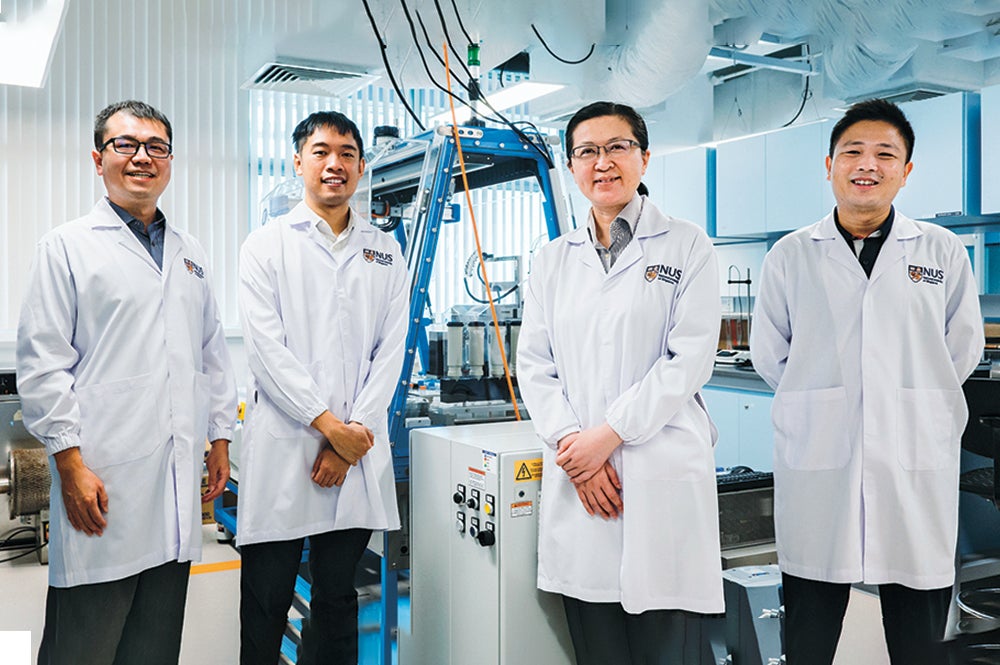
Professor Liu Bin (Science (PhD) ’01) is the Director of CHI, which commenced operations in July 2022. “Through the new Centre, we aim to advance hydrogen-related R&D in Singapore to solve high-value problems that can significantly bring down the cost of green hydrogen as a fuel. At the same time, we will provide talent training for both academia and industry to grow the pool of hydrogen-related researchers, as well as upskill the workforce to prepare Singapore for a hydrogen economy,” she said upon CHI’s opening. A member of the University Sustainability and Climate Action Council, Prof Liu also oversees NUS’ sustainability research cluster in her capacity as Senior Vice Provost (Faculty & Institutional Development).
Through the new Centre, we aim to advance hydrogen-related R&D in Singapore to solve high-value problems that can significantly bring down the cost of green hydrogen as a fuel.
Prof Liu Bin, Director, Centre for Hydrogen Innovations, NUS
In related news, a team led by Associate Professor Xue Jun Min from CDE’s Department of Materials Science and Engineering is making waves in the global scientific community for having devised a revolutionary technique of extracting hydrogen from water. They discovered that light can trigger or enhance the catalytic activity of a nickel oxyhydroxide-based material commonly used in water electrolysis (i.e. the splitting of water into hydrogen and oxygen). “This should require less energy in the electrolysis process, and it should be much easier using natural light,” said Assoc Prof Xue on his team’s findings, which were published in the journal Nature in October 2022. “More hydrogen can be produced in a shorter amount of time, with less energy consumed.”
A GREEN FINANCE HUB IN THE MAKING
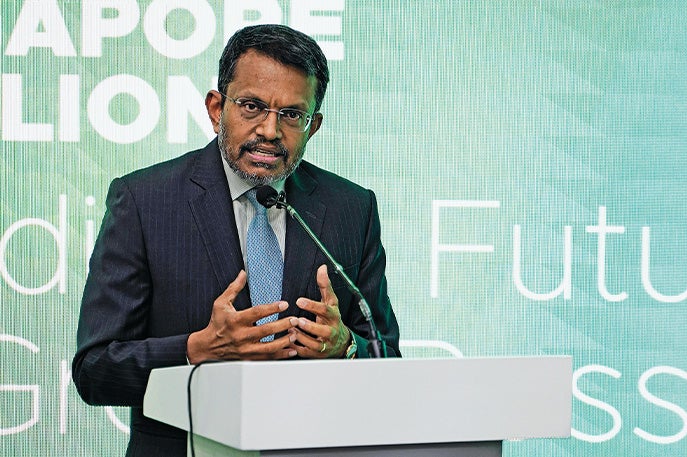
Developing and deploying decarbonisation technologies does not come cheap. According to a McKinsey report, around US$9.2 trillion per year will need to be spent globally on physical assets for energy and land-use systems to reach net-zero by 2050. Roughly one-third of that amount will need to be spent in Asia — and as a leading global financial centre, Singapore is well-placed to contribute to the effort.Speaking at the launch of the COP27 Singapore Pavilion, Mr Ravi Menon (Arts and Social Sciences ’87), Managing Director of the Monetary Authority of Singapore (MAS), outlined several measures Singapore is taking to mobilise capital and put the region on the path to net-zero. Technology plays a key role in creating “credible disclosure and transition plans”, said Mr Menon. “We must give investors confidence to invest in the transition, especially given concerns around ‘greenwashing’ [exaggerated environmental claims]. … Singapore has been contributing to international efforts towards comparable sustainability disclosures and sound climate data and metrics.”
For example, MAS is currently developing an artificial intelligence (AI) tool dubbed NovA! to help financial institutions assess the performance of companies which have taken out sustainability-linked loans. AI-derived insights would help define and track a firm’s key ESG metrics and detect greenwashing, while natural language processing would cut the time spent collecting, processing and analysing data. Once deployed, NovA! will join other MAS digital solutions in the pipeline, such as a blockchain-based registry to verify the provenance of ESG certifications, and an online marketplace connecting the global green fintech community.

US$3.1 TRILLION
Annual infrastructure investment required between
now and 2050 for Asia to meet its net-zero target.
That our planet is getting hotter is not a hunch or opinion, but an incontrovertible fact. On this point, it could be argued that Singapore has got the short end of the stick. From 1948 to 2019, Singapore’s annual mean temperature rose by about 0.25 degrees Celsius per decade — double the trend in global temperatures. In other words, climate change and global warming are happening everywhere, but Singapore is heating up twice as fast as the rest of the world. This is largely due to the urban heat island effect, which occurs when cities replace vegetation with buildings, roads and other heat-absorbing infrastructure, causing temperatures to rise. Factor in the carbon-emitting human activities in these built-up, densely-populated areas (e.g. greater use of air-conditioners and vehicles), and what emerges is a vicious circle of higher daytime temperatures, reduced nighttime cooling and higher air pollution levels.
Fortunately, climate-sensitive urban planning and design offers a solution to help mitigate or adapt to our new reality. Assistant Professor Yuan Chao from CDE’s Department of Architecture has dedicated his research to this area. “When I was a student, we talked about sustainability to ensure that there would be enough resources for the next generation. But now, we work on climate resilience, which is for the current generation, which highlights the urgency to tackle current climate issues,” said Asst Prof Yuan in an interview with NUS News. His team uses numerical simulation and field measurements to study the impact of building design and urban planning on the microclimate, such as the surrounding air temperature and wind flow. They have also developed a user-friendly Geographic Information System tool to estimate the impact of urban planning on anthropogenic heat dispersion (i.e. heat released due to human activities).
“Many people focus on combating climate change, but they often neglect the impact of urbanisation. As buildings are getting taller and cities become denser, we need to rethink our living environment and look at the joint effect of urbanisation and climate change,” said Asst Prof Yuan, who was awarded the NUS Presidential Young Professorship in 2019 for his research work. He added, “Another misconception is that we need to decrease urban density to achieve a better living environment. But through better building design and planning, we can actually increase the density and still achieve better living environments that are sustainable and resilient against the effects of climate change.”
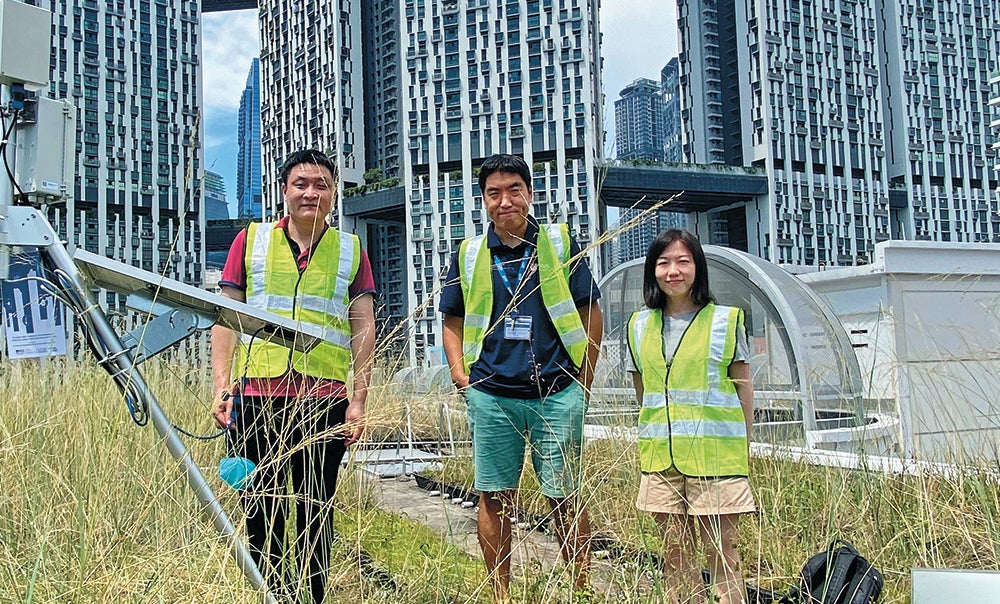
[T]hrough better building design and planning, we can actually increase the [urban] density and still achieve better living environments that are sustainable and resilient against the effects of climate change.
Asst Prof Yuan Chao, Department of Architecture, NUS
Sustainability research at NUS comprises six key pillars. In addition to nature-based climate solutions, green energy technologies and urban heat resilience (which are covered in this article), below is a quick round-up of the rest. By test-driving innovative solutions in these priority areas, NUS is set on translating new discoveries into ground-breaking technologies that could help Singapore — and other countries — meet its ambitious climate targets.
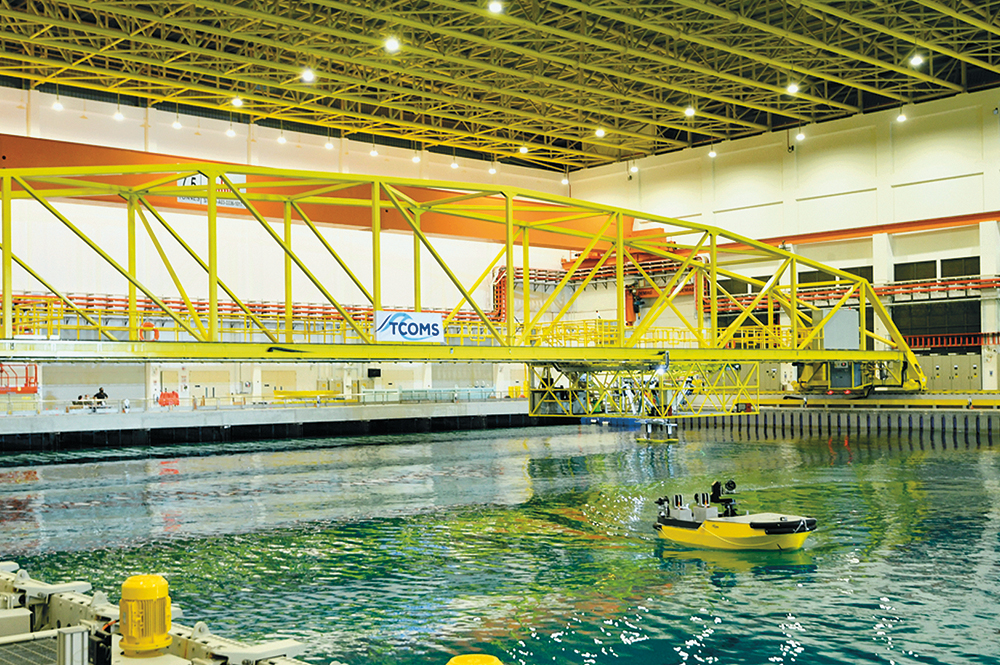
Coastal engineering and flood prevention NUS hosts the newly-opened Technology Centre for Offshore and Marine, Singapore (TCOMS), a national R&D centre and the country’s first deep-water ocean basin facility. Equipped with state-of-the-art wave and current generation systems, as well as advanced modelling and simulation capabilities, one of TCOMS’ objectives is to come up with solutions to protect low-lying areas like Singapore against flooding brought about by climate change and rising sea levels.
Water treatment and purification
A team from the NUS Environmental Research Institute (NERI) has pioneered a low-energy strategy of applying anaerobic membrane bioreactor (AnMBR) technology, which combines anaerobic digestion and membrane filtration, for municipal wastewater treatment. They are working to fully optimise the process in hopes of enhancing the appeal of municipal wastewater not only as an alternative water source, but also to produce biogas and recover nutrients.
We are in the business of making being sustainable attainable.
Mr Preston Wong, NUS alumnus and co-founder of treatsure
In the deep tech sector, Mr Bryan Oh (Business ’19) and Mr Kenneth Palmer (Engineering ’20) are co-founders of NEU Battery Materials, a start-up born out of GRIP in 2021. They aim to produce clean and sustainable lithium ion phosphate (LFP) batteries needed for EVs, with near-zero waste and minimal emissions, by bringing a patented electrochemical technology to market. Originally invented by CDE’s Associate Professor Wang Qing — who has joined the venture in an advisory capacity — the technology is believed to be the world’s first redox targeting-based solution for recycling spent LFP batteries. The company raised S$800,000 in seed funding in June 2022, and is now focused on building a pilot recycling plant in Singapore to process LFP batteries that can then be supplied back to manufacturers, hence promoting a circular economy.
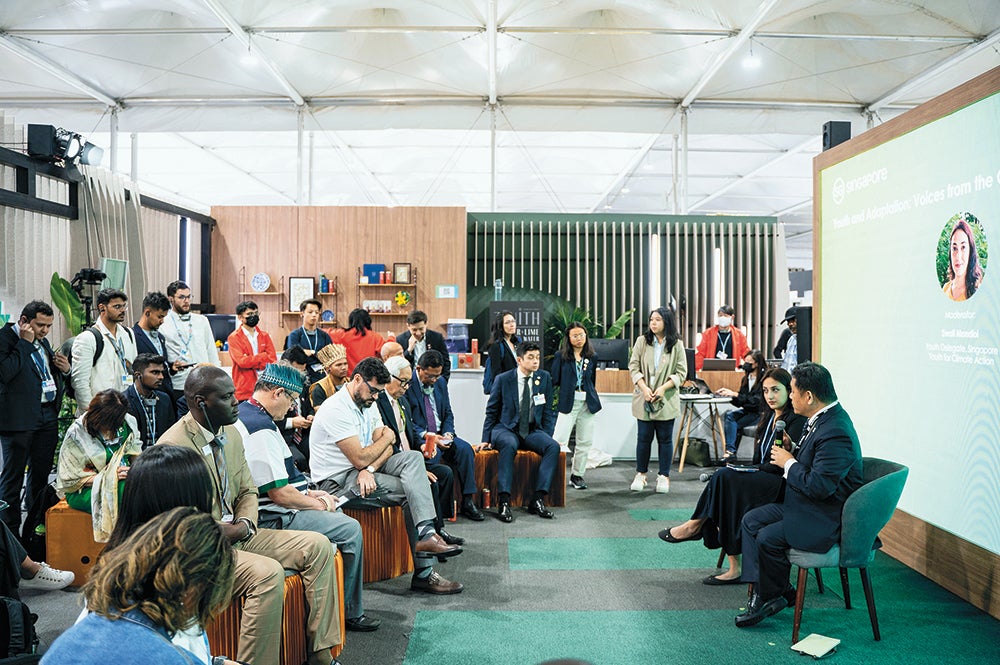

Ms Swati Mandloi, an NUS alumna, was part of Singapore’s youth delegation to COP27.
Ventures like these may fulfil the entrepreneurial passion of individuals, but more importantly, they are vital to guarantee a sustainable and liveable future. As youth activist Ms Swati Mandloi (MEM ’18), a COP27 delegate from non-governmental organisation Singapore Youth for Climate Action, told CNA during the summit, Singapore plays a strong and clear role in driving regional climate action, including “creating good carbon systems by financing projects, by decarbonising and by creating demand for certain energy solutions and technologies”. It may be too late to prevent climate change, but such innovations can help us avoid the worst impacts. The climate clock is ticking.
Photo of Ms Swati Mandloi by COP27 SG Pavilion
-
How NUS is Redesigning Undergraduate Education in the Age of AIAs generative AI transforms how we learn, work and think, NUS is taking a bold a... -
NUS: Reprogrammed for TomorrowIn just three years since the launch of ChatGPT, NUS has launched ambitious prog... -
Vox Alumni: Artificial Intelligence at WorkWith artificial intelligence poised to change the way we work, we asked alumni a...