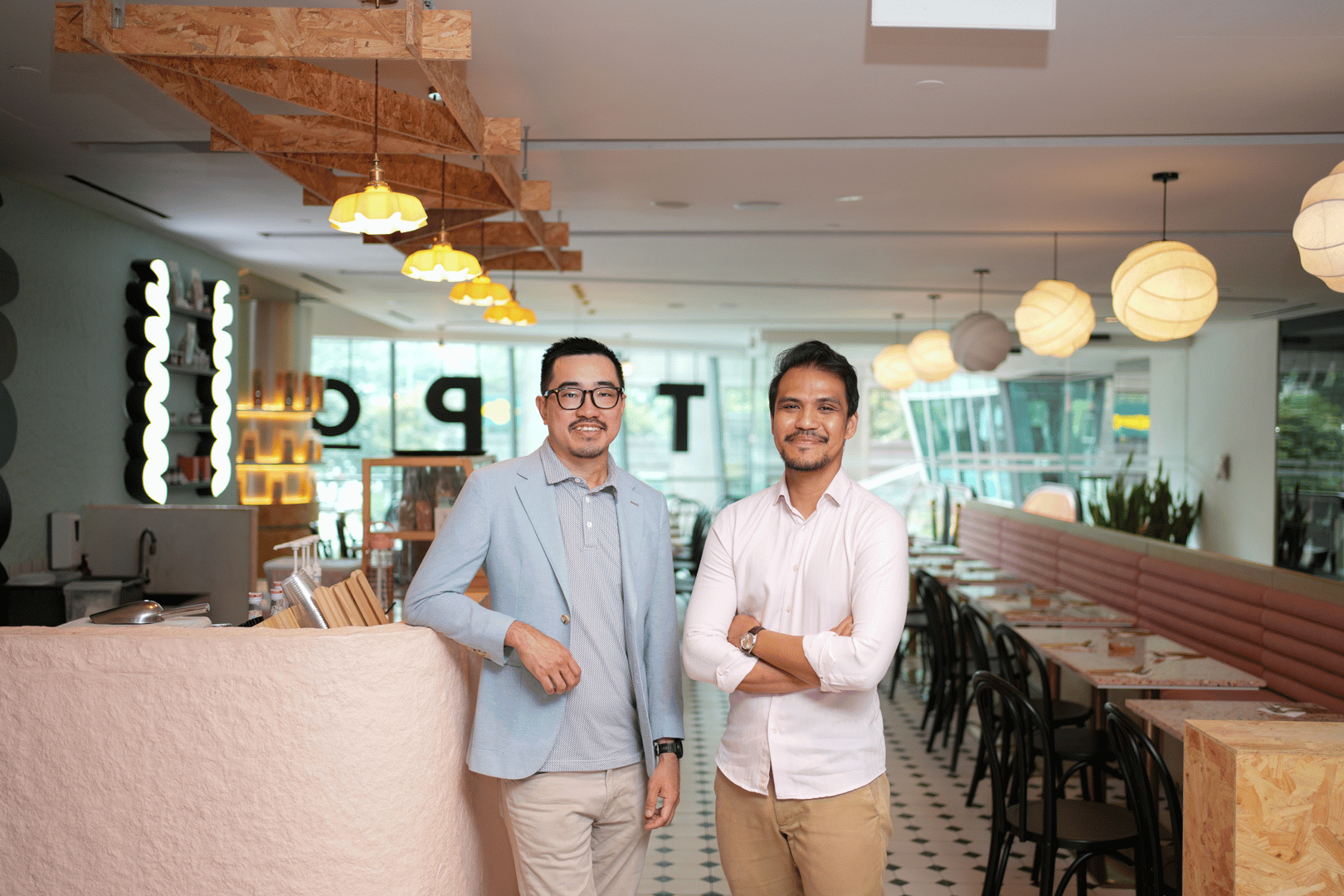
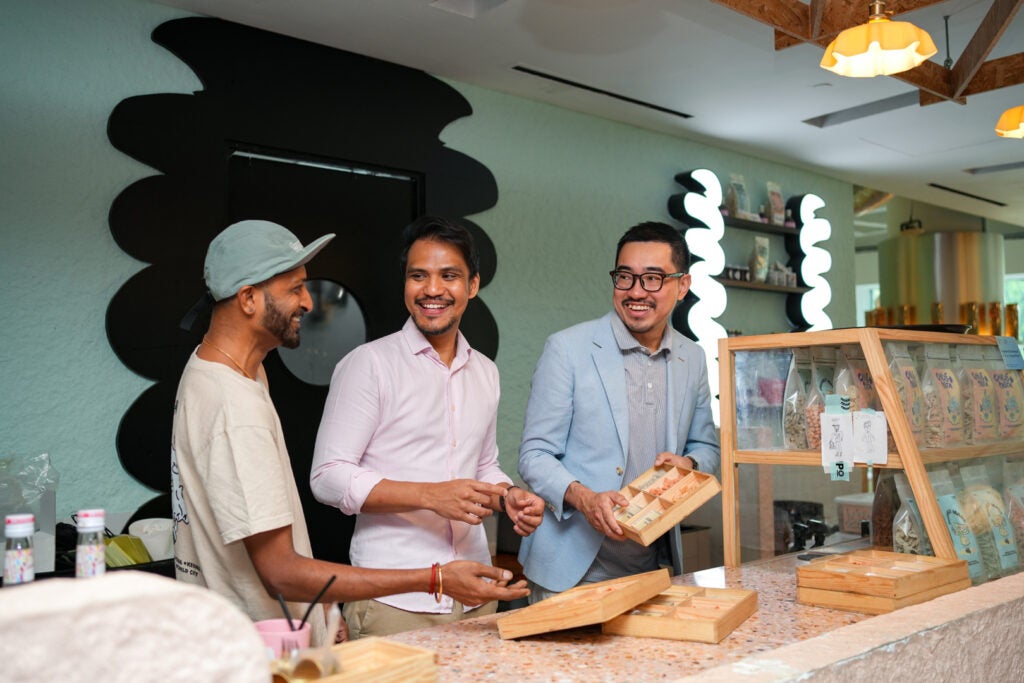
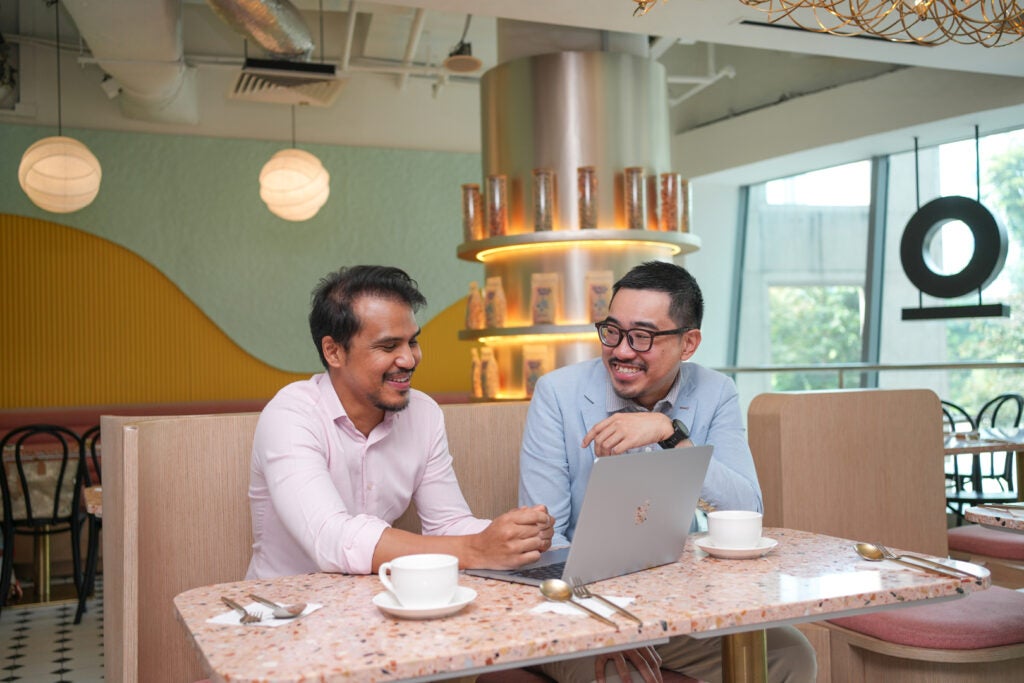
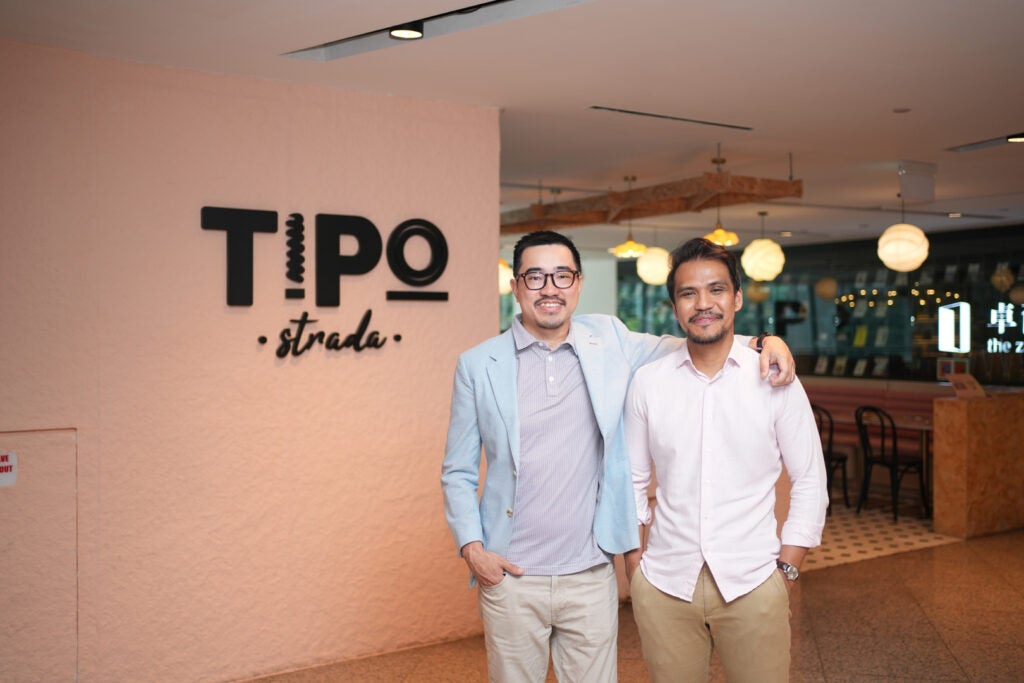
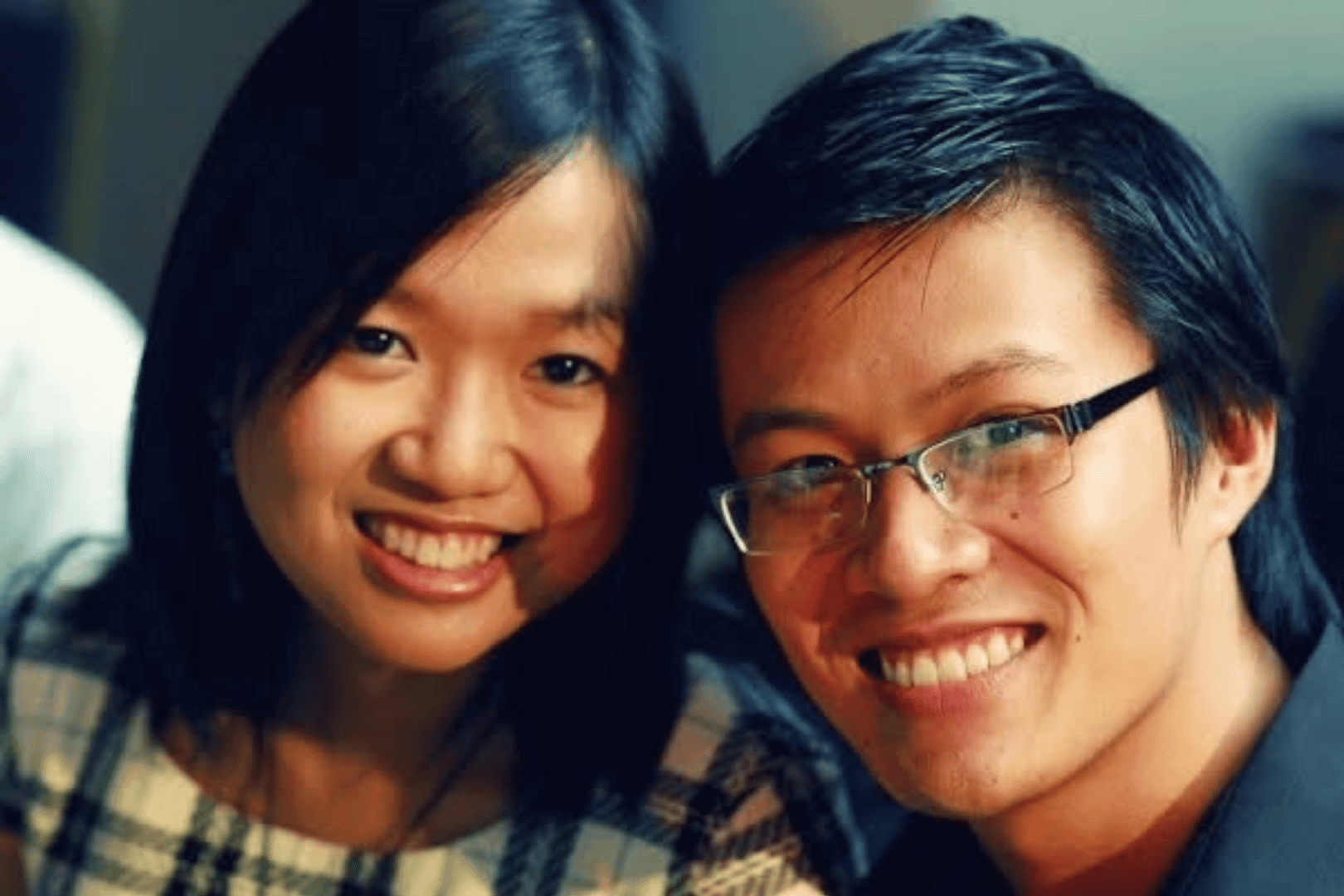
When Mr Calvin Seah (Business ’08) arrived at Tipo Strada at Wheelock Place for this interview, Mr Mustaffa Kamal (Arts & Social Sciences ’08) turned up a few minutes later carrying an extra blazer.
It was an unremarkable gesture between old friends. One slipped on a light blue jacket over his shirt; the other wore pale pink. The pair ended up colour-coordinated, prompting jokes before the interview had even begun. They spent the next hour teasing each other about junior college antics too incriminating to repeat, and whose job it was to keep the other grounded.
The jokes come easily. The victories no longer do.
Fourteen years after founding The Black Hole Group (BHG), the F&B company behind halal-friendly concepts including the Tipo brand of Italian eateries, Small Batch café and burger bar Working Title, the two alumni no longer measure success by expansion. “Surviving is winning,” says Mr Mustaffa simply.
It is not the answer either man might have given when they graduated from NUS in 2008. Back then, they were two friends eager to realise their dreams. Today, they are, in Mr Seah’s words, “bruised, battered… not yet broken”, still trying to steer the company through one of the toughest periods Singapore’s F&B industry has seen.
THE FIRST PROJECT
Their partnership began long before there was a company.
They met as classmates at Catholic Junior College, where football was the common language of a close-knit group of boys. In their second year, disappointed that the school had not organised an inter-class football tournament, the 17-year-olds decided to run one themselves.
They recruited classmates, persuaded students to referee matches, collected entry fees to fund prize money, produced daily match reports and filled the grandstand for the finals.
Looking back, they recognise it as the first project they ever built together. “We worked well together,” Mr Seah recalls. “We didn’t know then that it would lead to us working together at this stage.”
After National Service, their paths diverged but rarely drifted apart. Mr Seah read business administration at NUS while Mr Mustaffa studied psychology. Their circle of friends expanded, but the friendship endured. Then, several years later, Mr Mustaffa called Mr Seah for lunch.
A LEAP INTO THE UNKNOWN
Mr Mustaffa had begun to look beyond his government career, keen to pursue new ideas and leadership opportunities. A backpacking trip through the United States planted the idea of opening a hostel, but he had no business experience.
Mr Seah did. Then running his own events management company, he knew how to turn an idea into a business. It took no longer than a conversation over teh and prata to make up his mind.
“I told him I wanted to start a hostel,” says Mr Mustaffa. “He said, ‘Okay, let’s do it!’”
It never occurred to either of them to question whether friendship and business should mix. “The trust was already there,” Mr Seah says. “Even having that doubt to start with would have been a red flag.”
GUTS AND GUMPTION
Money was scarce. Their competitive advantage was their resourcefulness.
Unable to afford furniture, the duo scavenged discarded tables and crates, sanded timber, varnished surfaces and built much of the furniture themselves. They taught themselves carpentry, plumbing and coffee-making — all in an era before Carousell, Taobao and YouTube tutorials.
“We can do everything,” says Mr Mustaffa. “From painting the premises and creating playlists to branding, copywriting and website design.”
That approach later became one of their greatest strengths. Understanding every layer of the business, from strategy to the smallest operational detail, would later prove essential in an industry as demanding and fast-moving as F&B.
THE UNEXPECTED BATTLE
If the early years were characterised by optimism, the years that followed replaced idealism with hard-earned pragmatism.
The industry was already grappling with rising costs and labour shortages before COVID-19 upended everything. The lockdowns broke many businesses and, Mr Mustaffa adds, “are still breaking” others. They launched restaurants, but they also had to close them. They learnt that sometimes the bravest decision was to walk away.
Shuttering Working Title Riverside meant accepting losses approaching half a million dollars, yet both now see it as wisdom rather than failure. “It sounds counterintuitive,” says Mr Mustaffa. “But sometimes you lose half a million dollars and feel relief in being able to move on.”
The financial losses, however, are only part of the story. What hurts more, Mr Seah says, is believing wholeheartedly in an idea only to discover the market has shifted beneath your feet. “The things that used to work don’t work now.”
They launched Tipo, only to see more pasta concepts emerge. A winning formula in one location could falter in another.
It is why both men repeatedly describe entrepreneurship not as a triumph but as a campaign. They speak of battles, rescue missions and surviving another month.
Even after hiring a chief executive to lead the company last year, both founders eventually had to step back into operational roles when conditions demanded entrepreneurial instincts that could not simply be delegated.
PARTNERS AT WORK
The demands of operating a business together have changed their friendship. “There are days I ask myself, ‘Is he my friend today? Is he my business partner? Or is he my CEO?’’’ says Mr Seah.
The boundaries have blurred so much that even holidays become strategy sessions. A leadership retreat in Vietnam involved boardroom meetings in the morning, lunch by the beach, foot massages in the evening — and conversations about work throughout.
Rather than resisting that reality, they have learnt to accept it. What has evolved instead is a deep trust that comes from weathering crises together.
Early disagreements stemmed from trying to solve every problem together. Over time, they learnt to divide responsibilities according to their strengths.
Mr Mustaffa, grounded in psychology, gravitates towards people, company culture and long-term vision. Mr Seah, practical and unsentimental, oversees operations, logistics and finance. They weigh in on each other’s decisions but respect each other’s final call.
Mr Mustaffa has come to appreciate their complementary natures. “Long-term vision without short-term pragmatism would lose its bearings,” he says. “If you cannot survive today, tomorrow or next year, how can you talk about long-term plans?”
WHAT REMAINS
The company they imagined at the age of 25 is not the company they run today. Neither are they the same founders.
Mr Mustaffa still says he would do it all over again, armed this time with experience. What gives him the greatest satisfaction is seeing how ideas once discussed over prata have become part of so many people’s lives, from students to celebrities and politicians. Prime Minister Lawrence Wong, former President Halimah Yacob, and football legend Fandi Ahmad and his wife Wendi Jacobs have dropped by BHG’s restaurants.
Tellingly, Mr Mustaffa never misses the opportunity to point out that Mr Seah graduated with a CAP of 3.48 — just shy of Second Class Honours (Lower) — before building one of Singapore’s most recognisable halal-friendly dining brands. It has become a running joke between them , but it also reflects something both have come to believe: university grades are only one measure of achievement.
Mr Seah, however, is less certain he would make the same decision, at least when it comes to building an F&B business on this scale. Fatherhood has shifted his perspective on where to dedicate his time and energy.
Yet there is one reminder he carries with him every day. Tattooed across his arm is the logo of Working Title, the café that has since closed. It commemorates the friendships, the setbacks, the struggles and the chapter it represents in their lives.
Markets change, and restaurants open and close. The partnership, however, has already outlasted every concept they have created.

Photos by Zhiwei Chen. Main photo: Mr Calvin Seah (L) and Mr Mustaffa Kamal (R).
-
Building Careers, Community, and a Boxing GymThe AlumNUS catches up with campus couple Ms Yumi Nguyen (Science ’09, MBA ’... -
The Matchmaker: Connecting People, Technology and Opportunities“Matchmaker” is how London-based Ms Sarita Bahety (MPP ’10) uniquely descr... -
Just Keep Thinking: On Staying Curious and Making Science Go ViralFrom corals and climate change to food and Pokémon, Ms Kong Man Jing (Science '...