A quick glance at any world map reveals obvious disparities — and, from the perspective of small states like Singapore, a level of discomfort. Small states are naturally precarious.
Yet, they succeed. Take any number of global economic metrics of success in which the leading countries or territories are overwhelmingly diminutive. In GDP per capita, for example, Singapore—with only five million people—ranks third in the world. This is one reason our island republic draws admiring assessments from international media. Last year, The Economist called Singapore a “beacon of prosperity”. A quick Google search for “Singapore economic miracle” reveals just how widespread this idea has become. But this success is at risk of being overturned by great power manoeuvring.
With the United States and China locked in an escalating rivalry, Singapore finds itself having to navigate the treacherous crosscurrents of great power competition. Singapore’s survival and prosperity have always drawn on a stable, rules-based world order — an order that now appears to be fracturing. For Singapore, this is not just a distant academic debate; it is an existential challenge that permeates every facet of its foreign and economic policy, as underscored in statements by Singapore Prime Minister Lawrence Wong and Senior Minister Lee Hsien Loong.
Singapore’s trade-to-GDP ratio exceeds 300%, making it a canary in the coalmine of global trade. Prime Minister Wong referenced this in a recent interview with the Financial Times, where he reiterated that increased US-China tensions are unfavourable for trade-dependent Singapore because they undermine regional stability and disrupt global trade networks.
SHIFTING ORDER
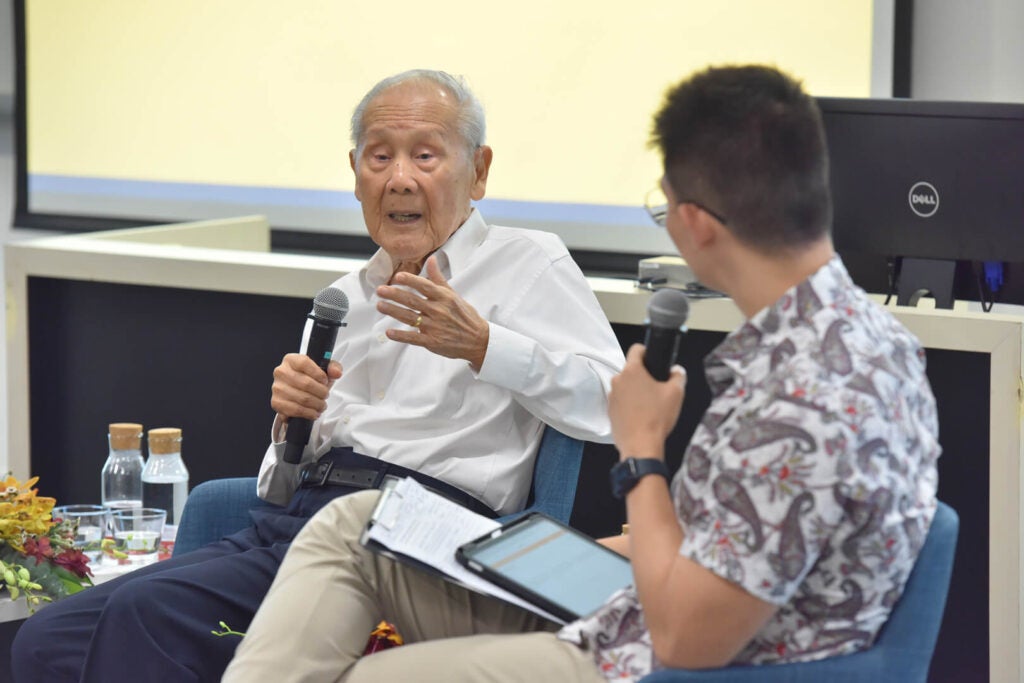
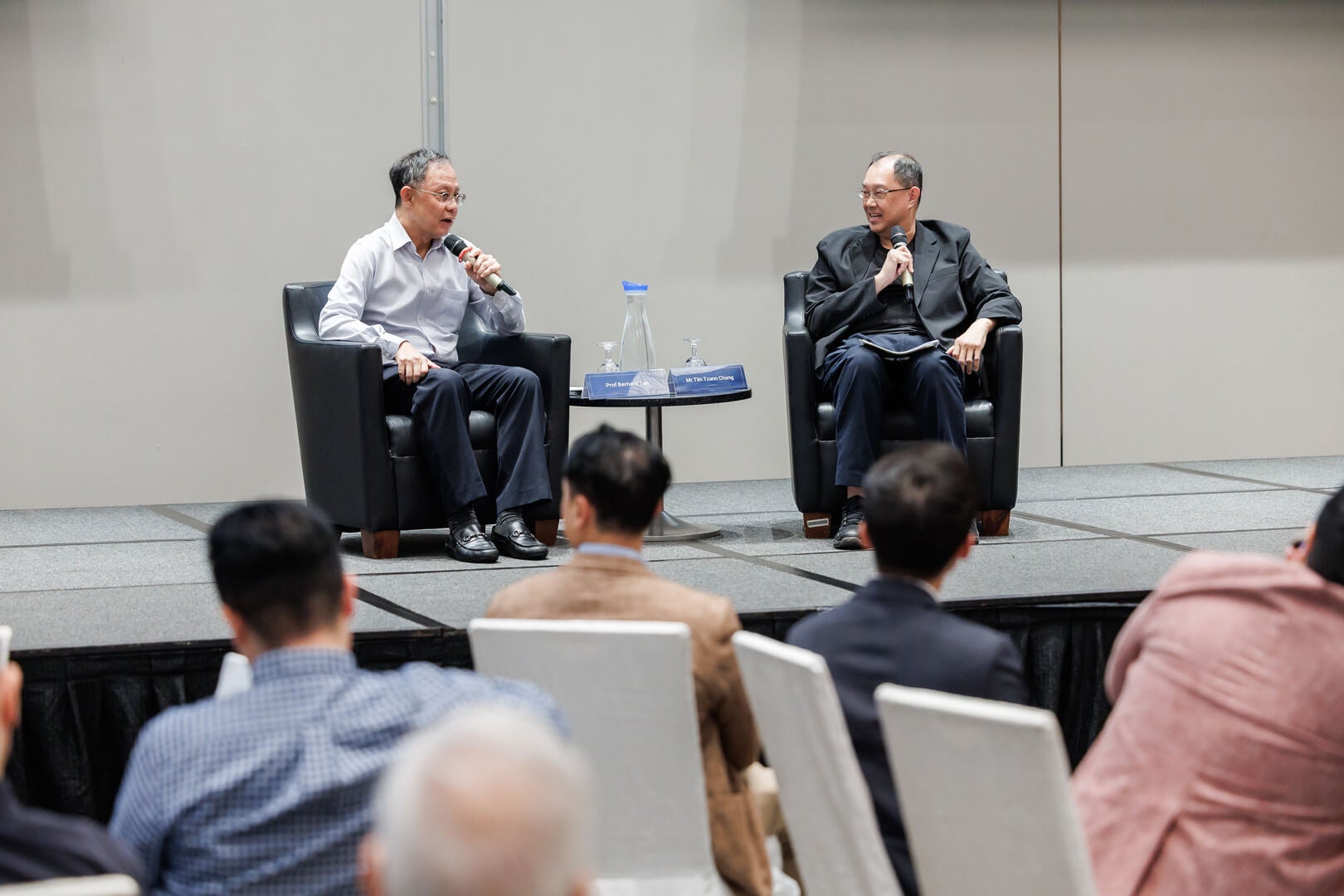
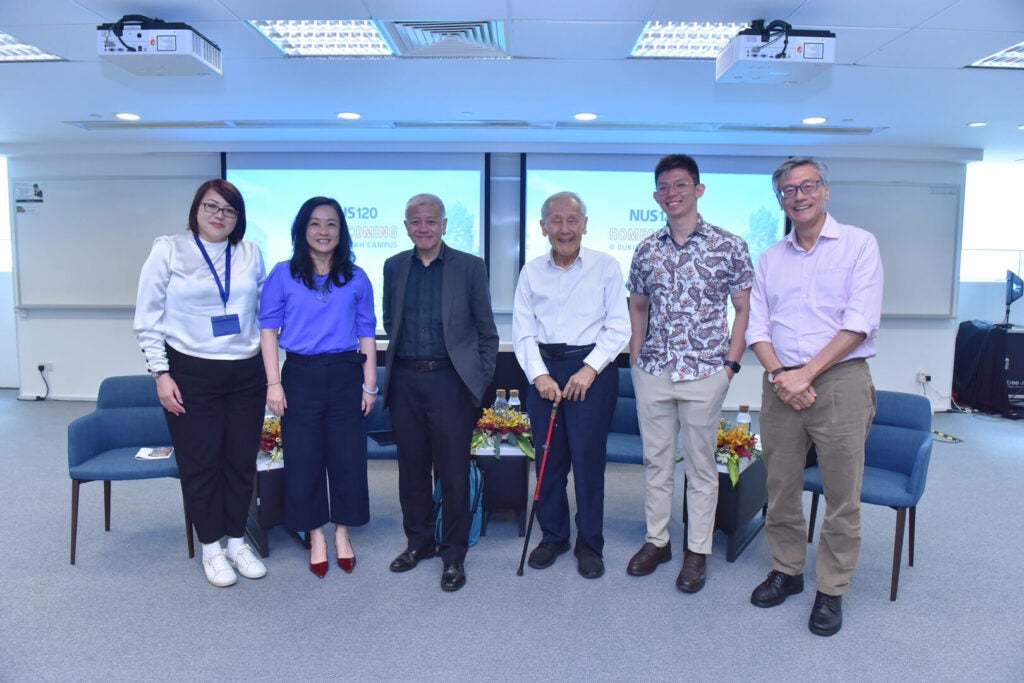
Given the importance of this subject, the NUS120 Homecoming panel on “Singapore in a Shifting Global Order: Economic Ambition and Geopolitical Realities,” was particularly germane. Held on Saturday, 20 September 2025, the discussion explored the historical context of the contemporary reality we all share and suggested a few potential paths forward for Singapore and the region. The panellists included University Professor Wang Gungwu (Arts ’53, MA ’56, HonDLitt ’22), Professor Danny Quah, Li Ka Shing Professor in Economics at the Lee Kuan Yew School of Public Policy (LKYSPP), and Associate Professor Selina Ho (Arts & Social Sciences ’94), Vice Dean (Research and Development) and Dean’s Chair at LKYSPP. Mr Keith Yap (Yale-NUS ’21, MPP ’21) served as moderator.
The city-state’s predicament is how to maintain its sovereignty and economic vitality when the two powers most critical to its success increasingly demand that other nations choose a side. Prof Quah reminded the gathering of the joke that perhaps the powers should not press the question too hard, lest they receive answers they will not like. Assoc Prof Ho went further, asserting that Singapore need not choose a side but actively choose to work with a variety of partners based on its national interest. Prof Wang offered perhaps the starkest take of all: “The world order is now based on two things: wealth and power,” he said. “Singapore’s success came out of the fact that from the very beginning, it recognised that its future lay in becoming a global city. Very soon after Singapore became independent, they saw they had no future in this region unless they operated globally.”
In fact, Singapore’s geopolitical position has been a masterclass in strategic hedging, a multi-layered approach that combines deep economic ties with China, a robust security partnership with the US, a strong commitment to regionalism through ASEAN, and a credible domestic deterrent. During the panel discussion, ASEAN’s role came up repeatedly.
FRIEND TO ALL, ALLY TO NONE
At the core of Singapore’s foreign policy is a pragmatic refusal to choose between what Prof Wang called two empires, one centred in Washington and the other in Beijing. This position, however, is becoming more costly and difficult to maintain. As NUS Associate Professor Chong Ja Ian argues in his article “Great Power Competition in Small States: The Case of Singapore,” published in Asian Perspective, maintaining this stance “depends on two key conditions: that Singapore does not have intractable and indivisible differences with both major powers and that a significant overlap in interests exists between the United States and China”. As that overlap shrinks, Singapore’s diplomatic space narrows.
Prof Quah acknowledged this, explicitly endorsing the idea that Singapore’s economic statecraft might evoke the national security strategy that has evolved from the defensive “poisonous shrimp” concept of its early years to the more agile “dolphin strategy” proposed more recently. A dolphin, he explained, is “agile, intelligent, and builds networks”, navigating dangerous waters collectively — just as Singapore must do with other like-minded small states. He stressed that smaller nations overwhelmingly desire three things: “a level playing field, peaceful dispute resolution and cooperation on the great global challenges.”
BUILDING RESILIENCE
Recognising its extreme vulnerability to external shocks, Singapore has implemented a comprehensive strategy to bolster its economic resilience. The government has openly warned of the “weaponisation of economic tools” and is actively working to mitigate these risks. “Economically, everything is in disruption,” said Prof Quah. “It is very difficult to make long-term economic decisions — trade, investment, growth and governance — in such an environment. Yes, there are grand visions for world order, but I think for today, 2025, all we want is a bit of stability.”
In a world beset by uncertainty, Singapore’s stability, rule of law, and pro-business policies make it an increasingly attractive hub for finance and commerce. As geopolitical tensions rise, “connector countries such as Singapore are playing an increasingly crucial role,” reported The Business Times in 2024. Capital and talent flow to Singapore, further solidifying its status as a pivotal financial centre —a role it zealously guards.
In pursuit of this now much-needed stability, Singapore has aggressively pursued a web of Free Trade Agreements (FTAs). According to SG101, it has inked 26 such agreements that allow Singapore-based firms preferential access to markets representing over 85% of global GDP. It is a key member of both the Comprehensive and Progressive Agreement for Trans-Pacific Partnership (CPTPP) and the Regional Comprehensive Economic Partnership (RCEP), placing it at the heart of the world’s two largest trading blocs.
ASEAN SHIELD
Of course, the Homecoming panellists are not alone in pointing out that as a small state, Singapore knows it cannot stand alone. What is novel here, in the context of the contemporary geopolitics of the region, is ASEAN. Singapore’s foreign policy is therefore anchored in the principle of “ASEAN centrality,” as Assoc Prof Ho pointed out. The Association of Southeast Asian Nations (ASEAN) acts as a diplomatic force multiplier, allowing Singapore and its neighbours to address great power competition collectively. By championing a strong, unified ASEAN, Singapore seeks to prevent Southeast Asia from becoming a battleground for external powers, according to Eurasia Review.
However, ASEAN’s internal divisions often blunt its effectiveness, with member states sometimes leaning towards either Washington or Beijing. This inconsistency weakens the bloc’s collective bargaining power and represents a significant challenge for Singapore’s strategy. Both Prof Quah and Assoc Prof Ho agreed that ASEAN is not perfect, but the grouping has a lot to offer despite its limitations and has made an impact on the global stage, as evidenced by the July 2025 meeting in Kuala Lumpur, Malaysia.
Assoc Prof Ho argued that as the world enters a protracted period of instability in the transition to a multipolar reality, Singapore cannot be passively neutral. Instead, she proposed three key strategies:
- Active Choosing: Singapore must proactively make choices based on its national interests, working with different partners on different issues, rather than being forced into a binary choice between the US and China.
- Upholding Multilateralism: A rules-based international order and free trade agreements like the RCEP and CPTPP remain the best protection for small states.
- Strengthening ASEAN: Assoc ProfHo presented compelling survey data showing that regional elites see ASEAN as the most influential and relevant organisation for their future. She stressed that a resilient and integrated ASEAN is crucial for collective strength and stability.
Ultimately, diplomacy and economics are backed by hard power. The nation invests heavily in the Singapore Armed Forces (SAF), maintaining the most technologically advanced military in Southeast Asia. This formidable defence capability is not for aggression, but to ensure that the cost of any potential attack would be prohibitively high, thus guaranteeing its sovereignty.
THE NARROWING PATH FORWARD
For decades, Singapore has masterfully navigated the complexities of global politics. Its leaders have successfully balanced pragmatism with principle, securing a level of prosperity and stability that is the envy of the world. Yet, the path forward has grown fraught and narrow. The intensifying US-China rivalry is testing the limits of Singapore’s traditional strategies.
The city-state’s ability to continue its delicate balancing act will hinge on its agility, the cohesion of ASEAN, and its capacity to remain economically and strategically indispensable to both giants. Singapore’s journey is a powerful lesson in how a small state can use its wits, wealth, and strategic foresight to not only survive but also shape its own destiny in a world of titans.
-
In Service to ManyA surgeon, educator and president of the Medical Alumni Association, Dato’ Pro... -
How NUS is Redesigning Undergraduate Education in the Age of AIAs generative AI transforms how we learn, work and think, NUS is taking a bold a... -
120th Pharmily Homecoming CarnivalThe 120th Pharmily Homecoming Carnival held on 13 December 2025 was a beautiful ...