“Who is Radin Mas?” isn’t a question most Singaporeans stop to ask. For many, it’s just the name of a quiet housing estate in the south of Singapore. But for playwright Mr Titus Hutch Jr. Yim (Arts & Social Sciences, Class of 2026) and performer Ms Chermaine Kumar (Arts & Social Sciences ’16), the story is an important chapter in their creative journeys, as The AlumNUS discovers.
Titus, you’re still a student, and Chermaine, you graduated almost a decade ago. Tell us about where you are in your journeys now.
Titus: I’m in my final year of psychology. I used to be a double major in Theatre Studies, but now I’m minoring in Life Sciences and focusing on writing. I’ve been in Mandarin theatre since primary school, actually. I was lucky to be mentored by teachers from Shanghai Theatre Academy — they really shaped the way I think about language and storytelling.
Chermaine: I was from NUS Social Work. But I’ve always done theatre — since I was two years old, actually! In NUS I joined the Chinese Drama CCA because it felt warm and communal. I worked as a hospital social worker for five years before deciding last year to go into acting full-time.
Tell us about your upcoming production, Radin Mas, Who?
Titus: This was commissioned by the Singapore Chinese Cultural Centre (SCCC), who wanted to do a play about Radin Mas, a princess of the Javanese Royal Court. Her name literally translates to ‘Princess of Golden Beauty’. One thing we found interesting was that Radin Mas was a migrant in some sense — she came from Java with her father and started a new family here. We thought those struggles were relatable not only to us but also to the migrant worker community.
Chermaine: They were looking for a migrant worker to cast, and in the last year, I’ve always been cast as a maid, so I thought, okay, I’ll try. I used to work in a hospital with many nurses from Myanmar, the Philippines and Malaysia, and I really resonated with their stories. They take care of our families here but worry about their own families back home.
Titus, tell us about the stories you are drawn to?
Titus: I have a journal, and every time I come across a person who has an interesting story or a newspaper article about something that is out of the norm, but thought-provoking, I will write it down. And I think those are the kinds of stories that I want to tell.
Chermaine, what made you take the leap from social work to acting?
Chermaine: It was scary, honestly. It’s always scarier to have no salary than to give one up. But I realised that I feel more alive on stage than anywhere else. For years, theatre was something I did on the side — community plays, small parts. Then one day I told myself: it’s now or never. Social work will always be there. But if I don’t try acting now, I might regret it forever.
Titus, why did you choose to use comedy to tell this story?
Titus: We wanted to make Mandarin accessible. There’s this notion that it’s very serious, it’s very difficult, very archaic, and I think we wanted to use comedy as an entry point — to make it inclusive to families. So if there’s a joke the grandparents understand, then that could bring conversations between the grandparents and the grandchildren as well.
What’s the difference between working in English and Mandarin theatre?
Titus: Language shapes how a story breathes. Mandarin is image-rich — it evokes rather than just describes. That changes how a play feels. In English theatre, the language tends to be more direct. In Mandarin, there’s space for imagery, rhythm and silence to do the work.
Chermaine: And it also changes the people. In Chinese drama, the vibe is different. It’s very communal, warm, familial. Even the way we address each other is different. In English theatre it’s more casual. In Mandarin, there’s a kind of hierarchy but also a lot of care. I don’t know how to describe it, but it just feels like family.
What do you hope audiences take away from this production?
Titus: I think it’s about creating a space where people can come together — across generations, across different backgrounds — and just enjoy the story.
Chermaine: I hope they come with open hearts. Maybe they’ll see something familiar in a new way. Maybe they’ll hear a story they haven’t really listened to before.
SO WHO WAS RADIN MAS, REALLY?
According to legend, Radin Mas Ayu was the daughter of a warrior prince from Java. Radin Mas Ayu and her father fled to Singapore to escape persecution and settled in a village in Telok Blangah, where her father’s bravery in defending the community earned him the respect of the Sultan of Singapore. Over time, Radin Mas Ayu became a beloved figure in the area, symbolising strength and compassion. Her tomb, known as Makam Puteri Radin Mas or Keramat Radin Mas, is located at the foot of Mount Faber, near the junction of Mount Faber Road and Telok Blangah Road.
Source: ROOTS
Radin Mas, Who? will be performed at the Singapore Chinese Cultural Auditorium from 14-23 November 2025. Tickets are available online.
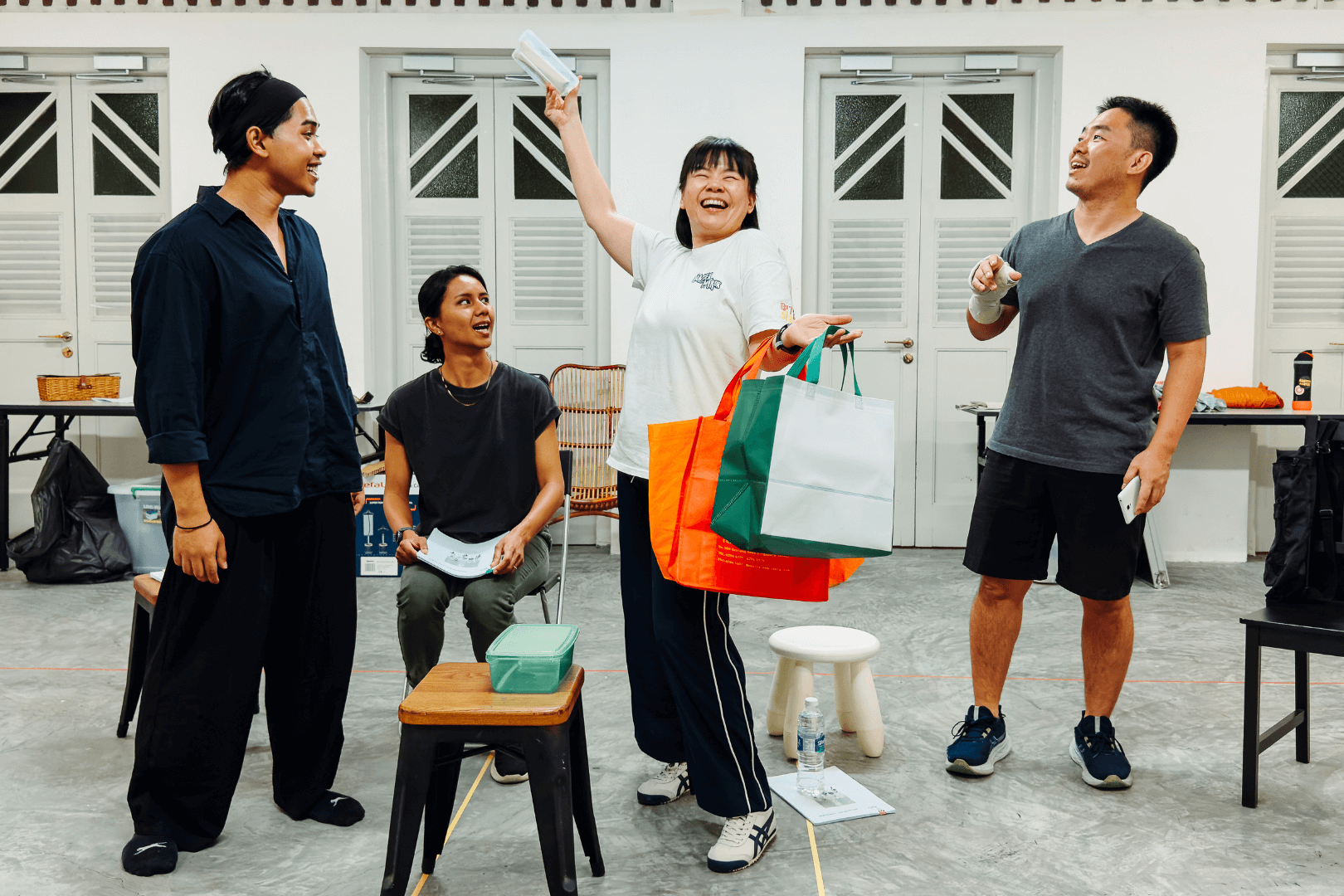
Main photo, from left to right: Sim Kee Joo (KJ), Chermaine Kumar, Sharon Mah and Lyle Yeo.
-
A Feast of Perspectives for Hari RayaAcross continents and time zones, three NUS alumni share a snippet of how they c... -
Love Unscripted: Andy & CherylCast as Mary and Joseph in a 1987 Christmas performance, Ms Cheryl Ng (Arts &... -
More Than A Business PartnerAs love and business intertwine, Ms Desiree Chang (Arts & Social Sciences ...