UNIVERSITIES IN THE AGE OF AI
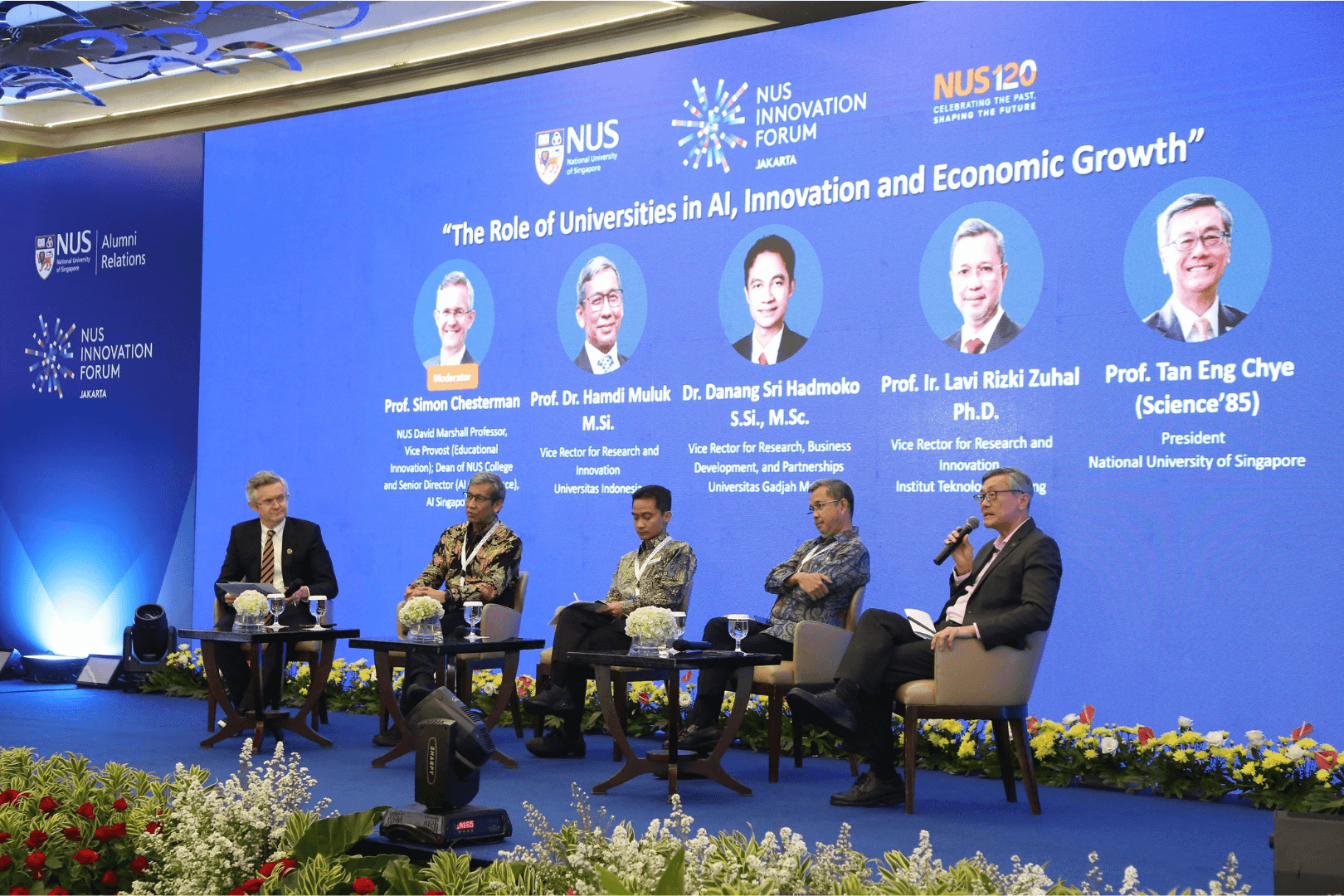
The Rectors’ Panel — featuring Professor Hamdi Muluk from Universitas Indonesia, Dr Danang Sri Hadmoko of Universitas Gadjah Mada (UGM), Professor Lavi Rizki Zuhal of Institut Teknologi Bandung (ITB) and NUS President Professor Tan Eng Chye (Science ’85) — tackled the harder, underlying issue: what is the purpose of a university when machines can already perform so many tasks that academics once thought are exclusive to humans? Moderated by Professor Simon Chesterman, NUS Vice Provost (Educational Innovation) and Dean of NUS College, the discussion went beyond technological disruption to examine the future of learning itself.
Early in the discussion, Prof Tan spoke candidly about the “tremendous opportunities and risks” presented by AI. To illustrate the speed and scale of change, he pointed to DeepMind’s breakthrough in protein folding, which modelled more than 200 million proteins in a single sweep — a feat that would otherwise have required “more than a billion PhD-years”.
Such leaps, he noted, show just how dramatically AI can supercharge scientific discovery. They also reveal how quickly universities must adapt. At NUS alone, 134 faculty members were hired over the past two years; 27 are AI specialists, and another 53 incorporate AI into their research. “It shows how pervasive AI has become, transforming all disciplines” he said.
Yet he also warned of a quieter academic danger: students using AI to avoid thinking rather than deepening their cognitive skills. He highlighted four risks — cognitive offloading, never-skilling, mis-skilling and de-skilling — that universities must actively guard against. “Learning must remain effortful,” he said. “AI cannot replace the process of thinking.”
From the Indonesian institutions came a shared recognition that AI is not just a technological development but a philosophical shift. Prof Zuhal believes that current trends demand a rethink of curriculum design. ITB has already overhauled its programmes with the aim of preparing students to work alongside intelligent systems. “We cannot keep teaching the way we were taught,” he said. Many lecturers, he acknowledged, still resist AI because “they think their own brains still function”. But he added that that doesn’t take away a fundamental truth: that educators need to be skilled in AI, simply because students are.
Dr Hadmoko emphasised the need for applied, cross-disciplinary research—particularly at the intersection of human behaviour and technology. UGM is increasingly pairing computer scientists with experts from diverse domains such as psychology, engineering, medicine, pharmacy, and the social sciences. This approach ensures that AI tools are not only technically robust, applicable across sectors, and responsive to real stakeholder needs, but also socially grounded. He also highlighted an important structural reality: AI research is inherently expensive. Cloud-computing costs alone can exceed the annual operating budgets of some faculties, and very few universities in the region can independently sustain large-scale modelling efforts. Consequently, multi-stakeholder collaboration is no longer optional but essential. Dr Hadmoko stressed that shared supercomputing infrastructure, joint research clusters, and industry-supported innovation centres are becoming critical pillars for advancing AI research and ensuring equitable access to computational power.
Prof Muluk reminded the room that AI will not only mirror humanity’s strengths, but also its vulnerabilities. He cited real cases of young people seeking emotional support from AI systems —sometimes with tragic consequences when models hallucinate, misjudge intent or offer unsafe advice. His message was clear: offline life still matters, as does physical interaction. Universities, he stressed, must invest as seriously in human resilience as they do in digital infrastructure. Community-building, peer-support systems, service learning and mental-health programmes are not peripheral — they are essential safeguards in an era where digital companionship can feel deceptively comforting. “We must equip students with wisdom,” he said. “And wisdom is not something AI can provide.”