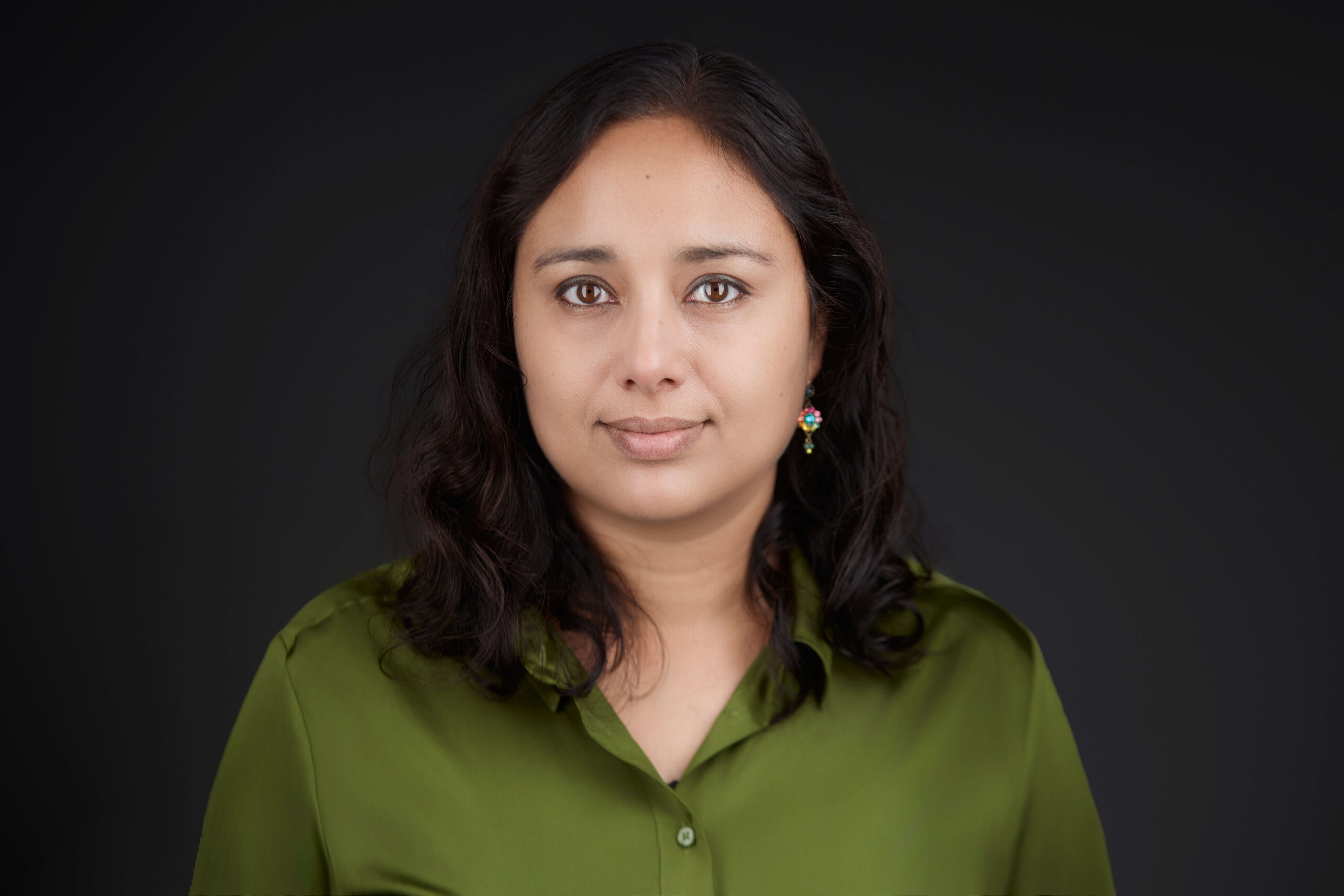
Professor Mangala Srinivas (Science + USP ’02) is the embodiment of the modern woman in STEM (Science, Technology, Engineering and Mathematics). She is one of the newly appointed chief scientific advisors to the European Commission (EC); a Full Professor and Head of the Department (Chair) of Cell Biology and Immunology at Wageningen University & Research; as well as a wife and mother of three. Professor Srinivas is the first Singaporean — and non-European Union (EU) citizen — to be appointed to the Group of Chief Scientific Advisors (GCSA) to the EC, part of the Scientific Advice Mechanism (SAM). She serves with six other advisors from varying fields for a three-year renewable term. The SAM is unique in that it is independent and provides evidence-based policy advice at the highest level of the EC.
This advisory group provides advice to the EC on science-related matters that impact the citizens of the EU, from sustainability and global warming to medical developments. “I think it’s very heartening that the EC is taking science so seriously,” she said, comparing it to other parts of the world where “there is not a lot of trust in scientists.”
The seven-member group meets every two weeks remotely for half a day, and at least four times a year with the EC Secretariat and others in the scientific network. “The seven of us are from different fields, but we don’t divide [work] according to our expertise per se,” said Prof Srinivas. The group works with several alliances of learned academies to allow access to international experts in relevant fields. Overall, the GCSA provides independent scientific evidence and policy recommendations to the EC; these Scientific Opinions are publicly available.
A LOVE OF LEARNING
Prof Srinivas, 44, grew up in Tampines, the daughter of an engineer father and a mother who worked for the National Library Board. She has a younger brother who is also an academic. Her parents still live in the same HDB estate. “I was very interested in biology and how cells worked,” the Mensa member said of her early years in school. She enrolled in NUS’ Faculty of Science under what was the Accelerated Programme, which allowed her to complete her Honours degree in three years instead of four. She also participated in an exchange programme in Canada, and NUS’ Talent Development Programme and Special Programme in Science (the precursors to the University Scholars Programme). “I really enjoyed my time in NUS,” she added. “It was very interesting for me how different the approach to learning and knowledge was at university level. You need to understand it and apply it.
“In the programme, we had to take history — it was compulsory. I always thought history was kind of dull, but at university level, it was completely different. There was a lot of questioning of what really happened — what are the perspectives, is this true, and why do we see it this way? That made me really interested in that way of critical thinking, and in the scientific process.”
Prof Srinivas went on to pursue her PhD at Carnegie Mellon University in the United States, and moved to the Netherlands thereafter, where she worked initially at Radboud University Medical Center, and then for GE Healthcare as a strategy, search and evaluation manager, while simultaneously maintaining her role in academia. To this day, she stays in touch with her Honours classmates via a WhatsApp group chat and will be in Singapore next March to speak at the Women in STEM and Medicine Symposium, at the invitation of Professor Yunn-Hwen Gan, her former NUS biochemistry professor, and the organisers of the symposium.
THE INHERENT VALUE OF RESEARCH
Prof Srinivas’s area of research focuses on the use of nanoparticles as imaging agents, as well as for other purposes. Nanoparticles, being non-invasive, hold great potential for both studying cell behaviour in the body as well as the effectiveness of targeted therapies, among other uses. “One of the newer aspects we’re looking at is oxygen delivery, which has many applications in terms of impact to the user,” she said. “There is a lot of need to optimise cell-based therapies — whether it’s stem cells or immune cells in cancer — to get a better understanding of where they are going in the patient and what they’re doing. And that’s where imaging can help.” Because such therapies are not invasive, it is possible for scientists and doctors to see their effect on the body without taking biopsies, she explained, adding that this is a trial that will be starting in the next couple of years.
She points out that it is important to separate impact from the value of science. “If you develop something, maybe there is no apparent impact at this point — but that doesn’t mean it has no inherent value of its own.” In her case, the hope is that the imaging technology will help with patient care in the future and in the understanding of how immune cells work. “But even if it doesn’t, I think it is a very interesting scientific project,” she added.
A ROLE MODEL AT HOME AND IN THE FIELD
Prof Srinivas is married to a fellow academic, and their three children are aged 13, 11 and 8. She is grateful that her job arrangement is flexible, allowing her to work from home. When asked how she achieves the elusive work-life balance, she clarified that it is not so much about balance but the need to find a setup that works for individuals and their families. “It is also important for kids to see that it’s not the man alone who is working,” she said, stressing the need to move away from a gendered separation of roles.
She tries not to work evenings or weekends, and every summer, the family goes away for an uninterrupted three to four weeks together. Self-care is non-negotiable: violin lessons, gym sessions, and time with friends are part of her routine. “You’re also showing your children — sons and daughters — that everyone shares in household duties and that you need to create a fulfilling life for yourself, whatever that means to you.”
Through her work and her role as scientific advisor, Prof Srinivas also models the value minority women bring to science. Women are under-represented in many spheres, including academia. The percentage of women who are full professors in a developed country like the Netherlands is far below 50 per cent and is unlikely to reach parity in the next few decades, she said. “I think in the GCSA, there was a conscious effort to have balance,” she added. “I think it’s really important to see people from different backgrounds with different perspectives in such roles, not only because it helps other people see that they could also get there, but also simply because you bring something valuable to the table.”