Thought leaders Mr Kishore Mahbubani (Arts & Social Sciences ’71), Mr George Yeo and NUS experts gathered at a recent book launch to reflect on the region’s future, peacebuilding and what it means for the ‘Asian century’.
On 22 August 2025, the Clifford Pier at Fullerton Bay Hotel became the stage for a powerful exchange of ideas on peace in Asia. Over 250 diplomats, academics and guests gathered for the launch of Can Asians Think of Peace? Essays on Managing Conflict in the Asian Century, published by Springer Nature.
The volume, edited by Mr Kishore Mahbubani (Arts and Social Sciences ’71), together with Dr Varigonda Kesava Chandra (Engineering ’08, Arts & Social Sciences PhD ’20) and Ms Kristen Tang (Arts & Social Sciences ’14, MA ’22), brings together 61 essays from practitioners and scholars from both Asia and the West. Written between 2020 and 2024, the essays examine flashpoints such as the US-China rivalry, India-Pakistan and China-India tensions, and how to strengthen relations among Southeast Asian countries, alongside global threats including nuclear war and climate change. The open-access book has already been downloaded more than 47,000 times within weeks of its publication.
Prof Tim Bunnell, Director of the Asia Research Institute, provided the opening remarks at the book launch.
THE ROLE OF THE ASIAN PEACE PROGRAMME
The evening began with welcome remarks by Professor Tim Bunnell, Director of the Asia Research Institute (ARI) at NUS, which houses the Asian Peace Programme (APP). Established in 2020 following military clashes on the China-India border, the programme was designed as “a credible peace initiative that was Asia-focused, Asia-centred and Asia-led”.
Professor Bunnell noted that since its founding, APP has published monthly policy essays, attracting contributions from both seasoned policymakers and younger scholars. He pointed out that two of the book’s co-editors, Ms Tang and Dr Chandra, are early-career researchers — a testament to the intergenerational nature of this work.
“The Asian Peace Programme is a small and tightly knit but extraordinarily productive unit,” he said. “This volume is one piece of evidence of the important work it has done in responding to the need for pragmatic, Asia-centred solutions.” As Professor Bunnell puts it, the new book is not just an academic exercise, but a resource for policymakers worldwide.
Mr Mahbubani signs a copy of Can Asians Think of Peace? Essays on Managing Conflict in the Asian Century for an audience member.
MR KISHORE MAHBUBANI: PEACE AS THE PRECONDITION FOR PROSPERITY
In his opening remarks, Mr Mahbubani, a Distinguished Fellow at ARI and founder of the APP, reminded the audience of Asia’s remarkable transformation over recent decades.
“The past three decades of Asian growth and development have been the best three decades in 3,000 years of Asian history,” he said. He cited striking statistics: in 1980, the European Union’s economy was ten times larger than China’s — today they are equal, and by 2050, China is expected to be twice the size of the EU. India, once far behind the UK, is now larger and projected to quadruple its size by mid-century.
Mr Mahbubani argued that none of this growth would have been possible without peace. Yet, he warned, Asia lacks institutions explicitly tasked with preserving peace. “If wars break out, there’s no one to call,” he said, comparing the situation to gang fights in his childhood neighbourhood, where at least the police could be summoned.
Against this backdrop, he positioned APP as a “small candle lighting up the darkness”. Its essays and podcasts are modest in scale but intended to spark fresh approaches to conflict management. He cited the example of India-China border monitoring, where the programme had suggested technical surveillance in place of human patrols. This idea, he noted, was eventually implemented.
MR GEORGE YEO: EMPATHY AND THE BIAS FOR PEACE
In his speech, Guest of Honour Mr George Yeo, Visiting Scholar at the Lee Kuan Yew School of Public Policy, praised APP’s outsized impact. “This book of 61 essays is proof that even a small outfit can make a lot of noise,” he said. “But it is not noise for its own sake — it carries an underlying theme: a bias for peace”.
Mr George Yeo
Drawing on his past experience as Singapore’s Foreign Minister, Mr Yeo stressed the importance of empathy in diplomacy. “When we start seeing problems from the other person’s perspective, the possibility of win-win outcomes becomes possible”. He recalled how former United States Secretary of State Dr Henry Kissinger, before writing his seminal book on China, spent time there to understand it on its own terms. Dr Kissinger’s approach earned Chinese respect that endures to this day.
Mr Yeo also warned of the dangers of demonisation, especially in great-power conflicts. “Never demonise the other, because when you demonise the other, then you become fearful, you become righteous, and out of self-righteousness arises the greatest evil,” he cautioned.
Drawing from Asian history, he explained that leaders such as Emperor Ashoka in India and the Qin dynasty in China recognised that the true objective of war was peace and the greatest achievement lay in securing peace without resorting to force. “The highest achievement is to be able to avoid having to use military force. But that requires you to be prepared for war all the time,” he said.
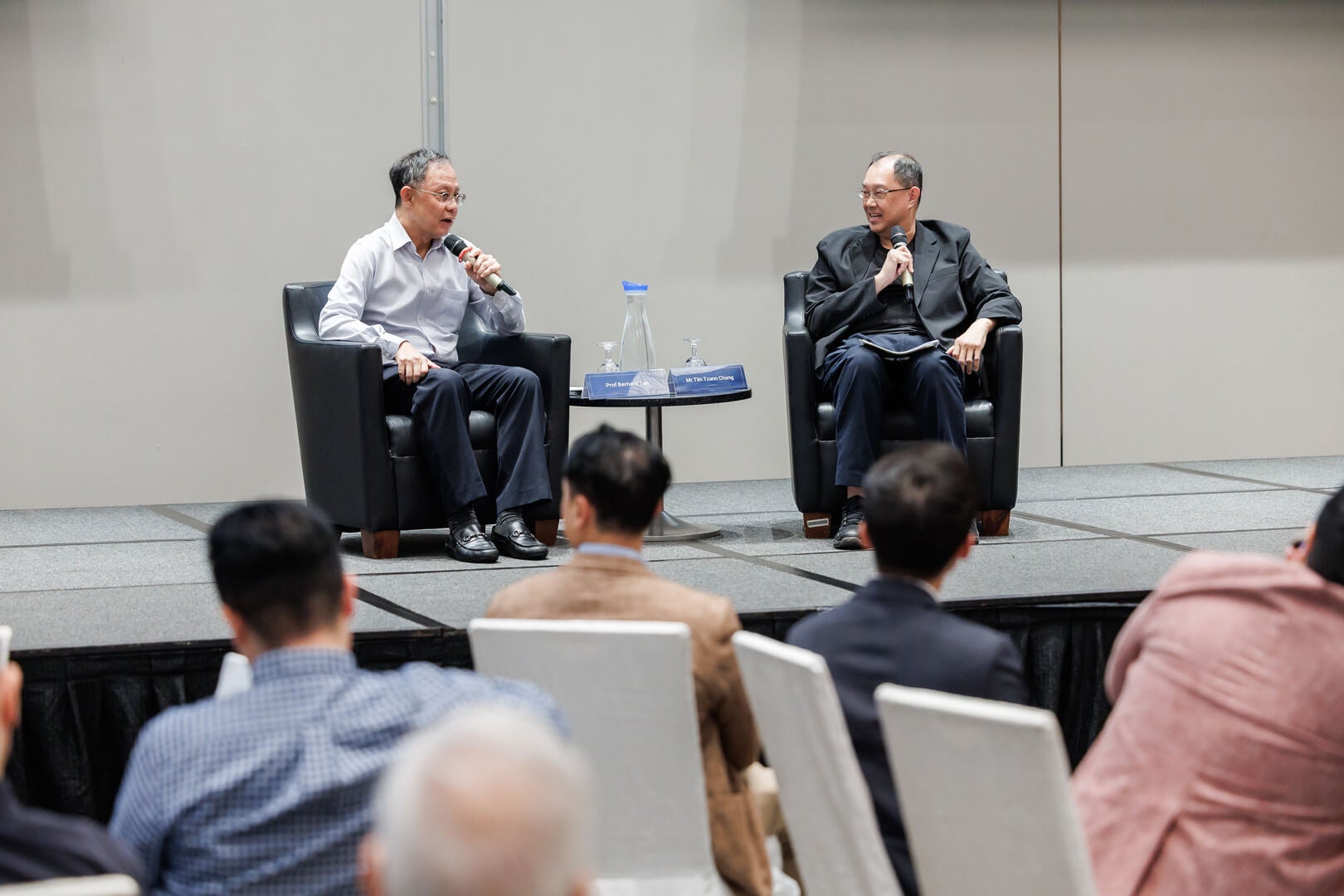
In a thought-provoking dialogue to close the evening, Mr Mahbubani and Mr Yeo exchanged candid views on global power shifts.
A DIALOGUE ON US-CHINA AND INDIA-CHINA RELATIONS
The evening closed with a panel discussion between Mr Mahbubani and Mr Yeo, which offered candid reflections on current geopolitical tensions. Mr Mahbubani recalled private conversations with Dr Kissinger in the latter’s final years, where the veteran diplomat expressed deep concern over deteriorating US-China ties. Despite his influence, Dr Kissinger could not stop the tide of demonisation.
Mr Yeo, however, struck a cautiously optimistic tone. “The reality today is that China understands the US more than the US understands China, and China is managing the US within the powers it has, and that’s more likely to lead to peace,” he stated.
On India-China relations, Mr Yeo pointed out that US efforts to pressure India over its purchase of Russian oil had backfired, stoking anti-US sentiment. This, he suggested, may paradoxically draw India and China closer together as Indian Prime Minister Narendra Modi attended the Shanghai Cooperation Organisation summit at the end of August — marking his first visit to China in seven years.
LIGHTING THE WAY FORWARD
The launch of Can Asians Think of Peace? reaffirmed NUS’ role as a hub for thought leadership in Asia. For the guests, the evening was more than a book launch — it was a reminder that peace underpins prosperity, that empathy and perspective-taking are critical in resolving conflicts, and that Asia’s future will depend not just on power, but on the wisdom of its leaders and people.
As Asia continues its historic rise, the challenge is not whether the region will grow more influential, but whether it can do so peacefully. The essays, reflections and candid exchanges at the launch underscored a clear message: peace is never guaranteed, but it can be nurtured through understanding, restraint, and dialogue. That is the enduring task of APP and the wider academic community at NUS, as they seek to help Asia—and the world—navigate the complexities of the 21st century with clarity and foresight.
Access and download a copy of Can Asians Think of Peace? online for free.