When disaster strikes, Singapore start-up Wateroam has been providing a life-saving solution for communities across the region. Its founders share how their NUS roots inspired a global quest for clean water for all.
When an earthquake measuring 7.7 on the Richter scale hit Myanmar in March this year, nearly 4,000 people died and it was tough for the survivors to access clean drinking water. Water supply pipelines were shattered, septic tanks were broken and UNICEF Deputy Representative Julia Rees said that among all the urgent needs, the most immediate need was for water.
Then Wateroam came in with a lifesaving device: Portable water filters the size of a bicycle pump, easily transported to disaster-struck areas and requiring no electricity to work. Since the earthquake, they have supplied more than 800 water filters to Myanmar. Said Wateroam co-founder Mr Lim Chong Tee (Engineering ’16), “Our agile deployment of ROAMfilter™ units provided an essential lifeline to affected communities, ensuring immediate access to safe drinking water in the critical aftermath of the crisis. It served as a humbling reminder of the urgency and importance of our work, strengthening communities’ resilience during critical times.”
This work is continuing as the World Health Organization (WHO) estimates that the risk of waterborne diseases such as cholera and vector-borne illnesses like dengue and malaria is now rising in Myanmar. For Wateroam’s three founders, their life-saving venture is the realisation of a belief started during their NUS days that everyone on the planet is entitled to safe drinking water.
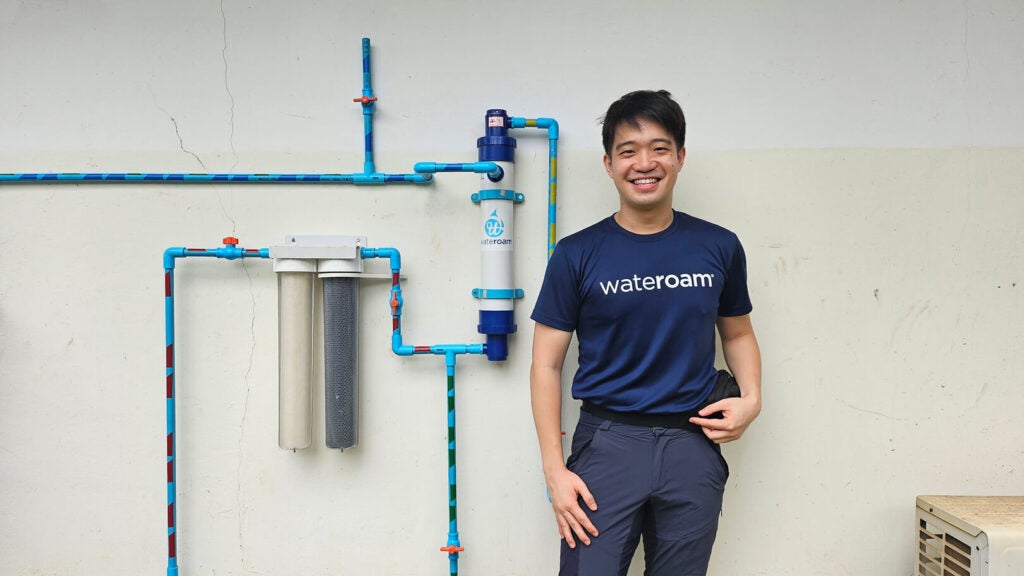
Wateroam co-founder Mr Lim Chong Tee
A UNIVERSAL RIGHT
Back in 2014, Mr Lim, together with fellow NUS alumni Mr David Pong (Business ’14), and Mr Vincent Loka (Engineering ’15), founded Wateroam and started work on designing a water filter system.They were motivated partly based on what they had witnessed during community outreach trips organised by the university.
Recalling one such trip, Mr Lim said, “I vividly recall a scorching day in Cambodia when I witnessed firsthand the stark disparity between the clean water we take for granted and the contaminated water that local children had to endure.”
At the same time, their professors encouraged them to apply their skills for the greater good. “In NUS, I realised that engineering is not just about solving problems but also a tool to serve society,” said Mr Lim. “Thinking beyond conventional boundaries helped us understand that success isn’t measured solely by academic achievements, but by the positive impact we can create.”
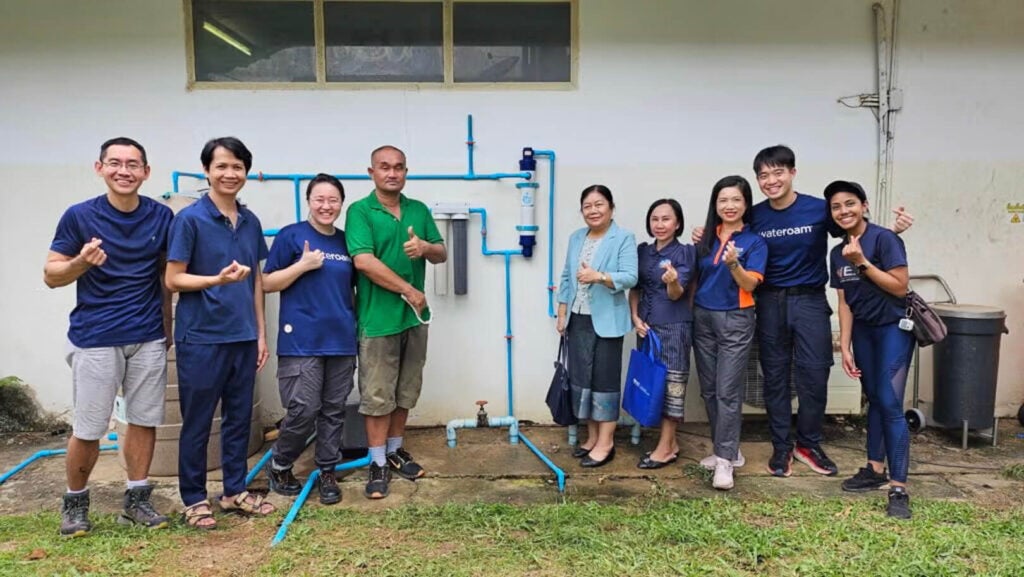
In Laos, Wateroam collaborated with NUS Global Health, the Lao Ministry of Health, the World Health Organization, and UNICEF to install water filtration systems at strategic locations.
THE FRUITS OF INSPIRATION
Over the past 11 years, Wateroam has helped nearly 400,000 people gain access to clean water, many of whom are in Southeast Asian countries including Cambodia, Indonesia, Laos, Myanmar and Thailand. Milestone projects include a collaboration in Laos with NUS Global Health, the Lao Ministry of Health, WHO and UNICEF. Wateroam water filtration systems were installed at strategic locations, including the Vang Vieng District Hospital and plans are in place to expand to at least 14 sites nationwide.
For this project in particular, Mr Lim notes that partnering NUS helped to amplify Wateroam’s impact because of the academic rigour, research insights and strong network of experts which the university brought to the table. “The synergy between academia and practical field work drove meaningful innovation,” he said. The team has grown from just three founders to a diverse group with skills in research and development, field operations, manufacturing and strategic partnerships.
While Wateroam is now making the news and winning awards — including becoming the first recipient of Temasek’s newly-launched T-Ignite fund in 2024, winning the United Arab Emirates’ Zayed Sustainability Prize in January 2022, and receiving the Team Award at the 2019 NUS Alumni Awards— there was much blood, sweat and tears shed in their start-up journey.
Wateroam was the recipient of the Team Award at the 2019 NUS Alumni Awards. Co-founders Mr Lim Chong Tee (second from left), Mr David Pong (second from right), and Mr Vincent Loka (right) are pictured with Mr Johnny Tan (left), then Co-Chair of the NUS Alumni Advisory Board.
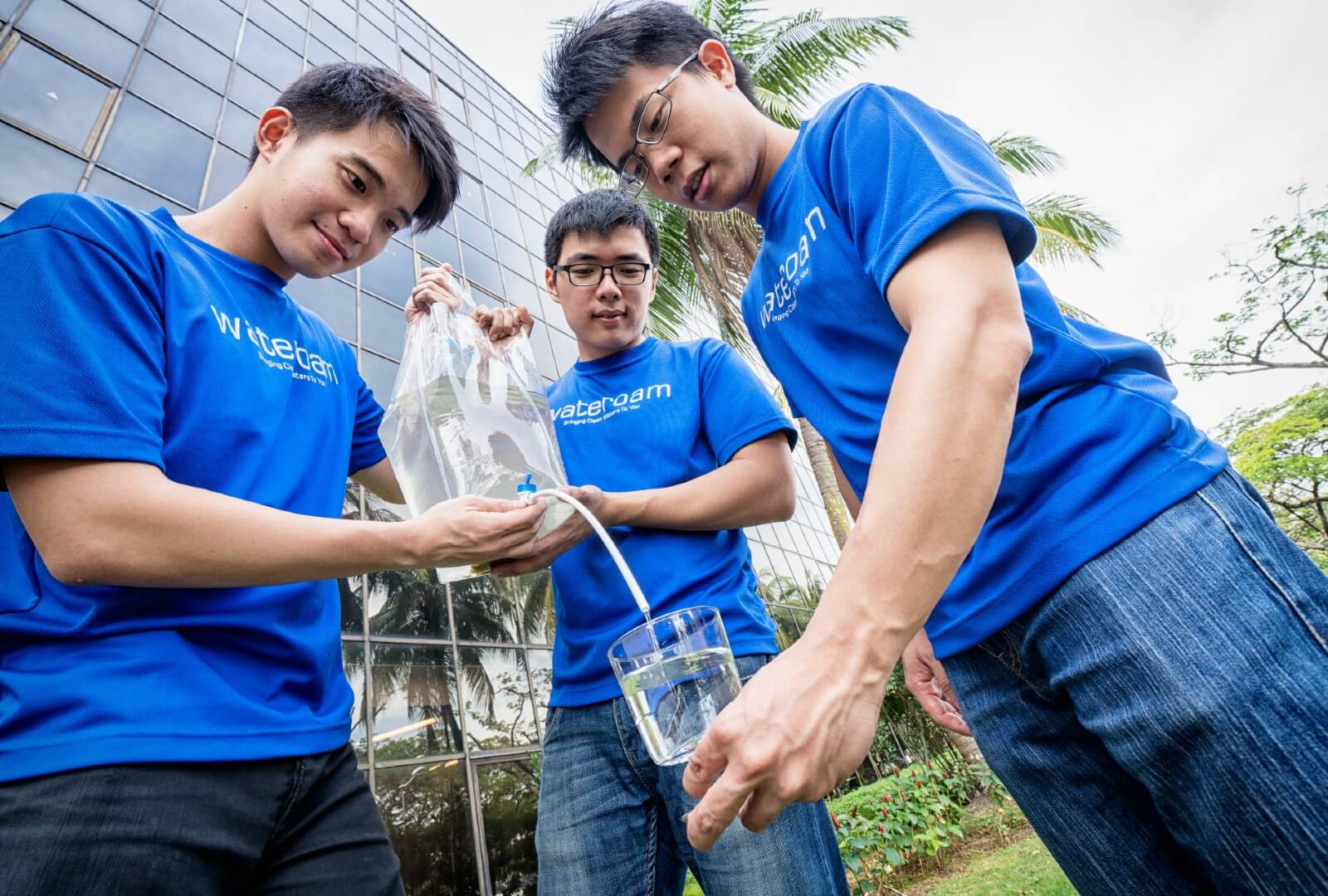
In the early days, their prototype water filters worked well but were bulky and difficult to transport. One prototype was so unwieldy that one of their team members suffered a severe injury trying to move it around. But inspiration struck when they saw a villager in Kelantan, Malaysia, using a bicycle pump. They thought: Instead of air, why can’t we pump out clean water using the same mechanism? They spent more than two years engineering a water filter which works exactly like a bicycle pump — except that dirty or muddy water that is drawn in via a hose is filtered before it is pumped out, flowing out through a tap. “We re-engineered our system into a lightweight, compact solution capable of delivering up to 300 litres of clean water per hour without electricity,” said Mr Lim, on their trademark ROAMfilter™ Plus. “We also saw the need for safety and usability in our designs and [that] ultimately drove us to innovate with even greater care.”
In the years ahead, Wateroam hopes to scale their production and outreach efforts, work with local partners and train local providers, so that even more communities around the world can benefit from their water filters. “Our goal is to transform our model of rapid response and iterative innovation into a sustainable platform that adapts to various regional challenges,” said Mr Lim. “We want to move closer to a future where the access and distribution to safe and clean drinking water is more equitable and a universal right for all.”