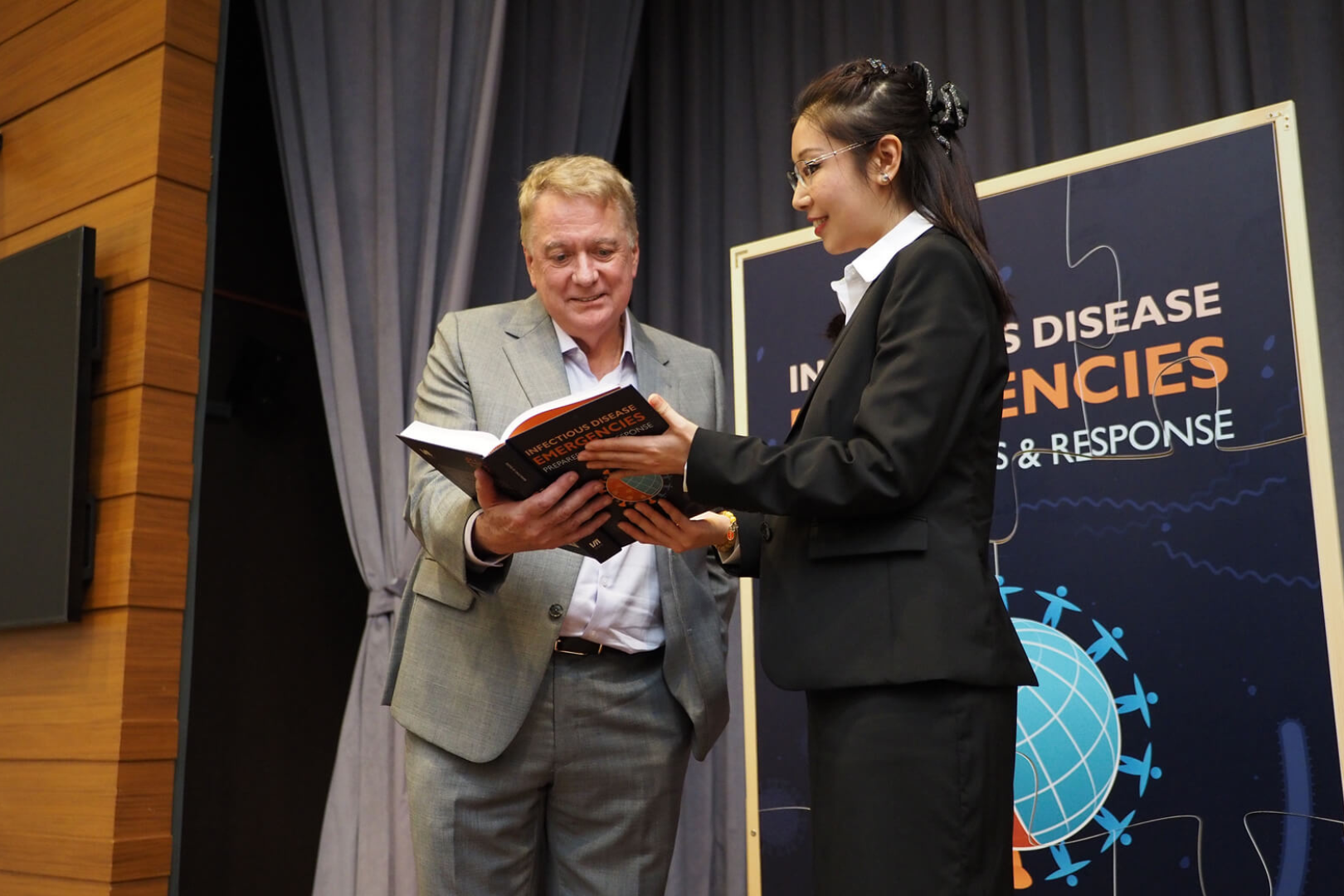
WHO THEY ARE:
Professor Dale Fisher is an Australian infectious diseases physician with extensive experience in global outbreak response. A former chair of the World Health Organization (WHO) Global Outbreak Alert & Response Network steering committee, he was among 12 international technical experts who visited China — the initial epicentre of the pandemic — in February 2020 to investigate the COVID-19 outbreak.
Dr Louisa Sun (MMed (Internal Medicine) ’15, MPH ‘23) is an infectious diseases consultant and head of the Infection Prevention and Control and Epidemiology Unit at Alexandra Hospital. She serves on multiple committees with the Ministry of Health (MOH) focusing on infection control and antimicrobial resistance and consults part-time with the Communicable Diseases Division.
During the pandemic there were 18 million excess deaths in what is regarded as the largest global health crisis of our time. Besides the disease’s severity, it overturned the very ways in which we lived and worked and at times brought cities to a standstill. While COVID-19 no longer poses the same level of threat, it exposed humankind’s vulnerability to novel infectious diseases, and made us alert to the fact that the next deadly virus might just be around the corner, waiting to strike.
The need for comprehensive pandemic preparedness — how, and how well, we respond to the next major outbreak — has never been clearer. Singapore’s Centre for Infectious Disease Emergency Response (CIDER), a pioneering initiative by the Yong Loo Lin School of Medicine, National University of Singapore (NUS Medicine), is at the forefront of global efforts to strengthen infectious disease resilience. In an interview with The AlumNUS, CIDER Director Professor Dale Fisher and Deputy Director Dr Louisa Sun share their insights on education, cross-sector collaboration and the future of global health security.
A HOLISTIC APPROACH TO PANDEMIC LEADERSHIP
At the heart of CIDER’s work lies a clear vision: to foster global resilience by training professionals across Southeast Asia and beyond, creating a network of leaders equipped to spearhead national and regional preparedness and response to infectious disease emergencies. Professor Fisher — who joined the National University Hospital in 2003 and has led international outbreak missions and training programmes across Africa and Asia — explained that the centre aims to fill a crucial gap in pandemic preparedness education. “We felt there was a gap in the landscape,” he said. “Lots of people are doing research and developing policy, but there was no educational hub. So, we felt that being a university, this could be where we could step up.”
This gap became glaringly evident during the COVID-19 pandemic, which catalysed the creation of CIDER. Officially launched in February this year, the centre aims to train professionals from diverse fields to become leading experts in their home countries, ultimately strengthening global outbreak preparedness strategies.
One of CIDER’s flagship initiatives is its Master of Science in Infectious Disease Emergencies (MSc IDE) programme, which will launch this July. The course is designed as a multidisciplinary programme welcoming professionals from diverse sectors including healthcare, veterinary science and journalism.
Professor Fisher highlighted that this broad approach is intentional. “We’re really trying to target people who have had a couple of years in the workforce,” explained the Group Chief of Medicine at the National University Health System and Professor of Medicine at NUS Medicine. He received the Commendation Medal for COVID-19 by the Prime Minister’s Office, Singapore, in 2023, among other awards over the years. “They’ve got their own experiences to bring to the course and their own questions to share,” he added.
The programme aims to enrol up to 80 students per year initially and will offer a holistic education covering surveillance, risk communication, leadership and the technical aspects of pandemic management.
Dr Sun noted the course is flexible for those balancing studies and work. “We offer a unique hybrid learning model, which includes intensive in-person training at the beginning and end of each semester, boosted with ongoing virtual engagement and facilitated sessions during the bulk of the semester,” she said.
Dr Sun played a key role in Singapore’s COVID-19 response, including managing dormitory outbreaks, overseeing risk communication and engagement for migrant workers, and overseeing community isolation and treatment facilities. In recognition of her contributions, she received the Public Administration Medal (Bronze) in the National Awards (COVID-19) and the Healthcare Humanity Award in 2023.
COLLABORATING ACROSS SECTORS
Dr Sun also stressed the importance of interdisciplinary teaching and cross-sector collaboration to equip students for real-world outbreak response. “One of the most pressing challenges is that many developing countries remain dependent on external expertise and interventions during outbreaks,” she said. “Academic institutions have a responsibility to help shift this dynamic by ensuring outbreak response knowledge is owned and applied locally.”
“In our mission to become a regional hub for pandemic education, CIDER ensures preparedness is not just theoretical but practical, applied and sustainable, directly benefiting communities most vulnerable to future outbreaks,” added Dr Sun, who is also a Senior Lecturer at NUS Medicine. “The MSc IDE programme reinforces this by combining up-to-date knowledge with country-specific case studies, allowing students to adapt global best practices to their national health systems.”
She also highlighted how CIDER’s approach integrates experts from global health policy, epidemiology, vaccines and surveillance into the course curriculum. “We have recruited renowned global health experts across critical domains,” she said. “These experts will bring valuable knowledge and experience to the course, providing a well-rounded and practical education.”
A key feature of the MSc IDE course is peer learning, where professionals from diverse backgrounds — including policy, clinical care and emergency response — collaborate to tackle complex pandemic challenges. “Professionals will not just learn from faculty, but from one another as well, enriching their understanding of complex pandemic response scenarios,” Dr Sun added.
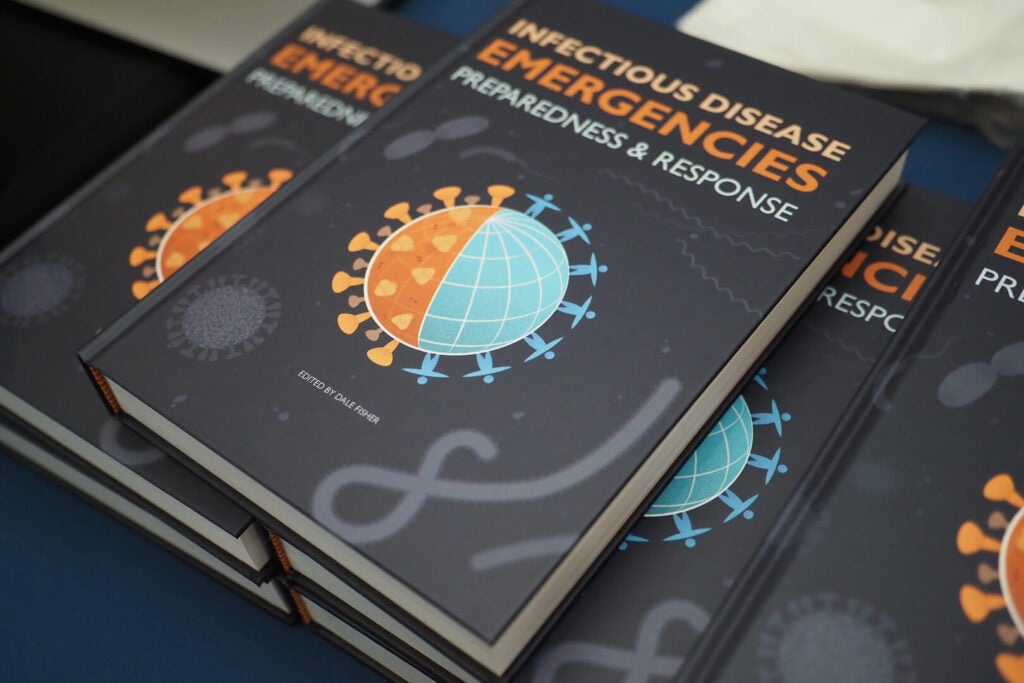
CIDER has also published Infectious Disease Emergencies: Preparedness and Response, a textbook that Professor Fisher calls a crucial resource for global pandemic management. The book can be accessed online for free and is available for purchase in hard copy around the world via NUS Press’ global distribution channels. To expand the book’s reach, CIDER is seeking donors to help fund translations into Chinese and other languages. “If we can get it translated in different languages, especially French and Spanish, it would be very helpful,” Professor Fisher said.
BUILDING INTERNATIONAL COLLABORATION
International partnerships are central to CIDER’s success, with the centre drawing on expertise from WHO, Doctors Without Borders and other global health organisations. This collaboration ensures that students have access to the latest knowledge and best practices in infectious disease response. “We’ve got the best researchers, the best laboratory people, the best to understand gene sequencing, the best to understand contact tracing and surveillance,” said Professor Fisher.
As CIDER expands, Professor Fisher and Dr Sun hope to strengthen connections between academic institutions, health agencies and the private sector — making pandemic preparedness a global priority. “International collaboration is essential for shaping a shared vision of global pandemic preparedness, and our partnerships ensure that CIDER stays at the forefront of this mission,” said Dr Sun.
For now, the centre’s focus is on building a strong educational framework, beginning with the MSc IDE programme, which will serve as a platform for developing short courses and training workshops across various sectors. Dr Sun stressed the importance of fostering regional and international collaboration to enhance knowledge exchange, cross-border cooperation and outbreak response capacity in preparation for future health crises.
Looking ahead, Dr Sun outlined the centre’s goal of becoming a global leader in outbreak preparedness education. “The long-term impact of CIDER will be gauged by the strength of its alumni and partners — a diverse, multidisciplinary network of experts who will drive outbreak response efforts at local, national and international levels,” she said, adding that its growing network will be key to shaping future pandemic responses.
-
How NUS is Redesigning Undergraduate Education in the Age of AIAs generative AI transforms how we learn, work and think, NUS is taking a bold a... -
NUS: Reprogrammed for TomorrowIn just three years since the launch of ChatGPT, NUS has launched ambitious prog... -
Vox Alumni: Artificial Intelligence at WorkWith artificial intelligence poised to change the way we work, we asked alumni a...